
Entry
Reader's guide
Entries A-Z
Subject index
Colonialism
Colonialism is generally defined as extended rule over a foreign territory. Colonial rule had political, economic, religious, social, and cultural aspects. Widespread indigenous independence movements, beginning in the 1960s, broke apart Western colonial empires. Western-developed nations, however, continued to maintain economic control of developing nations, a phenomenon termed neocolonialism. Questions regarding colonialism's legitimacy and concerns over hypocrisy and dishonesty within the colonial system began to emerge alongside justifications of the practice. Critics of colonialism and neocolonialism cite the untrustworthiness of colonial powers, based on their history of dishonest behavior. They also cite colonialism's negative impacts, including military and political domination, economic exploitation, claims of racial and cultural superiority, forced assimilation, and sometimes genocide.
The practice of maintaining colonies has existed since ancient times, but colonialism is most often associated with European control of American, Australian, Asian, African, and other overseas territories from the 15th to 20th centuries. Advances in navigation were a key factor in facilitating this wave of colonization. Great Britain administered the largest colonial system, with the British Empire encompassing India and portions of Africa, the Americas, and the Caribbean. Colonial experiences differed based on each individual colonized nation's unique resources and conditions, as well as the motives of the colonizers.
Scholars further divide colonialism into settler versus exploitation colonialism. Settler colonialism is defined as control over a foreign territory for the purpose of widespread permanent settlement by emigrants from the home country. Examples include North America, Brazil, and Australia and New Zealand. Exploitation colonialism involves control of a foreign land with no plans for large-scale settlement. Examples include European colonialism in Africa. Exploitation colonialism is more associated with a dominant nation seeking to impose its culture on subordinate peoples.
Local government bodies provided daily local rule over settler colonial states, and members of the indigenous population held political offices under exploitation colonialism, but the colonial country maintained ultimate sovereign political control in both cases. Critics argued that this practice provided a false illusion of settler or indigenous participation in their colonization, or that those indigenous figures in power hid ulterior motives of self-interest within the guise of helping their people. Trouble often arose when settlers felt that home governments were suppressing their local interests, such as occurred in the American Revolution against British rule.
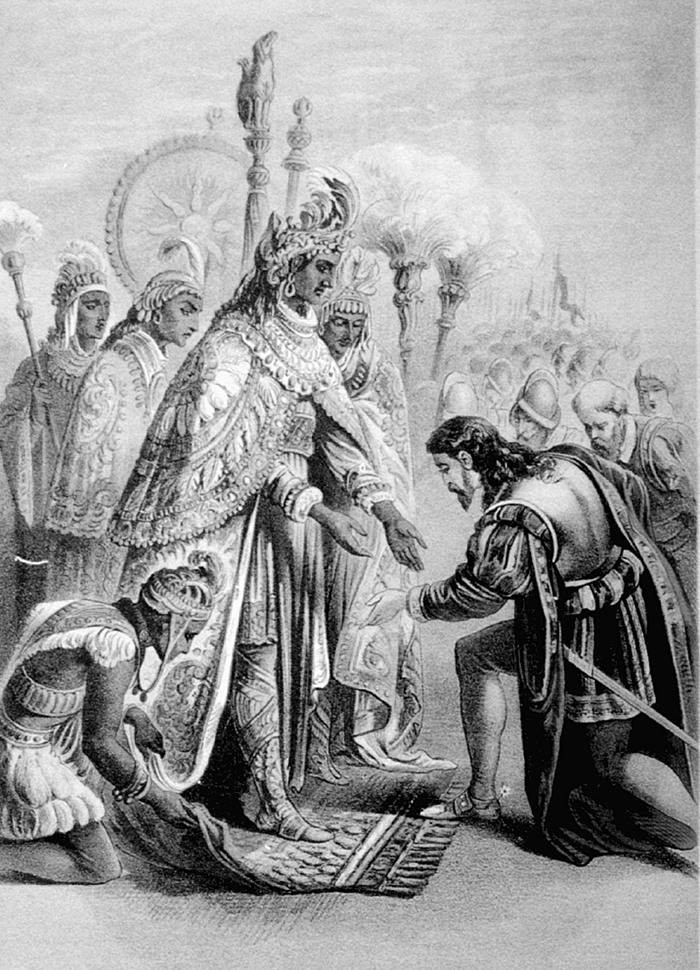
Hernán Cortés and his men kneel before Emperor Montezuma in an illustration in Frank Leslie's Popular Monthly, Volume 6, 1878. Some scholars assert that Cortés was able to conquer the Aztecs of Mexico by leveraging their belief that his arrival equaled the expected return of their god, Quetzalcoatl.
Justifications and Criticisms
A variety of justifications for colonialism have been posited throughout history, although widespread theoretical justification for colonialism emerged in the more modern period. These justifications have included national and individual prestige, the natural dominance of the strong over the weak, economic benefits, beliefs in a progressive view of history and its accompanying motive to spread civilization, and the missionary impulse. Critics of colonialism often state that these justifications for modern colonialism, especially those claiming the best interest of the colonized as their primary motivation, are backed by either hypocrisy or self-deception.
...
- Advertising, Marketing, and Public Relations
- Animals and Nature
- Communication
- “Boy Who Cried Wolf”
- Aroused Suspicion
- Bluffing
- Bragging and Grandiosity
- Burgoon, Judee
- Coherence and Correspondence
- Communication
- Content in Context
- Deception Detection Accuracy
- Discovered Deception, Reactions to
- Equivocation
- Exaggeration
- Frank, Mark
- Frankfurt, Harry G.
- Generalized Communicative Suspicion
- Goffman, Erving
- Half-Truths
- Honesty
- Infidelity
- Information Manipulation Theory 1
- Information Manipulation Theory 2
- Interpersonal Deception Theory
- Knapp, Mark
- Language
- Lie Acceptability
- Lie Bias
- Lies, Types of
- Lying, Prevalence of
- McCornack-Parks Model
- McCornack, Steven
- Miller, Gerald
- Paltering
- Park-Levine Probability Model
- Park, Hee Sun
- Plausibility
- Probing Effect
- Relationships: Family
- Relationships: Friends
- Relationships: Romantic
- Relationships: Sexual
- Reputation
- Sender Demeanor
- Sock Puppetry
- Source Credibility
- Tall Tales
- Transparent Liars
- Truth
- Truth Bias
- Veracity Effect
- White Lies
- Deception in Different Cultures
- Entertainment, Media, and Sports
- Invention of Lying, The
- Lie to Me
- To Tell the Truth
- War of the Worlds
- Audience
- Baseball
- Basketball
- Beatles Hoax
- Blair, Jayson
- Brer Rabbit
- Children's Sports Teams
- College Sports
- Computer-Generated Images
- Fairy Tales
- Fantasy and Imagination
- Fiction
- Football
- Frey, James
- Games, Children's
- Glass, Stephen
- Gossip
- High School Sports
- Hockey
- Humor
- Iago (Shakespeare's Othello)
- Internet: Chat Rooms
- Internet: E-Mail
- Internet: Facebook and Social Media Sites
- Internet: Online Dating
- Magic Tricks
- Memoirs
- Movies, Lying in
- News Media: Internet
- News Media: Print
- News Media: Television and Radio
- Photographs, Altered
- Pinocchio
- Poker
- Rose, Pete
- Rumor
- Sawyer, Tom
- Soccer (Football)
- Ethics, Morality, and Religion
- Law, Business, and Academia
- Academia
- Accounting
- Alibi
- Attorneys
- Bankruptcy
- Business
- Caveat Emptor
- Cold Fusion
- Collusion
- Context
- Corporate Fraud
- Corporations
- Credibility
- Dot-Com Bubble
- Financial Markets
- Forgery, Art
- Greenspan, Alan
- Identity Theft
- Insider Trading
- Investment Fraud
- Justice
- Law and Law Enforcement
- Letters of Recommendation
- Libel and Slander
- Manipulation
- Marketing, Deceptive
- Medical and Pharmaceutical Industry
- Perjury
- Plagiarism
- Résumés
- Stylometry
- Witness, False Testimony of
- Military
- Battle of Fishguard
- Battle of the Bulge
- Bush, George W.
- Camouflage
- Churchill, Winston
- Civil War, U.S.
- Clausewitz, Carl von
- Defense Academy for Credibility Assessment
- Department of Defense, U.S.
- Disinformation
- Feigned Retreat
- Iran-Contra Affair
- Iraq War
- Korean War
- Military Deception
- Napoleon Bonaparte
- Nazi Propaganda
- Normandy, Allied Invasion of
- Operation Bodyguard
- Operation Mincemeat
- Operation Neptune
- Operation Quicksilver
- Siege of Mafeking
- Smoke Screen
- Sun Tzu
- Terrorism
- Torture
- Vietnam War
- World War I
- World War II
- Politics and Government
- Authoritarian States
- Big Lie Technique
- Bush, George W.
- Central Intelligence Agency, U.S.
- Clinton, Bill
- Contagious Disease Outbreaks
- Disasters
- Edwards, John
- Espionage and Counterespionage
- Government Propaganda
- Government, Decline of Public Trust in
- Iran-Contra Affair
- Kennedy, John F.
- Nazi Propaganda
- Nixon, Richard
- Secrecy
- Spin, Political
- Stalin, Josef
- Watergate
- White House Press Secretaries
- Psychology: Clinical and Developmental
- Adolescence, Lying in
- Brain
- Childhood, Lying in
- Children, Development of Deception in
- Consciousness
- Consensual Reality
- Cooperation
- Crying
- Disbelief, Suspension of
- Drugs
- Emotions
- False Memories
- Freud, Sigmund
- Guilt
- Impression
- Intelligence
- Lying as Exercise of Power
- Lying as Norm in Social Interactions
- Lying, Accusations of
- Lying, Costs of
- Lying, Difficulty of
- Lying, Intentionality of
- Malingering
- Memory
- Mental Effort in Lying
- Narcissism
- Neurophysiology
- Pathological Lying
- Projection
- Psychoanalysis
- Rationality
- Repressed Memories
- Self-Deception
- Self-Esteem
- Self-Justification
- Theory of Mind
- Ward, Lester F.
- Psychology: Social, Legal, and Forensic
- Behavioral Analysis Interview
- Betrayal
- Bond, Charles
- Cheating
- Cognitive Dissonance
- Cognitive Heuristics
- Cognitive Load
- Concealed Information Test
- Courtship, Deception in
- Daily Life, Lying in
- Deception and Technology
- Deception and Trust
- Deception in Different Contexts
- Deception in Research Design
- Deception Motives
- Deception, Attitudes Toward
- Deception, Characteristics of
- Deception, Definitions of
- Deception, Research on
- Deniability
- Denial
- DePaulo, Bella
- Dishonesty
- Distrust
- Duchenne Smile
- Duping Delight
- Ekman, Paul
- Electroencephalography
- Evidence, Strategic Use of
- Eye Contact
- False Confessions
- Functional Magnetic Resonance Imaging
- Guilt
- Gullibility
- Honest Baseline Behaviors
- Investigator Bias
- Leakage
- Linguistic Cues
- Lying as Ability or Skill
- Machiavellianism
- Meta-Analysis
- Microfacial Expressions
- Motivational Impairment Effect
- Nonverbal Cues
- Othello Effect
- Overconfidence
- Polygraph
- Reaction Time
- Reality Monitoring
- Scientific Content Analysis
- Situational Familiarity
- Sock Puppetry
- Statement Validity Assessment
- Thermal Imaging
- Vocal Stress Analysis
- Vrij, Aldert
- Wizards of Lie Detection
- Social History: Lies in History, Famous Liars, and Hoaxes
- Great Gatsby, The
- New York Sun's Moon Series
- War of the Worlds
- Anderson, Anna (Anastasia)
- Anthropology, Cultural
- April Fool's Day
- Aristotle
- Bailey, Frederick George
- Barnum, P. T.
- Cardiff Giant
- Charles II Plot
- Churchill, Winston
- Civil War, U.S.
- Clausewitz, Carl von
- Clever Hans
- Colonialism
- Columbus, Christopher
- Con Man
- Conspiracies
- Cottingley Fairies
- Cromwell, Oliver
- Darwin, Charles
- Disasters
- Dreyfus Affair
- Eisenhower, Dwight
- Freud, Sigmund
- Hartzell, Oscar
- Hearst, William Randolph
- Historical Narratives, False
- History of Deception: 1600 to 1700
- History of Deception: 1700 to 1800
- History of Deception: 1800 to 1900
- History of Deception: 1900 to 1950
- History of Deception: 1950 to the Present
- History of Deception: Ancient Civilizations
- History of Deception: Medieval Period
- History of Deception: Renaissance
- Hitler, Adolf
- Inca Empire
- Iran-Contra Affair
- Irving, Clifford
- Jackalope
- Jackson, Andrew
- Jefferson, Thomas
- Kennedy, John F.
- Korean War
- Machiavelli, Niccolò
- Madoff, Bernard
- Memoirs
- Myth
- Napoleon Bonaparte
- Native Americans
- Nazi Propaganda
- Newman, Cardinal
- Nietzsche, Friedrich
- Nixon, Richard
- Normandy, Allied Invasion of
- Nostradamus
- Operation Bodyguard
- Operation Mincemeat
- Operation Neptune
- Operation Quicksilver
- Piltdown Man
- Plato
- Rose, Pete
- Santa Claus
- Siege of Mafeking
- Spanish-American Conquests
- Stalin, Josef
- Stewart, Martha
- Sun Tzu
- Trojan Horse
- UFOs
- Urban Legends
- Vietnam War
- Washington, George
- White House Press Secretaries
- World War I
- World War II
- Loading...
Get a 30 day FREE TRIAL
-
 Watch videos from a variety of sources bringing classroom topics to life
 -
Read modern, diverse business cases
-
Explore hundreds of books and reference titles

Read next

More like this
Sage Recommends
We found other relevant content for you on other Sage platforms.
Have you created a personal profile? Login or create a profile so that you can save clips, playlists and searches