
Entry
Reader's guide
Entries A-Z
Subject index
Central Intelligence Agency, U.S.
The Central Intelligence Agency (CIA) is the bureau of the U.S. government charged with providing national security intelligence to other federal agencies and the military. Created in 1947 to succeed the Office of Strategic Services (OSS), the CIA was responsible for coordinating and leading all intelligence activity conducted by the U.S. government and its agencies. While this changed after 2004, the CIA is still the primary source of intelligence information regarding foreign governments, corporations, organizations, and individuals, and also conducts tactical operations in the field, some of which are covert.
At various times over its history, leaders and agents of the CIA have been accused of lying or engaging in other deceptive practices that have caused skepticism about the reliability of the agency's work. The CIA has also been charged with relying too much on information sources that are at best unreliable and at worst purposefully providing incorrect or inaccurate information to the agency, which has caused the U.S. government to make decisions that have been costly, and even harmful to citizens of the United States and other countries.
Background
Although intelligence had been gathered for use by the military and government agencies since the Revolutionary War, there was no centralized system to coordinate this information until World War II. Before this, various branches of government, including the U.S. Army, Navy, State, and Treasury departments, maintained separate intelligence-gathering offices. There was no coordination or cooperation between these different offices, and there was often duplication of efforts. After the United States entered World War II, President Franklin D. Roosevelt sought to improve the control and direction of intelligence gathering conducted on behalf of the United States. To that end, Roosevelt formed the Office of Strategic Services (OSS) by means of a military order on June 13, 1942. The OSS was charged with collecting and analyzing intelligence data needed by the military during the war. As a result, the OSS provided the military with reports containing facts and analysis, although it did not have the sole responsibility for intelligence gathering internationally. The Federal Bureau of Investigation (FBI) maintained control of information-gathering in Central and South America, while the Army and Navy jealously maintained control of their own intelligence infrastructure.
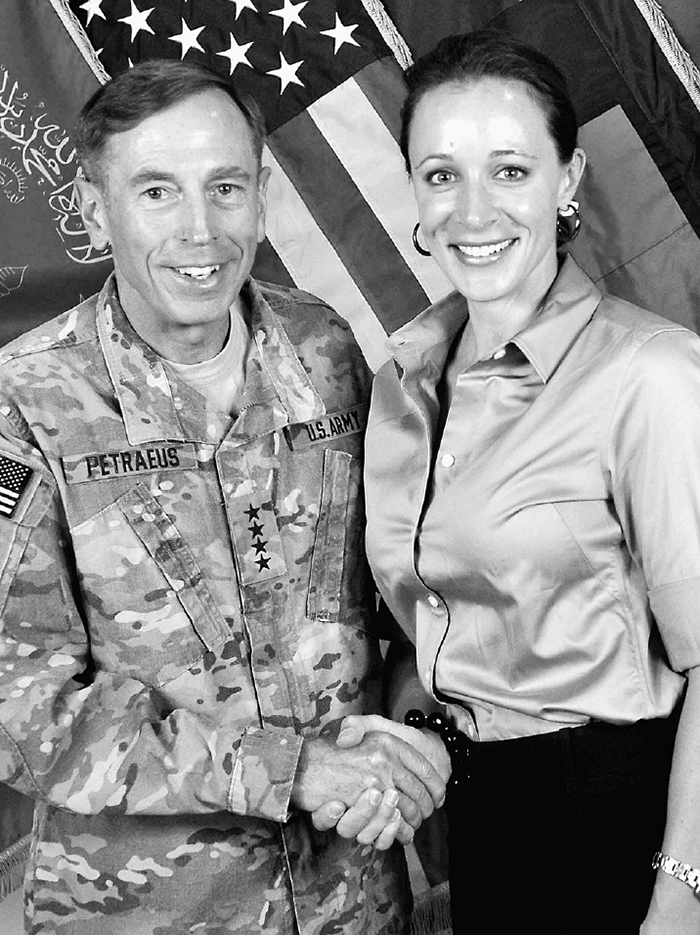
General David Petraeus shakes hands with his biography author Paula Broadwell, July 13, 2011. Sworn in as Central Intelligence Agency (CIA) director with his wife, Holly, by his side in September 2011, Petraeus began an extramarital affair with Broadwell two months later, creating yet another deception scandal for the CIA. The Federal Bureau of Investigation discovered a private Gmail account where Petraeus used an alias.
After the allied victory in World War II, President Harry S. Truman dissolved the OSS by means of an executive order in October 1945. At that point, the OSS's Strategic Services Unit, which was responsible for clandestine intelligence and counterespionage, was absorbed into the War Department. The Interim Research and Intelligence Service, which conducted analyses on intelligence, was moved to the State Department. The Psychological Warfare Division, which focused on morale and propaganda, was split between the War Department and the Army General Staff.
...
- Advertising, Marketing, and Public Relations
- Animals and Nature
- Communication
- “Boy Who Cried Wolf”
- Aroused Suspicion
- Bluffing
- Bragging and Grandiosity
- Burgoon, Judee
- Coherence and Correspondence
- Communication
- Content in Context
- Deception Detection Accuracy
- Discovered Deception, Reactions to
- Equivocation
- Exaggeration
- Frank, Mark
- Frankfurt, Harry G.
- Generalized Communicative Suspicion
- Goffman, Erving
- Half-Truths
- Honesty
- Infidelity
- Information Manipulation Theory 1
- Information Manipulation Theory 2
- Interpersonal Deception Theory
- Knapp, Mark
- Language
- Lie Acceptability
- Lie Bias
- Lies, Types of
- Lying, Prevalence of
- McCornack-Parks Model
- McCornack, Steven
- Miller, Gerald
- Paltering
- Park-Levine Probability Model
- Park, Hee Sun
- Plausibility
- Probing Effect
- Relationships: Family
- Relationships: Friends
- Relationships: Romantic
- Relationships: Sexual
- Reputation
- Sender Demeanor
- Sock Puppetry
- Source Credibility
- Tall Tales
- Transparent Liars
- Truth
- Truth Bias
- Veracity Effect
- White Lies
- Deception in Different Cultures
- Entertainment, Media, and Sports
- Invention of Lying, The
- Lie to Me
- To Tell the Truth
- War of the Worlds
- Audience
- Baseball
- Basketball
- Beatles Hoax
- Blair, Jayson
- Brer Rabbit
- Children's Sports Teams
- College Sports
- Computer-Generated Images
- Fairy Tales
- Fantasy and Imagination
- Fiction
- Football
- Frey, James
- Games, Children's
- Glass, Stephen
- Gossip
- High School Sports
- Hockey
- Humor
- Iago (Shakespeare's Othello)
- Internet: Chat Rooms
- Internet: E-Mail
- Internet: Facebook and Social Media Sites
- Internet: Online Dating
- Magic Tricks
- Memoirs
- Movies, Lying in
- News Media: Internet
- News Media: Print
- News Media: Television and Radio
- Photographs, Altered
- Pinocchio
- Poker
- Rose, Pete
- Rumor
- Sawyer, Tom
- Soccer (Football)
- Ethics, Morality, and Religion
- Law, Business, and Academia
- Academia
- Accounting
- Alibi
- Attorneys
- Bankruptcy
- Business
- Caveat Emptor
- Cold Fusion
- Collusion
- Context
- Corporate Fraud
- Corporations
- Credibility
- Dot-Com Bubble
- Financial Markets
- Forgery, Art
- Greenspan, Alan
- Identity Theft
- Insider Trading
- Investment Fraud
- Justice
- Law and Law Enforcement
- Letters of Recommendation
- Libel and Slander
- Manipulation
- Marketing, Deceptive
- Medical and Pharmaceutical Industry
- Perjury
- Plagiarism
- Résumés
- Stylometry
- Witness, False Testimony of
- Military
- Battle of Fishguard
- Battle of the Bulge
- Bush, George W.
- Camouflage
- Churchill, Winston
- Civil War, U.S.
- Clausewitz, Carl von
- Defense Academy for Credibility Assessment
- Department of Defense, U.S.
- Disinformation
- Feigned Retreat
- Iran-Contra Affair
- Iraq War
- Korean War
- Military Deception
- Napoleon Bonaparte
- Nazi Propaganda
- Normandy, Allied Invasion of
- Operation Bodyguard
- Operation Mincemeat
- Operation Neptune
- Operation Quicksilver
- Siege of Mafeking
- Smoke Screen
- Sun Tzu
- Terrorism
- Torture
- Vietnam War
- World War I
- World War II
- Politics and Government
- Authoritarian States
- Big Lie Technique
- Bush, George W.
- Central Intelligence Agency, U.S.
- Clinton, Bill
- Contagious Disease Outbreaks
- Disasters
- Edwards, John
- Espionage and Counterespionage
- Government Propaganda
- Government, Decline of Public Trust in
- Iran-Contra Affair
- Kennedy, John F.
- Nazi Propaganda
- Nixon, Richard
- Secrecy
- Spin, Political
- Stalin, Josef
- Watergate
- White House Press Secretaries
- Psychology: Clinical and Developmental
- Adolescence, Lying in
- Brain
- Childhood, Lying in
- Children, Development of Deception in
- Consciousness
- Consensual Reality
- Cooperation
- Crying
- Disbelief, Suspension of
- Drugs
- Emotions
- False Memories
- Freud, Sigmund
- Guilt
- Impression
- Intelligence
- Lying as Exercise of Power
- Lying as Norm in Social Interactions
- Lying, Accusations of
- Lying, Costs of
- Lying, Difficulty of
- Lying, Intentionality of
- Malingering
- Memory
- Mental Effort in Lying
- Narcissism
- Neurophysiology
- Pathological Lying
- Projection
- Psychoanalysis
- Rationality
- Repressed Memories
- Self-Deception
- Self-Esteem
- Self-Justification
- Theory of Mind
- Ward, Lester F.
- Psychology: Social, Legal, and Forensic
- Behavioral Analysis Interview
- Betrayal
- Bond, Charles
- Cheating
- Cognitive Dissonance
- Cognitive Heuristics
- Cognitive Load
- Concealed Information Test
- Courtship, Deception in
- Daily Life, Lying in
- Deception and Technology
- Deception and Trust
- Deception in Different Contexts
- Deception in Research Design
- Deception Motives
- Deception, Attitudes Toward
- Deception, Characteristics of
- Deception, Definitions of
- Deception, Research on
- Deniability
- Denial
- DePaulo, Bella
- Dishonesty
- Distrust
- Duchenne Smile
- Duping Delight
- Ekman, Paul
- Electroencephalography
- Evidence, Strategic Use of
- Eye Contact
- False Confessions
- Functional Magnetic Resonance Imaging
- Guilt
- Gullibility
- Honest Baseline Behaviors
- Investigator Bias
- Leakage
- Linguistic Cues
- Lying as Ability or Skill
- Machiavellianism
- Meta-Analysis
- Microfacial Expressions
- Motivational Impairment Effect
- Nonverbal Cues
- Othello Effect
- Overconfidence
- Polygraph
- Reaction Time
- Reality Monitoring
- Scientific Content Analysis
- Situational Familiarity
- Sock Puppetry
- Statement Validity Assessment
- Thermal Imaging
- Vocal Stress Analysis
- Vrij, Aldert
- Wizards of Lie Detection
- Social History: Lies in History, Famous Liars, and Hoaxes
- Great Gatsby, The
- New York Sun's Moon Series
- War of the Worlds
- Anderson, Anna (Anastasia)
- Anthropology, Cultural
- April Fool's Day
- Aristotle
- Bailey, Frederick George
- Barnum, P. T.
- Cardiff Giant
- Charles II Plot
- Churchill, Winston
- Civil War, U.S.
- Clausewitz, Carl von
- Clever Hans
- Colonialism
- Columbus, Christopher
- Con Man
- Conspiracies
- Cottingley Fairies
- Cromwell, Oliver
- Darwin, Charles
- Disasters
- Dreyfus Affair
- Eisenhower, Dwight
- Freud, Sigmund
- Hartzell, Oscar
- Hearst, William Randolph
- Historical Narratives, False
- History of Deception: 1600 to 1700
- History of Deception: 1700 to 1800
- History of Deception: 1800 to 1900
- History of Deception: 1900 to 1950
- History of Deception: 1950 to the Present
- History of Deception: Ancient Civilizations
- History of Deception: Medieval Period
- History of Deception: Renaissance
- Hitler, Adolf
- Inca Empire
- Iran-Contra Affair
- Irving, Clifford
- Jackalope
- Jackson, Andrew
- Jefferson, Thomas
- Kennedy, John F.
- Korean War
- Machiavelli, Niccolò
- Madoff, Bernard
- Memoirs
- Myth
- Napoleon Bonaparte
- Native Americans
- Nazi Propaganda
- Newman, Cardinal
- Nietzsche, Friedrich
- Nixon, Richard
- Normandy, Allied Invasion of
- Nostradamus
- Operation Bodyguard
- Operation Mincemeat
- Operation Neptune
- Operation Quicksilver
- Piltdown Man
- Plato
- Rose, Pete
- Santa Claus
- Siege of Mafeking
- Spanish-American Conquests
- Stalin, Josef
- Stewart, Martha
- Sun Tzu
- Trojan Horse
- UFOs
- Urban Legends
- Vietnam War
- Washington, George
- White House Press Secretaries
- World War I
- World War II
- Loading...
Get a 30 day FREE TRIAL
-
 Watch videos from a variety of sources bringing classroom topics to life
 -
Read modern, diverse business cases
-
Explore hundreds of books and reference titles

Read next

More like this
Sage Recommends
We found other relevant content for you on other Sage platforms.
Have you created a personal profile? Login or create a profile so that you can save clips, playlists and searches