
Entry
Reader's guide
Entries A-Z
Subject index
Bush, George W.
George W. Bush was president of the United States from January 20, 2001, to January 20, 2009. After narrowly winning the 2000 presidential election against Vice President Al Gore, the Bush administration faced the terrorist attacks of September 11, 2001, which led to wars in Afghanistan and Iraq. President Bush and his administration have been publicly scrutinized and criticized for providing false information to the American people in the run-up to the Iraq War.
The Bush administration first made claims against Iraq and the country's connection to weapons of mass destruction (WMDs) in February 2002. Joseph C. Wilson, the former ambassador to Gabon and São Tomé and Principe, was commissioned by the administration to investigate Iraq's alleged desire to obtain yellowcake uranium from Niger in 2002. Wilson reported to Bush and his colleagues that the belief that Iraq was engaging in illicit construction of a nuclear weapon was “unequivocally wrong.” However, the administration persisted in searching for a connection between Iraq and WMDs. In his 2003 State of the Union Address, President Bush professed that raq sought to obtain uranium, despite a Central Intelligence Agency (CIA) investigation confirming the opposite to be true.
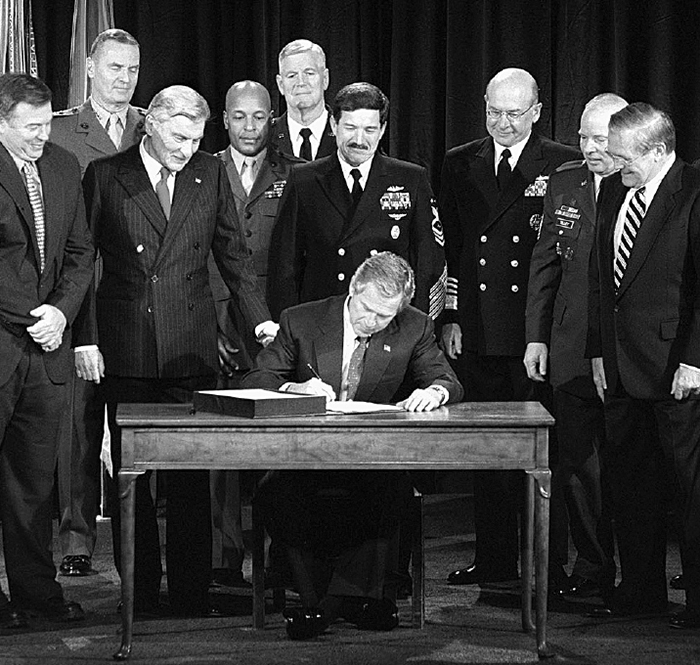
President George W. Bush signs the U.S. Department of Defense Authorization Bill at the Pentagon on December 2, 2002, noting that Iraq's responses up to that date were “not encouraging.” Signing the act helped chart the course of the War on Terror.
In September 2002, the Bush administration, the CIA, and the Defense Intelligence Agency suspected that Iraq was looking for ways to acquire high-strength aluminum tubes in order to “make centrifuges to enrich uranium for nuclear bombs.” The Bureau of Intelligence Research and Department of Energy refuted the assertion that high-strength aluminum tubes were being used to build nuclear weapons. Rather, the two agencies maintained that the tubes were being used for conventional military procedures, and that the tubes were not able to enrich uranium. Despite this information from various government departments, Secretary of State Colin Powell presented information to the United Nations (UN) implicating Iraq as a country destined to use high-strength aluminum tubes for the eventual creation of a nuclear bomb. Upon further review, Powell rescinded his statements to the UN, and noted that he was given “deliberately misleading” information on Iraq's quest for nuclear weapons.
Downing Street Memo
On May 1, 2005, the national Sunday newspaper of the United Kingdom, the Sunday Times, published the Downing Street Memo. The memo was documentation of a secret meeting held by the British Labour Party and British defense and intelligence figures on July 23, 2002. Meeting participants discussed the ramp-up to a war in Iraq, and referenced the United States as also having a stake in the war effort. The leader of the Secret Intelligence Service in Britain noted that during his most recent visit to the United States, “Bush wanted to remove Saddam Hussein,” the president and prime minister of Iraq, “through military action, justified by the conjunction of terrorism and WMD. But the intelligence and facts were being fixed around the policy.” Despite numerous allegations from the Bush administration stating that Iraq was preparing to construct a nuclear weapon, substantial evidence never surfaced from either U.S. or UN investigations.
...
- Advertising, Marketing, and Public Relations
- Animals and Nature
- Communication
- “Boy Who Cried Wolf”
- Aroused Suspicion
- Bluffing
- Bragging and Grandiosity
- Burgoon, Judee
- Coherence and Correspondence
- Communication
- Content in Context
- Deception Detection Accuracy
- Discovered Deception, Reactions to
- Equivocation
- Exaggeration
- Frank, Mark
- Frankfurt, Harry G.
- Generalized Communicative Suspicion
- Goffman, Erving
- Half-Truths
- Honesty
- Infidelity
- Information Manipulation Theory 1
- Information Manipulation Theory 2
- Interpersonal Deception Theory
- Knapp, Mark
- Language
- Lie Acceptability
- Lie Bias
- Lies, Types of
- Lying, Prevalence of
- McCornack-Parks Model
- McCornack, Steven
- Miller, Gerald
- Paltering
- Park-Levine Probability Model
- Park, Hee Sun
- Plausibility
- Probing Effect
- Relationships: Family
- Relationships: Friends
- Relationships: Romantic
- Relationships: Sexual
- Reputation
- Sender Demeanor
- Sock Puppetry
- Source Credibility
- Tall Tales
- Transparent Liars
- Truth
- Truth Bias
- Veracity Effect
- White Lies
- Deception in Different Cultures
- Entertainment, Media, and Sports
- Invention of Lying, The
- Lie to Me
- To Tell the Truth
- War of the Worlds
- Audience
- Baseball
- Basketball
- Beatles Hoax
- Blair, Jayson
- Brer Rabbit
- Children's Sports Teams
- College Sports
- Computer-Generated Images
- Fairy Tales
- Fantasy and Imagination
- Fiction
- Football
- Frey, James
- Games, Children's
- Glass, Stephen
- Gossip
- High School Sports
- Hockey
- Humor
- Iago (Shakespeare's Othello)
- Internet: Chat Rooms
- Internet: E-Mail
- Internet: Facebook and Social Media Sites
- Internet: Online Dating
- Magic Tricks
- Memoirs
- Movies, Lying in
- News Media: Internet
- News Media: Print
- News Media: Television and Radio
- Photographs, Altered
- Pinocchio
- Poker
- Rose, Pete
- Rumor
- Sawyer, Tom
- Soccer (Football)
- Ethics, Morality, and Religion
- Law, Business, and Academia
- Academia
- Accounting
- Alibi
- Attorneys
- Bankruptcy
- Business
- Caveat Emptor
- Cold Fusion
- Collusion
- Context
- Corporate Fraud
- Corporations
- Credibility
- Dot-Com Bubble
- Financial Markets
- Forgery, Art
- Greenspan, Alan
- Identity Theft
- Insider Trading
- Investment Fraud
- Justice
- Law and Law Enforcement
- Letters of Recommendation
- Libel and Slander
- Manipulation
- Marketing, Deceptive
- Medical and Pharmaceutical Industry
- Perjury
- Plagiarism
- Résumés
- Stylometry
- Witness, False Testimony of
- Military
- Battle of Fishguard
- Battle of the Bulge
- Bush, George W.
- Camouflage
- Churchill, Winston
- Civil War, U.S.
- Clausewitz, Carl von
- Defense Academy for Credibility Assessment
- Department of Defense, U.S.
- Disinformation
- Feigned Retreat
- Iran-Contra Affair
- Iraq War
- Korean War
- Military Deception
- Napoleon Bonaparte
- Nazi Propaganda
- Normandy, Allied Invasion of
- Operation Bodyguard
- Operation Mincemeat
- Operation Neptune
- Operation Quicksilver
- Siege of Mafeking
- Smoke Screen
- Sun Tzu
- Terrorism
- Torture
- Vietnam War
- World War I
- World War II
- Politics and Government
- Authoritarian States
- Big Lie Technique
- Bush, George W.
- Central Intelligence Agency, U.S.
- Clinton, Bill
- Contagious Disease Outbreaks
- Disasters
- Edwards, John
- Espionage and Counterespionage
- Government Propaganda
- Government, Decline of Public Trust in
- Iran-Contra Affair
- Kennedy, John F.
- Nazi Propaganda
- Nixon, Richard
- Secrecy
- Spin, Political
- Stalin, Josef
- Watergate
- White House Press Secretaries
- Psychology: Clinical and Developmental
- Adolescence, Lying in
- Brain
- Childhood, Lying in
- Children, Development of Deception in
- Consciousness
- Consensual Reality
- Cooperation
- Crying
- Disbelief, Suspension of
- Drugs
- Emotions
- False Memories
- Freud, Sigmund
- Guilt
- Impression
- Intelligence
- Lying as Exercise of Power
- Lying as Norm in Social Interactions
- Lying, Accusations of
- Lying, Costs of
- Lying, Difficulty of
- Lying, Intentionality of
- Malingering
- Memory
- Mental Effort in Lying
- Narcissism
- Neurophysiology
- Pathological Lying
- Projection
- Psychoanalysis
- Rationality
- Repressed Memories
- Self-Deception
- Self-Esteem
- Self-Justification
- Theory of Mind
- Ward, Lester F.
- Psychology: Social, Legal, and Forensic
- Behavioral Analysis Interview
- Betrayal
- Bond, Charles
- Cheating
- Cognitive Dissonance
- Cognitive Heuristics
- Cognitive Load
- Concealed Information Test
- Courtship, Deception in
- Daily Life, Lying in
- Deception and Technology
- Deception and Trust
- Deception in Different Contexts
- Deception in Research Design
- Deception Motives
- Deception, Attitudes Toward
- Deception, Characteristics of
- Deception, Definitions of
- Deception, Research on
- Deniability
- Denial
- DePaulo, Bella
- Dishonesty
- Distrust
- Duchenne Smile
- Duping Delight
- Ekman, Paul
- Electroencephalography
- Evidence, Strategic Use of
- Eye Contact
- False Confessions
- Functional Magnetic Resonance Imaging
- Guilt
- Gullibility
- Honest Baseline Behaviors
- Investigator Bias
- Leakage
- Linguistic Cues
- Lying as Ability or Skill
- Machiavellianism
- Meta-Analysis
- Microfacial Expressions
- Motivational Impairment Effect
- Nonverbal Cues
- Othello Effect
- Overconfidence
- Polygraph
- Reaction Time
- Reality Monitoring
- Scientific Content Analysis
- Situational Familiarity
- Sock Puppetry
- Statement Validity Assessment
- Thermal Imaging
- Vocal Stress Analysis
- Vrij, Aldert
- Wizards of Lie Detection
- Social History: Lies in History, Famous Liars, and Hoaxes
- Great Gatsby, The
- New York Sun's Moon Series
- War of the Worlds
- Anderson, Anna (Anastasia)
- Anthropology, Cultural
- April Fool's Day
- Aristotle
- Bailey, Frederick George
- Barnum, P. T.
- Cardiff Giant
- Charles II Plot
- Churchill, Winston
- Civil War, U.S.
- Clausewitz, Carl von
- Clever Hans
- Colonialism
- Columbus, Christopher
- Con Man
- Conspiracies
- Cottingley Fairies
- Cromwell, Oliver
- Darwin, Charles
- Disasters
- Dreyfus Affair
- Eisenhower, Dwight
- Freud, Sigmund
- Hartzell, Oscar
- Hearst, William Randolph
- Historical Narratives, False
- History of Deception: 1600 to 1700
- History of Deception: 1700 to 1800
- History of Deception: 1800 to 1900
- History of Deception: 1900 to 1950
- History of Deception: 1950 to the Present
- History of Deception: Ancient Civilizations
- History of Deception: Medieval Period
- History of Deception: Renaissance
- Hitler, Adolf
- Inca Empire
- Iran-Contra Affair
- Irving, Clifford
- Jackalope
- Jackson, Andrew
- Jefferson, Thomas
- Kennedy, John F.
- Korean War
- Machiavelli, Niccolò
- Madoff, Bernard
- Memoirs
- Myth
- Napoleon Bonaparte
- Native Americans
- Nazi Propaganda
- Newman, Cardinal
- Nietzsche, Friedrich
- Nixon, Richard
- Normandy, Allied Invasion of
- Nostradamus
- Operation Bodyguard
- Operation Mincemeat
- Operation Neptune
- Operation Quicksilver
- Piltdown Man
- Plato
- Rose, Pete
- Santa Claus
- Siege of Mafeking
- Spanish-American Conquests
- Stalin, Josef
- Stewart, Martha
- Sun Tzu
- Trojan Horse
- UFOs
- Urban Legends
- Vietnam War
- Washington, George
- White House Press Secretaries
- World War I
- World War II
- Loading...
Get a 30 day FREE TRIAL
-
 Watch videos from a variety of sources bringing classroom topics to life
 -
Read modern, diverse business cases
-
Explore hundreds of books and reference titles

Read next

More like this
Sage Recommends
We found other relevant content for you on other Sage platforms.
Have you created a personal profile? Login or create a profile so that you can save clips, playlists and searches