
Entry
Reader's guide
Entries A-Z
Subject index
Beatles Hoax
The Beatles were a rock and roll group that formed in 1960 in Liverpool, England. The band's classic line-up included George Harrison, John Lennon, Paul McCartney, and Ringo Starr (stage name for drummer Richard Starkey, who replaced the band's original drummer, Pete Best). At the height of their career, the Beatles dominated the airwaves and produced a record-breaking number of hit singles and albums. To this day, they remain one of the best-selling musical acts since the advent of recording technology.
In addition to their commercial success, the Beatles were critically acclaimed for the range and quality of their rapidly evolving music, much of which is credited to the writing team of Lennon and McCartney, even though some songs were actually solo compositions. Because of personal and professional tensions, the two frequently wrote independently of one another, especially toward the end of the band's career. The Beatles' groundbreaking albums and innovative songs challenged the conventions of pop music in terms of content, format, and length. The influence of the Beatles was not limited to their music, however. During the decade when they were active as a band, they exercised a significant influence on culture, fashion, grooming, religious beliefs and practices, and social mores. In 1970, the band broke up, and each of its members went on to pursue successful solo careers.
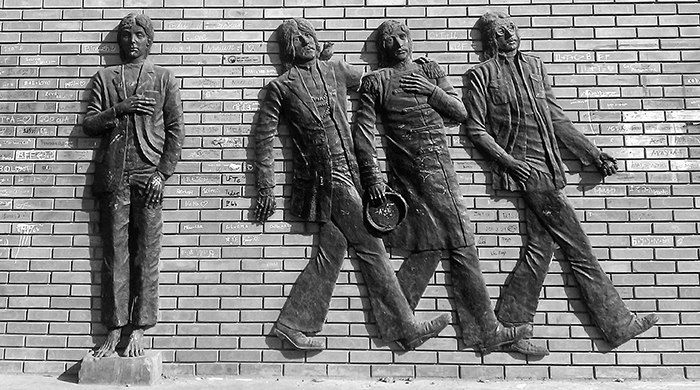
A Beatles tribute prominently stands in an unlikely spot—downtown Ulaanbaatar, Mongolia. The sculpture mimics the Abbey Road album cover, which has fueled the conspiracy theory that Paul McCartney died in 1967, and was surreptitiously replaced by a look-alike. Like the cover, which some fans argue symbolizes a funeral march, Paul is set off from his companions; he is also the only one barefoot.
“Paul Is Dead” Rumor
In 1969, a rumor began to spread that Paul McCartney had died in an automobile accident in 1967 and had been replaced by the band with a look-alike. Speculation regarding Paul's possible death was perhaps fueled by his relative absence from the media, from which he says he was taking a break at that time. The first known printed mention regarding the rumor appeared in an article written by Tim Harper that appeared on the front page of the September 17 edition of the Times-Delphic, the student newspaper for Drake University in Iowa. Harper claimed to have learned about Paul's death from his friend, Dartanyan Brown, who said that he heard it from a musician who lived in his dorm, who in turn claimed that he heard of Paul's death somewhere in coastal California.
Tracing the rumor back to its origin has proven an impossible task because it involves a pattern of information transmission that folklorists specializing in urban myths refer to as “friend of a friend” (FOAF), in which one source references another, which points to yet another, and so on. In October 1969, disc jockey Russell Gibb of WKNR in Detroit related the rumor. Later that same month, Roby Yonge of radio super-station WABC in New York City discussed it at length on his show. Before long, the rumor had become such a pop culture phenomenon that it was reported upon by such respected mainstream news and entertainment media outlets as the New York Times, Life magazine, and Time. In response to the rumor's rapid spread, the Beatles issued a press release denying that Paul was deceased.
...
- Advertising, Marketing, and Public Relations
- Animals and Nature
- Communication
- “Boy Who Cried Wolf”
- Aroused Suspicion
- Bluffing
- Bragging and Grandiosity
- Burgoon, Judee
- Coherence and Correspondence
- Communication
- Content in Context
- Deception Detection Accuracy
- Discovered Deception, Reactions to
- Equivocation
- Exaggeration
- Frank, Mark
- Frankfurt, Harry G.
- Generalized Communicative Suspicion
- Goffman, Erving
- Half-Truths
- Honesty
- Infidelity
- Information Manipulation Theory 1
- Information Manipulation Theory 2
- Interpersonal Deception Theory
- Knapp, Mark
- Language
- Lie Acceptability
- Lie Bias
- Lies, Types of
- Lying, Prevalence of
- McCornack-Parks Model
- McCornack, Steven
- Miller, Gerald
- Paltering
- Park-Levine Probability Model
- Park, Hee Sun
- Plausibility
- Probing Effect
- Relationships: Family
- Relationships: Friends
- Relationships: Romantic
- Relationships: Sexual
- Reputation
- Sender Demeanor
- Sock Puppetry
- Source Credibility
- Tall Tales
- Transparent Liars
- Truth
- Truth Bias
- Veracity Effect
- White Lies
- Deception in Different Cultures
- Entertainment, Media, and Sports
- Invention of Lying, The
- Lie to Me
- To Tell the Truth
- War of the Worlds
- Audience
- Baseball
- Basketball
- Beatles Hoax
- Blair, Jayson
- Brer Rabbit
- Children's Sports Teams
- College Sports
- Computer-Generated Images
- Fairy Tales
- Fantasy and Imagination
- Fiction
- Football
- Frey, James
- Games, Children's
- Glass, Stephen
- Gossip
- High School Sports
- Hockey
- Humor
- Iago (Shakespeare's Othello)
- Internet: Chat Rooms
- Internet: E-Mail
- Internet: Facebook and Social Media Sites
- Internet: Online Dating
- Magic Tricks
- Memoirs
- Movies, Lying in
- News Media: Internet
- News Media: Print
- News Media: Television and Radio
- Photographs, Altered
- Pinocchio
- Poker
- Rose, Pete
- Rumor
- Sawyer, Tom
- Soccer (Football)
- Ethics, Morality, and Religion
- Law, Business, and Academia
- Academia
- Accounting
- Alibi
- Attorneys
- Bankruptcy
- Business
- Caveat Emptor
- Cold Fusion
- Collusion
- Context
- Corporate Fraud
- Corporations
- Credibility
- Dot-Com Bubble
- Financial Markets
- Forgery, Art
- Greenspan, Alan
- Identity Theft
- Insider Trading
- Investment Fraud
- Justice
- Law and Law Enforcement
- Letters of Recommendation
- Libel and Slander
- Manipulation
- Marketing, Deceptive
- Medical and Pharmaceutical Industry
- Perjury
- Plagiarism
- Résumés
- Stylometry
- Witness, False Testimony of
- Military
- Battle of Fishguard
- Battle of the Bulge
- Bush, George W.
- Camouflage
- Churchill, Winston
- Civil War, U.S.
- Clausewitz, Carl von
- Defense Academy for Credibility Assessment
- Department of Defense, U.S.
- Disinformation
- Feigned Retreat
- Iran-Contra Affair
- Iraq War
- Korean War
- Military Deception
- Napoleon Bonaparte
- Nazi Propaganda
- Normandy, Allied Invasion of
- Operation Bodyguard
- Operation Mincemeat
- Operation Neptune
- Operation Quicksilver
- Siege of Mafeking
- Smoke Screen
- Sun Tzu
- Terrorism
- Torture
- Vietnam War
- World War I
- World War II
- Politics and Government
- Authoritarian States
- Big Lie Technique
- Bush, George W.
- Central Intelligence Agency, U.S.
- Clinton, Bill
- Contagious Disease Outbreaks
- Disasters
- Edwards, John
- Espionage and Counterespionage
- Government Propaganda
- Government, Decline of Public Trust in
- Iran-Contra Affair
- Kennedy, John F.
- Nazi Propaganda
- Nixon, Richard
- Secrecy
- Spin, Political
- Stalin, Josef
- Watergate
- White House Press Secretaries
- Psychology: Clinical and Developmental
- Adolescence, Lying in
- Brain
- Childhood, Lying in
- Children, Development of Deception in
- Consciousness
- Consensual Reality
- Cooperation
- Crying
- Disbelief, Suspension of
- Drugs
- Emotions
- False Memories
- Freud, Sigmund
- Guilt
- Impression
- Intelligence
- Lying as Exercise of Power
- Lying as Norm in Social Interactions
- Lying, Accusations of
- Lying, Costs of
- Lying, Difficulty of
- Lying, Intentionality of
- Malingering
- Memory
- Mental Effort in Lying
- Narcissism
- Neurophysiology
- Pathological Lying
- Projection
- Psychoanalysis
- Rationality
- Repressed Memories
- Self-Deception
- Self-Esteem
- Self-Justification
- Theory of Mind
- Ward, Lester F.
- Psychology: Social, Legal, and Forensic
- Behavioral Analysis Interview
- Betrayal
- Bond, Charles
- Cheating
- Cognitive Dissonance
- Cognitive Heuristics
- Cognitive Load
- Concealed Information Test
- Courtship, Deception in
- Daily Life, Lying in
- Deception and Technology
- Deception and Trust
- Deception in Different Contexts
- Deception in Research Design
- Deception Motives
- Deception, Attitudes Toward
- Deception, Characteristics of
- Deception, Definitions of
- Deception, Research on
- Deniability
- Denial
- DePaulo, Bella
- Dishonesty
- Distrust
- Duchenne Smile
- Duping Delight
- Ekman, Paul
- Electroencephalography
- Evidence, Strategic Use of
- Eye Contact
- False Confessions
- Functional Magnetic Resonance Imaging
- Guilt
- Gullibility
- Honest Baseline Behaviors
- Investigator Bias
- Leakage
- Linguistic Cues
- Lying as Ability or Skill
- Machiavellianism
- Meta-Analysis
- Microfacial Expressions
- Motivational Impairment Effect
- Nonverbal Cues
- Othello Effect
- Overconfidence
- Polygraph
- Reaction Time
- Reality Monitoring
- Scientific Content Analysis
- Situational Familiarity
- Sock Puppetry
- Statement Validity Assessment
- Thermal Imaging
- Vocal Stress Analysis
- Vrij, Aldert
- Wizards of Lie Detection
- Social History: Lies in History, Famous Liars, and Hoaxes
- Great Gatsby, The
- New York Sun's Moon Series
- War of the Worlds
- Anderson, Anna (Anastasia)
- Anthropology, Cultural
- April Fool's Day
- Aristotle
- Bailey, Frederick George
- Barnum, P. T.
- Cardiff Giant
- Charles II Plot
- Churchill, Winston
- Civil War, U.S.
- Clausewitz, Carl von
- Clever Hans
- Colonialism
- Columbus, Christopher
- Con Man
- Conspiracies
- Cottingley Fairies
- Cromwell, Oliver
- Darwin, Charles
- Disasters
- Dreyfus Affair
- Eisenhower, Dwight
- Freud, Sigmund
- Hartzell, Oscar
- Hearst, William Randolph
- Historical Narratives, False
- History of Deception: 1600 to 1700
- History of Deception: 1700 to 1800
- History of Deception: 1800 to 1900
- History of Deception: 1900 to 1950
- History of Deception: 1950 to the Present
- History of Deception: Ancient Civilizations
- History of Deception: Medieval Period
- History of Deception: Renaissance
- Hitler, Adolf
- Inca Empire
- Iran-Contra Affair
- Irving, Clifford
- Jackalope
- Jackson, Andrew
- Jefferson, Thomas
- Kennedy, John F.
- Korean War
- Machiavelli, Niccolò
- Madoff, Bernard
- Memoirs
- Myth
- Napoleon Bonaparte
- Native Americans
- Nazi Propaganda
- Newman, Cardinal
- Nietzsche, Friedrich
- Nixon, Richard
- Normandy, Allied Invasion of
- Nostradamus
- Operation Bodyguard
- Operation Mincemeat
- Operation Neptune
- Operation Quicksilver
- Piltdown Man
- Plato
- Rose, Pete
- Santa Claus
- Siege of Mafeking
- Spanish-American Conquests
- Stalin, Josef
- Stewart, Martha
- Sun Tzu
- Trojan Horse
- UFOs
- Urban Legends
- Vietnam War
- Washington, George
- White House Press Secretaries
- World War I
- World War II
- Loading...
Get a 30 day FREE TRIAL
-
 Watch videos from a variety of sources bringing classroom topics to life
 -
Read modern, diverse business cases
-
Explore hundreds of books and reference titles

Read next

More like this
Sage Recommends
We found other relevant content for you on other Sage platforms.
Have you created a personal profile? Login or create a profile so that you can save clips, playlists and searches