
Entry
Reader's guide
Entries A-Z
Subject index
Wildfire
Forest and rangeland fires (wildfires) are sources of important ecological and economic damage, as well as serious risks to human lives and settlements. A wildfire is an environmental conflagration that burns out of control and threatens people, buildings, or resources. In Australia, where wildfires are a particularly important natural hazard, they are known as bushfires. About 40 percent of Australia is susceptible to bushfire hazards (i.e., it has enough combustible vegetation), which are a particularly strong risk at the urban-wildland interface. Although it is the hottest part of Australia, the desert at the heart of the continent is not at risk; rather, it is the vegetation in less arid areas, especially those that are settled.
Wildfire is a natural phenomenon that has always existed where dry vegetation is present. The causes of wildfires can be divided into natural and anthropogenic. Lightning strikes are a natural cause whose importance varies from place to place with meteorological and vegetational conditions. Human negligence and vandalism have come to be dominant causes, especially at the urban-rural interface. It is thought that vegetative fermentation leading to spontaneous combustion may cause fires, but the evidence for this is extremely scarce. The frequency of wildfires in the past can be calculated by assessing damage to the xylem (wood) of trees and dating it by counting the annual rings, a process known as dendrochronology. Indications may also be present in the sedimentary record, as fires are often followed by episodes of accelerated erosion and deposition.
The essential ingredients of a wildfire are combustible material (fuel), heat, and oxygen. The dimensions, duration, and intensity of wildfires vary according to several group factors. The first of these includes the type, flammability, and water content of combustible material (Table 1). Together, these represent the fuel loading factor. Second are meteorological conditions, in particular temperature, ambient humidity, and the speed, direction, and variability of winds. Finally, the topography and ground slope in the local area interact with the other factors to exert some control on rates and directions of burning. In fact, a wildfire can climb a slope, propelled by convection of wind and radiation of heat.
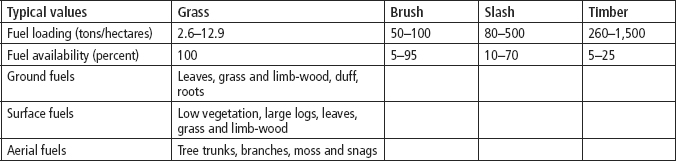
Table 1 Characteristics of fuels in relation to wildfire occurrence
In geographical terms, fires tend to spread in a nonlinear manner. Large expansions in area occur during the early phases as abundant fuel is consumed, and asymptotically smaller expansions are characteristic of later periods as fuel is consumed or the fire is brought under control. Owing to their demand for oxygen, large fires create their own drafts, which can lead to fire-induced convection and a positive feedback situation in which the fire creates substantial winds, effectively a firestorm.
There are various classifications of wildfires. The simplest and most common has six categories. A “ground fire” involves combustion without flames in the roots and undergrowth. A “surface fire” may occur in rangelands, bushes, and plant litter. In a “dependent crown fire,” the crowns of trees catch fire but the fire is propagated in the undergrowth. In contrast, a “running crown fire” propagates the flames rapidly through the tree crowns. This may lob burning brands ahead on the wind and thus cause a localized, concentrated “spot fire.” Finally, if the wind changes direction and the combustible material has not been completely consumed, the result may be a “backfire.”
...
- Agencies, United Nations
- Bureau for Crisis Prevention and Recovery, UN (UNDP/BCPR)
- Environment Programme, UN (UNEP)
- Food and Agriculture Organization of the United Nations (FAO)
- International Children's Fund, UN (UNICEF)
- International Strategy for Disaster Reduction, UN (UNISDR)
- Interregional Crime and Justice Research Institute, UN (UNICRI)
- Office for the Coordination of Humanitarian Affairs (OCHA), UN
- World Health Organization (WHO), UN
- Agencies, U.S.
- Centers for Disease Control and Prevention (CDC)
- Department of Homeland Security (DHS)
- Emergency Management Agencies, City and County
- Federal Bureau of Investigation (FBI)
- Federal Emergency Management Agency (FEMA)
- National Oceanic and Atmospheric Administration (NOAA)
- State Emergency Management Agencies
- U.S. Geological Survey (USGS)
- Categories of Crises: Engineering and Technological
- Air Traffic Control
- Air Travel
- Biological Engineering Risk
- Bridges
- Buildings
- Chemical Risk
- Cyber Crime
- Cyber Security
- Cyber Warfare
- Dams, Levees, and Seawalls
- Electronics Waste
- Environmental Contamination
- Hazardous Materials
- Hazardous Waste Disposal
- Improvised Explosive Devices
- Manufacturing Risks
- Marine Shipping
- Marine Travel
- Mining
- Nanotechnology
- Nuclear Risks
- Ozone Layer Depletion
- Petrochemical Risk
- Sewage Spill
- Smog
- Spaceflight
- Transportation Systems, Vulnerability
- Y2K Bug
- Categories of Crises: Financial and Business
- Categories of Crises: Natural Disasters
- Categories of Crises: Politics, International Relations, and Civil Violence
- Arms Control
- Biological Weapons
- Border Disputes
- Cabinet Office, UK
- Chemical Weapons
- Civil War
- Ethnic Cleansing
- Failed States
- Foreign Policy Crises
- Hijackings
- Hostage Taking and Negotiation
- Human Trafficking
- Interstate War
- Land Mines
- Missiles
- Nuclear and Radiological Weapons
- Nuclear Proliferation
- Peacekeeping
- Protest
- Religious Violence
- Revolution
- Riots
- Suicide Bombings
- Terrorism
- Transportation Security
- War Crimes
- Weapons Trafficking
- Categories of Crises: Population and Demographics
- Disaster Information Databases
- Nongovernmental Organizations
- Risk Management Standards
- Theory, Issues, and Techniques: Civil
- Agency Notification and Mobilization
- Civil Protection
- Civilian Protection, Post-Conflict
- Contingency Planning
- Continuity of Government
- Crisis Information Management Systems
- Debris Management
- Decision Making
- Decision Support Tools
- Disaster Assessment
- Disaster Declaration
- Disaster Risk Reduction
- Documentation
- Emergency Alert Systems
- Emergency Management System
- Emergency Manager
- Emergency Support Functions
- Financial Risk Management in Higher Education
- Hazard Mitigation
- Incident Action Plans
- National Incident Management System (NIMS)
- National Preparedness Goal
- National Response Framework
- Operational Plans
- Operational Readiness
- Perimeter Control
- Policy Setting
- Political and Organizational Leadership
- Preparedness
- Prevention
- Protection
- Search and Rescue
- Situational Analysis
- Stafford Act
- Sustainability
- Threat Detection
- Theory, Issues, and Techniques: Corporate
- Alternate Site, Corporate
- Auditing
- Backup Facility
- Backup Media
- Backup Strategy
- Business Continuity Management
- Business Continuity Planning
- Business Continuity Planning Life Cycle
- Business Impact Analysis
- Business Resumption Planning
- Classification of Systems
- Cluster
- Cold Site
- Continual Improvement
- Critical Applications
- Critical Business Functions
- Criticality Assessment
- Data Mirroring
- Data Recovery
- Dedicated Site
- Disaster Declaration Officer
- Disaster Recovery
- Disaster Recovery Life Cycle
- Disaster Recovery Plan Test Cycle
- Downtime
- Electronic Vaulting
- Failover
- Fink's Crisis Life Cycle
- Impact Analysis
- Incident Management
- Incident Response
- Insurance
- Journaling
- Losses, Quantitative Versus Qualitative
- Maximum Acceptable Outage
- Minimum Business Continuity Objective
- Mirroring
- Mitroff's Five Stages of Crisis Management
- Mobile Recovery Site
- Reciprocal Agreement
- Reciprocal Site
- Recovery Time Objective
- Reinsurance
- Reputational Risk
- Response Team
- Strengths, Weaknesses, Opportunities, and Threat (SWOT) Analysis
- Supply Chain
- Vital Records
- Warm Site
- Theory, Issues, and Techniques: General
- All-Hazards
- Cascading Crisis
- Catastrophe, Definition of
- Climate Change Adaptation
- Collaboration
- Command and Control
- Contingent Coordination
- Coordination
- Coping Capacity and Response Capability
- Credibility
- Crisis Communications
- Crisis Management, Emerging Trends in
- Crisis Simulations
- Crisis, Definition of
- Critical Infrastructure
- Damage Assessment
- Damage Containment
- Debriefing
- Decision Making Under Stress
- Disaster Drills
- Disaster, Definition of
- Disruption of Organizations
- Early Warning Systems
- Electronic Media
- Emergency Management, Principles of
- Emergency Medical Care
- Emergency Operations Center
- Emergency Public Information
- Emergency Responders
- Emergency, Definition of
- Evacuation
- Exercises
- Fusion Center
- Hazard Vulnerability Analysis
- Hazard, Definition of
- Historical Analogies, Use of
- Impact, Definition of
- Improvising
- Incidents Versus Crises
- Interdependence
- Interoperability
- Legal Liability
- Logistics
- Mass Care
- Mass Fatality Management
- Mass Media
- Mental Models
- Methods, Qualitative
- Methods, Quantitative
- Multiple Disaster Problem
- News Media
- Nongovernmental Organizations
- Nonlinearity
- Panic, Nature and Conditions of
- Pre-Crisis Training and Planning
- Pre-Impact Planning Process
- Public Awareness and Education
- Public Image
- Public Relations
- Recovery
- Residual Risk
- Resiliency
- Resource Management
- Response
- Risk Analysis
- Risk Assessment
- Risk Treatment
- Routine Emergencies Versus True Crises
- Safety Policies
- Scapegoating
- Scenario Planning
- Shelter-in-Place
- Simulations
- Social Media
- Spokesperson, Designating and Utilizing
- Stakeholders
- Strategic Plans
- Training
- Trauma
- Trigger Events
- Uncertainty
- Volunteer Coordination
- Vulnerability
- Warning
- Whistle Blowers
- Worker Error
- Theory, Issues, and Techniques: Public Health
- Cholera
- Drug Resistance
- Ebola Virus
- Emergency Medicine
- Epidemics
- Health and Medical Response Scenarios
- HIV/AIDS Epidemic
- Hospital Emergency Room
- Infectious Disease
- Infestations, Parasite
- Influenza
- Living Modified Organisms
- Malaria
- Measles
- Mental Illness
- Noncommunicable Diseases
- Pandemics
- Post-Traumatic Stress Disorder
- Public Health Surveillance
- Public Safety Canada
- Quarantine
- Severe Acute Respiratory Syndrome (SARS)
- Smallpox
- Social Distancing
- Surge Capacity, Hospitals
- Triage
- Tuberculosis
- Vaccinations
- Theory, Issues, and Techniques: Social Sciences
- Blame, Politics of
- Bounded Rationality
- Bureaucracy
- Chaos Theory
- Cognitive Novelty, Engaging in
- Cosmology Episode
- Coupling
- Decision Making, Theories of
- Decision Stream
- Groupthink
- High Reliability Organization Theory
- Information Asymmetry
- Information Vacuums
- Normal Accident Theory
- Normalization of Deviance
- Organizational Failure
- Paradigm Blindness
- Practical Drift
- Risk Society
- Structural Secrecy
- Loading...
Get a 30 day FREE TRIAL
-
 Watch videos from a variety of sources bringing classroom topics to life
 -
Read modern, diverse business cases
-
Explore hundreds of books and reference titles

Read next

More like this
Sage Recommends
We found other relevant content for you on other Sage platforms.
Have you created a personal profile? Login or create a profile so that you can save clips, playlists and searches