
Entry
Reader's guide
Entries A-Z
Subject index
Operational Plans
General Dwight D. Eisenhower once remarked, “In preparing for battle I have always found that plans are useless, but planning is indispensable.” His observation is equally valid for civil emergencies. The point is that the provisions stated in written plans will always have to be adapted to the specific circumstances of a particular emergency, but the process of planning is important because it induces the planner to consider the elements and dynamics of emergencies and the choices among possible response strategies.
Planning to conduct and manage relief operations for civil contingencies, emergencies, and disasters is a complex process but one that could be characterized as “organized common sense.” Its main aim is to integrate emergency resources and ensure that they are used in the most practical and efficient way to solve the problems created by the emergency (for example, search and rescue, provision of medical care and shelter, damage limitation, and the maintenance of public safety).
Several elements are present in the emergency environment. One consists of the permanent emergency plans that different organizations and levels of government require. Another is the contingency planning that adapts the provisions of the permanent plan to the evolving reality of the emergency situation. In this context, one should distinguish between plans and procedures. Operational planning should not be designed to specify in detail the procedures to be used. For instance, the plan should not instruct police officers how to direct traffic or tell firefighters how to extinguish a blaze. It should instead explain how to use standard operating procedures in concert among many organizations during unusual and probably extreme circumstances. Hence, the plan is rather like the score of a symphony. Individual players have their own music (the procedures), but the overall effect must be one of harmony by synchronizing highly compatible contributions (the plan).
Planning is the opposite of improvisation. However, in reality the two concepts are not quite so antagonistic. Contingency planning conducted in the period before an emergency (when lead times and alerts are sufficient) is supplemented by short-term strategic and tactical planning during the emergency, which serves to adapt operations to the dynamic needs generated by the impact (Figure 1). This is a form of “bounded improvisation.” Nonetheless, although pure improvisation cannot be eliminated from the emergency response, largely because every crisis involves some unique elements, it should be reduced to a minimum. Failure to anticipate needs that can be foreseen in advance is tantamount to negligence. Hence, in large measure, improvisation can be equated with inefficiency, and inefficiency adds up to impacts that could be reduced or avoided. In synthesis, plans should regulate the use of procedures, including the standard operating procedures of particular organizations, and protocols, the “rules of engagement” to be adopted under particular circumstances.
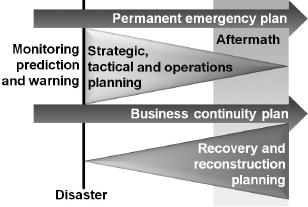
Figure 1 Interaction between types of plans during the aftermath of a disaster
Emergency and operational planning are part of a hierarchy in the decision-making and organizational system known as civil protection or civil defense. At the top level, policies define the broad objectives of the system and are concerned with the prevention of casualties, the limitation of damage, and the avoidance or reduction of interruptions to normal activities. By identifying concrete actions to be taken, strategic planning aims to connect policies with the means of making them operational. Strategic planners concentrate on finding the resources to be used in foreseeable emergency situations. Tactical planners concentrate on how to distribute those resources to best effect. Operational planners try to look ahead of ongoing operations in order to ensure that the most efficient use is made of the available resources as these arrive at the scene. This is a supply-and-demand problem: when the crisis begins, there is a large, unfulfilled demand for resources (to save lives, evacuate people who are at risk, provide shelter and meals, and all the typical actions of emergency first responders), but the gradual accumulation of resources in the area redresses the balance in favor of supply. The speed, accuracy, and efficiency with which this occurs is a function of the quality of both prior and ongoing planning and management. In synthesis, one role of operational planning is to regulate the “convergence reaction” that usually occurs when emergency resources are sent to the scene of an incident or disaster.
...
- Agencies, United Nations
- Bureau for Crisis Prevention and Recovery, UN (UNDP/BCPR)
- Environment Programme, UN (UNEP)
- Food and Agriculture Organization of the United Nations (FAO)
- International Children's Fund, UN (UNICEF)
- International Strategy for Disaster Reduction, UN (UNISDR)
- Interregional Crime and Justice Research Institute, UN (UNICRI)
- Office for the Coordination of Humanitarian Affairs (OCHA), UN
- World Health Organization (WHO), UN
- Agencies, U.S.
- Centers for Disease Control and Prevention (CDC)
- Department of Homeland Security (DHS)
- Emergency Management Agencies, City and County
- Federal Bureau of Investigation (FBI)
- Federal Emergency Management Agency (FEMA)
- National Oceanic and Atmospheric Administration (NOAA)
- State Emergency Management Agencies
- U.S. Geological Survey (USGS)
- Categories of Crises: Engineering and Technological
- Air Traffic Control
- Air Travel
- Biological Engineering Risk
- Bridges
- Buildings
- Chemical Risk
- Cyber Crime
- Cyber Security
- Cyber Warfare
- Dams, Levees, and Seawalls
- Electronics Waste
- Environmental Contamination
- Hazardous Materials
- Hazardous Waste Disposal
- Improvised Explosive Devices
- Manufacturing Risks
- Marine Shipping
- Marine Travel
- Mining
- Nanotechnology
- Nuclear Risks
- Ozone Layer Depletion
- Petrochemical Risk
- Sewage Spill
- Smog
- Spaceflight
- Transportation Systems, Vulnerability
- Y2K Bug
- Categories of Crises: Financial and Business
- Categories of Crises: Natural Disasters
- Categories of Crises: Politics, International Relations, and Civil Violence
- Arms Control
- Biological Weapons
- Border Disputes
- Cabinet Office, UK
- Chemical Weapons
- Civil War
- Ethnic Cleansing
- Failed States
- Foreign Policy Crises
- Hijackings
- Hostage Taking and Negotiation
- Human Trafficking
- Interstate War
- Land Mines
- Missiles
- Nuclear and Radiological Weapons
- Nuclear Proliferation
- Peacekeeping
- Protest
- Religious Violence
- Revolution
- Riots
- Suicide Bombings
- Terrorism
- Transportation Security
- War Crimes
- Weapons Trafficking
- Categories of Crises: Population and Demographics
- Disaster Information Databases
- Nongovernmental Organizations
- Risk Management Standards
- Theory, Issues, and Techniques: Civil
- Agency Notification and Mobilization
- Civil Protection
- Civilian Protection, Post-Conflict
- Contingency Planning
- Continuity of Government
- Crisis Information Management Systems
- Debris Management
- Decision Making
- Decision Support Tools
- Disaster Assessment
- Disaster Declaration
- Disaster Risk Reduction
- Documentation
- Emergency Alert Systems
- Emergency Management System
- Emergency Manager
- Emergency Support Functions
- Financial Risk Management in Higher Education
- Hazard Mitigation
- Incident Action Plans
- National Incident Management System (NIMS)
- National Preparedness Goal
- National Response Framework
- Operational Plans
- Operational Readiness
- Perimeter Control
- Policy Setting
- Political and Organizational Leadership
- Preparedness
- Prevention
- Protection
- Search and Rescue
- Situational Analysis
- Stafford Act
- Sustainability
- Threat Detection
- Theory, Issues, and Techniques: Corporate
- Alternate Site, Corporate
- Auditing
- Backup Facility
- Backup Media
- Backup Strategy
- Business Continuity Management
- Business Continuity Planning
- Business Continuity Planning Life Cycle
- Business Impact Analysis
- Business Resumption Planning
- Classification of Systems
- Cluster
- Cold Site
- Continual Improvement
- Critical Applications
- Critical Business Functions
- Criticality Assessment
- Data Mirroring
- Data Recovery
- Dedicated Site
- Disaster Declaration Officer
- Disaster Recovery
- Disaster Recovery Life Cycle
- Disaster Recovery Plan Test Cycle
- Downtime
- Electronic Vaulting
- Failover
- Fink's Crisis Life Cycle
- Impact Analysis
- Incident Management
- Incident Response
- Insurance
- Journaling
- Losses, Quantitative Versus Qualitative
- Maximum Acceptable Outage
- Minimum Business Continuity Objective
- Mirroring
- Mitroff's Five Stages of Crisis Management
- Mobile Recovery Site
- Reciprocal Agreement
- Reciprocal Site
- Recovery Time Objective
- Reinsurance
- Reputational Risk
- Response Team
- Strengths, Weaknesses, Opportunities, and Threat (SWOT) Analysis
- Supply Chain
- Vital Records
- Warm Site
- Theory, Issues, and Techniques: General
- All-Hazards
- Cascading Crisis
- Catastrophe, Definition of
- Climate Change Adaptation
- Collaboration
- Command and Control
- Contingent Coordination
- Coordination
- Coping Capacity and Response Capability
- Credibility
- Crisis Communications
- Crisis Management, Emerging Trends in
- Crisis Simulations
- Crisis, Definition of
- Critical Infrastructure
- Damage Assessment
- Damage Containment
- Debriefing
- Decision Making Under Stress
- Disaster Drills
- Disaster, Definition of
- Disruption of Organizations
- Early Warning Systems
- Electronic Media
- Emergency Management, Principles of
- Emergency Medical Care
- Emergency Operations Center
- Emergency Public Information
- Emergency Responders
- Emergency, Definition of
- Evacuation
- Exercises
- Fusion Center
- Hazard Vulnerability Analysis
- Hazard, Definition of
- Historical Analogies, Use of
- Impact, Definition of
- Improvising
- Incidents Versus Crises
- Interdependence
- Interoperability
- Legal Liability
- Logistics
- Mass Care
- Mass Fatality Management
- Mass Media
- Mental Models
- Methods, Qualitative
- Methods, Quantitative
- Multiple Disaster Problem
- News Media
- Nongovernmental Organizations
- Nonlinearity
- Panic, Nature and Conditions of
- Pre-Crisis Training and Planning
- Pre-Impact Planning Process
- Public Awareness and Education
- Public Image
- Public Relations
- Recovery
- Residual Risk
- Resiliency
- Resource Management
- Response
- Risk Analysis
- Risk Assessment
- Risk Treatment
- Routine Emergencies Versus True Crises
- Safety Policies
- Scapegoating
- Scenario Planning
- Shelter-in-Place
- Simulations
- Social Media
- Spokesperson, Designating and Utilizing
- Stakeholders
- Strategic Plans
- Training
- Trauma
- Trigger Events
- Uncertainty
- Volunteer Coordination
- Vulnerability
- Warning
- Whistle Blowers
- Worker Error
- Theory, Issues, and Techniques: Public Health
- Cholera
- Drug Resistance
- Ebola Virus
- Emergency Medicine
- Epidemics
- Health and Medical Response Scenarios
- HIV/AIDS Epidemic
- Hospital Emergency Room
- Infectious Disease
- Infestations, Parasite
- Influenza
- Living Modified Organisms
- Malaria
- Measles
- Mental Illness
- Noncommunicable Diseases
- Pandemics
- Post-Traumatic Stress Disorder
- Public Health Surveillance
- Public Safety Canada
- Quarantine
- Severe Acute Respiratory Syndrome (SARS)
- Smallpox
- Social Distancing
- Surge Capacity, Hospitals
- Triage
- Tuberculosis
- Vaccinations
- Theory, Issues, and Techniques: Social Sciences
- Blame, Politics of
- Bounded Rationality
- Bureaucracy
- Chaos Theory
- Cognitive Novelty, Engaging in
- Cosmology Episode
- Coupling
- Decision Making, Theories of
- Decision Stream
- Groupthink
- High Reliability Organization Theory
- Information Asymmetry
- Information Vacuums
- Normal Accident Theory
- Normalization of Deviance
- Organizational Failure
- Paradigm Blindness
- Practical Drift
- Risk Society
- Structural Secrecy
- Loading...
Get a 30 day FREE TRIAL
-
 Watch videos from a variety of sources bringing classroom topics to life
 -
Read modern, diverse business cases
-
Explore hundreds of books and reference titles

Read next

More like this
Sage Recommends
We found other relevant content for you on other Sage platforms.
Have you created a personal profile? Login or create a profile so that you can save clips, playlists and searches