
Entry
Reader's guide
Entries A-Z
Subject index
Improvised Explosive Devices
An improvised explosive device (IED) is a bomb manufactured in an unconventional way that incorporates destructive, lethal, noxious, pyrotechnic, or incendiary chemicals and is designed to destroy or incapacitate people, buildings, and vehicles, including aircraft and ships. Although such devices are much older, the term is believed to have originated in Northern Ireland, when it was used by the British Army after the Provisional Irish Republican Army (PIRA) manufactured and used bombs made from fertilizer and semtex smuggled from Libya.
An IED has five main components: an initiator, a switch, a power source, a main charge, and a container. Additional material such as nails or metal fragments can be included in the main charge or secured around the outside in order to increase its destructive ability. The main difference between an IED and a conventional explosive armament is that the former can appear to be any kind of object. IEDs have taken the form of luggage, cans of cooking oil, television sets, packages of various types, books, and letters. They have been sent through the mail, transported in vehicles—these are then known as vehicle-borne improvised explosive devices (VBIEDs)—or pedal cycles, or worn in vests or belts on the person. VBIEDs, including those carried by boats, can contain a huge amount of explosive material. The method of delivery list is endless.
IEDs planted by roads, commonly referred to as roadside bombs, are typically placed in drains or culverts or are buried close to the edge of the road and exploded by remote control as a target draws level. In such cases, the target forces often cease moving by road in favor of moving by helicopter.
Many commonly available materials can be used to manufacture IEDs. Powerful explosives can be made from precursor chemicals found in common consumer goods that are readily available commercially. For instance, ammonium nitrate, normally used in fertilizers, can be mixed with such items as fuel oil, icing sugar, nitrobenzene, and sugar. IEDs can be triggered using, among other things, a command wire, radio, and cell phone and a variety of timing devices, whereby the device is set to go off at a specific time. Advances in the miniaturization of electronics and the ready availability of cheap triggering devices such as cellular telephones, pagers, oven timers, video timers, and the like have enhanced the means of activation considerably.
IEDs were used by the Viet Cong against South Vietnamese and U.S. forces during the Vietnam War. In both the Iraq and Afghanistan conflicts, IEDs have been used extensively against coalition forces, government forces, and civilian targets. In Afghanistan, IEDs were also used against Soviet troops following the invasion in 1979. In Chechnya, Russian forces have again been the target of IEDs since 1994. Between 1982 and 2000, Hezbollah regularly used IEDs to attack Israeli forces in Lebanon.
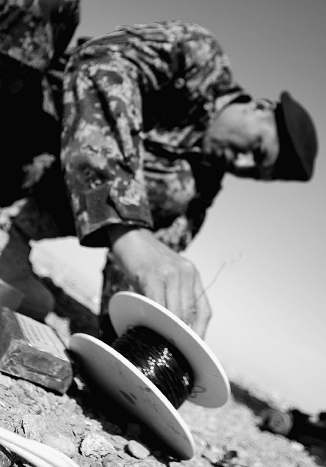
An Afghan National Army soldier participates in a simulated counter–improvised explosive device operation with U.S. Air Force explosive ordnance disposal technicians on March 13, 2012, at Kandahar Airfield, Afghanistan.
There are a number of examples of incidents where IEDs have been used in countries not associated with such conflict. In the United States, for instance, a truck containing an IED was driven into an underground parking garage at the World Trade Center in April 1993; the IED was subsequently estimated to be a urea-nitrate-hydrogen gas enhanced device weighing 606 kilograms. The occupants of the vehicle lit the 20-foot fuse and fled, leaving it to explode, killing six and injuring over 1,000 people when it exploded. Two years later, Timothy McVeigh drove another VBIED, manufactured from 2,300 kilograms of ammonium nitrate and nitromethane, and parked it outside the Alfred P. Murrah Federal Building in Oklahoma City. The IED exploded, destroying much of the building and killing 169 people. A year later, Eric Rudolph left a backpack containing “pipe bombs” in the Centennial Olympic Park in Atlanta where the 1996 Olympic Games were being held. The resultant explosion killed two people and injured a number of others. In May 2010, a terrorist attack was foiled in Times Square when two street vendors noticed smoke coming from a car that had recently been parked. Inside the vehicle were four IEDs, making up one large IED, consisting of gasoline, a quantity of firecrackers, gunpowder, propane, and urea-based fertilizer. This was all connected by wires to two alarm clocks, which were to act as the triggering device. Fortunately, the device's ignition failed to set it off.
...
- Agencies, United Nations
- Bureau for Crisis Prevention and Recovery, UN (UNDP/BCPR)
- Environment Programme, UN (UNEP)
- Food and Agriculture Organization of the United Nations (FAO)
- International Children's Fund, UN (UNICEF)
- International Strategy for Disaster Reduction, UN (UNISDR)
- Interregional Crime and Justice Research Institute, UN (UNICRI)
- Office for the Coordination of Humanitarian Affairs (OCHA), UN
- World Health Organization (WHO), UN
- Agencies, U.S.
- Centers for Disease Control and Prevention (CDC)
- Department of Homeland Security (DHS)
- Emergency Management Agencies, City and County
- Federal Bureau of Investigation (FBI)
- Federal Emergency Management Agency (FEMA)
- National Oceanic and Atmospheric Administration (NOAA)
- State Emergency Management Agencies
- U.S. Geological Survey (USGS)
- Categories of Crises: Engineering and Technological
- Air Traffic Control
- Air Travel
- Biological Engineering Risk
- Bridges
- Buildings
- Chemical Risk
- Cyber Crime
- Cyber Security
- Cyber Warfare
- Dams, Levees, and Seawalls
- Electronics Waste
- Environmental Contamination
- Hazardous Materials
- Hazardous Waste Disposal
- Improvised Explosive Devices
- Manufacturing Risks
- Marine Shipping
- Marine Travel
- Mining
- Nanotechnology
- Nuclear Risks
- Ozone Layer Depletion
- Petrochemical Risk
- Sewage Spill
- Smog
- Spaceflight
- Transportation Systems, Vulnerability
- Y2K Bug
- Categories of Crises: Financial and Business
- Categories of Crises: Natural Disasters
- Categories of Crises: Politics, International Relations, and Civil Violence
- Arms Control
- Biological Weapons
- Border Disputes
- Cabinet Office, UK
- Chemical Weapons
- Civil War
- Ethnic Cleansing
- Failed States
- Foreign Policy Crises
- Hijackings
- Hostage Taking and Negotiation
- Human Trafficking
- Interstate War
- Land Mines
- Missiles
- Nuclear and Radiological Weapons
- Nuclear Proliferation
- Peacekeeping
- Protest
- Religious Violence
- Revolution
- Riots
- Suicide Bombings
- Terrorism
- Transportation Security
- War Crimes
- Weapons Trafficking
- Categories of Crises: Population and Demographics
- Disaster Information Databases
- Nongovernmental Organizations
- Risk Management Standards
- Theory, Issues, and Techniques: Civil
- Agency Notification and Mobilization
- Civil Protection
- Civilian Protection, Post-Conflict
- Contingency Planning
- Continuity of Government
- Crisis Information Management Systems
- Debris Management
- Decision Making
- Decision Support Tools
- Disaster Assessment
- Disaster Declaration
- Disaster Risk Reduction
- Documentation
- Emergency Alert Systems
- Emergency Management System
- Emergency Manager
- Emergency Support Functions
- Financial Risk Management in Higher Education
- Hazard Mitigation
- Incident Action Plans
- National Incident Management System (NIMS)
- National Preparedness Goal
- National Response Framework
- Operational Plans
- Operational Readiness
- Perimeter Control
- Policy Setting
- Political and Organizational Leadership
- Preparedness
- Prevention
- Protection
- Search and Rescue
- Situational Analysis
- Stafford Act
- Sustainability
- Threat Detection
- Theory, Issues, and Techniques: Corporate
- Alternate Site, Corporate
- Auditing
- Backup Facility
- Backup Media
- Backup Strategy
- Business Continuity Management
- Business Continuity Planning
- Business Continuity Planning Life Cycle
- Business Impact Analysis
- Business Resumption Planning
- Classification of Systems
- Cluster
- Cold Site
- Continual Improvement
- Critical Applications
- Critical Business Functions
- Criticality Assessment
- Data Mirroring
- Data Recovery
- Dedicated Site
- Disaster Declaration Officer
- Disaster Recovery
- Disaster Recovery Life Cycle
- Disaster Recovery Plan Test Cycle
- Downtime
- Electronic Vaulting
- Failover
- Fink's Crisis Life Cycle
- Impact Analysis
- Incident Management
- Incident Response
- Insurance
- Journaling
- Losses, Quantitative Versus Qualitative
- Maximum Acceptable Outage
- Minimum Business Continuity Objective
- Mirroring
- Mitroff's Five Stages of Crisis Management
- Mobile Recovery Site
- Reciprocal Agreement
- Reciprocal Site
- Recovery Time Objective
- Reinsurance
- Reputational Risk
- Response Team
- Strengths, Weaknesses, Opportunities, and Threat (SWOT) Analysis
- Supply Chain
- Vital Records
- Warm Site
- Theory, Issues, and Techniques: General
- All-Hazards
- Cascading Crisis
- Catastrophe, Definition of
- Climate Change Adaptation
- Collaboration
- Command and Control
- Contingent Coordination
- Coordination
- Coping Capacity and Response Capability
- Credibility
- Crisis Communications
- Crisis Management, Emerging Trends in
- Crisis Simulations
- Crisis, Definition of
- Critical Infrastructure
- Damage Assessment
- Damage Containment
- Debriefing
- Decision Making Under Stress
- Disaster Drills
- Disaster, Definition of
- Disruption of Organizations
- Early Warning Systems
- Electronic Media
- Emergency Management, Principles of
- Emergency Medical Care
- Emergency Operations Center
- Emergency Public Information
- Emergency Responders
- Emergency, Definition of
- Evacuation
- Exercises
- Fusion Center
- Hazard Vulnerability Analysis
- Hazard, Definition of
- Historical Analogies, Use of
- Impact, Definition of
- Improvising
- Incidents Versus Crises
- Interdependence
- Interoperability
- Legal Liability
- Logistics
- Mass Care
- Mass Fatality Management
- Mass Media
- Mental Models
- Methods, Qualitative
- Methods, Quantitative
- Multiple Disaster Problem
- News Media
- Nongovernmental Organizations
- Nonlinearity
- Panic, Nature and Conditions of
- Pre-Crisis Training and Planning
- Pre-Impact Planning Process
- Public Awareness and Education
- Public Image
- Public Relations
- Recovery
- Residual Risk
- Resiliency
- Resource Management
- Response
- Risk Analysis
- Risk Assessment
- Risk Treatment
- Routine Emergencies Versus True Crises
- Safety Policies
- Scapegoating
- Scenario Planning
- Shelter-in-Place
- Simulations
- Social Media
- Spokesperson, Designating and Utilizing
- Stakeholders
- Strategic Plans
- Training
- Trauma
- Trigger Events
- Uncertainty
- Volunteer Coordination
- Vulnerability
- Warning
- Whistle Blowers
- Worker Error
- Theory, Issues, and Techniques: Public Health
- Cholera
- Drug Resistance
- Ebola Virus
- Emergency Medicine
- Epidemics
- Health and Medical Response Scenarios
- HIV/AIDS Epidemic
- Hospital Emergency Room
- Infectious Disease
- Infestations, Parasite
- Influenza
- Living Modified Organisms
- Malaria
- Measles
- Mental Illness
- Noncommunicable Diseases
- Pandemics
- Post-Traumatic Stress Disorder
- Public Health Surveillance
- Public Safety Canada
- Quarantine
- Severe Acute Respiratory Syndrome (SARS)
- Smallpox
- Social Distancing
- Surge Capacity, Hospitals
- Triage
- Tuberculosis
- Vaccinations
- Theory, Issues, and Techniques: Social Sciences
- Blame, Politics of
- Bounded Rationality
- Bureaucracy
- Chaos Theory
- Cognitive Novelty, Engaging in
- Cosmology Episode
- Coupling
- Decision Making, Theories of
- Decision Stream
- Groupthink
- High Reliability Organization Theory
- Information Asymmetry
- Information Vacuums
- Normal Accident Theory
- Normalization of Deviance
- Organizational Failure
- Paradigm Blindness
- Practical Drift
- Risk Society
- Structural Secrecy
- Loading...
Get a 30 day FREE TRIAL
-
 Watch videos from a variety of sources bringing classroom topics to life
 -
Read modern, diverse business cases
-
Explore hundreds of books and reference titles

Read next

More like this
Sage Recommends
We found other relevant content for you on other Sage platforms.
Have you created a personal profile? Login or create a profile so that you can save clips, playlists and searches