
Entry
Reader's guide
Entries A-Z
Subject index
Hazard Mitigation
Hazard mitigation can be broadly defined as measures directed at reducing risk or damage to property and lives from natural or human-made hazards. Suitable mitigation measures are determined by assessing which factors cause the most risk, and which of those will provide the most safety for cost. Hazard risk mitigation techniques can diminish the hazard and reduce the vulnerability of the property or life exposed to the hazard. Hazard mitigation techniques are structural (for example, dykes to protect from floods). Vulnerability mitigation techniques can be structural (for example, raising a home above flood level) and nonstructural (for example, regulation to address behavioral changes among the population with regard to the hazard). Mitigation is generally considered to be the first stage of disaster/crisis management. It allows for building community and personal resilience to hazards prior to the event through long-term investments in safety. This discussion focuses on nonstructural mitigation of natural hazards through incorporation of indigenous knowledge and local land use planning. The case study features the process of collaborative development of a risk-based land use guide for Metro Vancouver, British Columbia, Canada, with a goal of mitigating hazards and strengthening community safety through informed land use decisions.
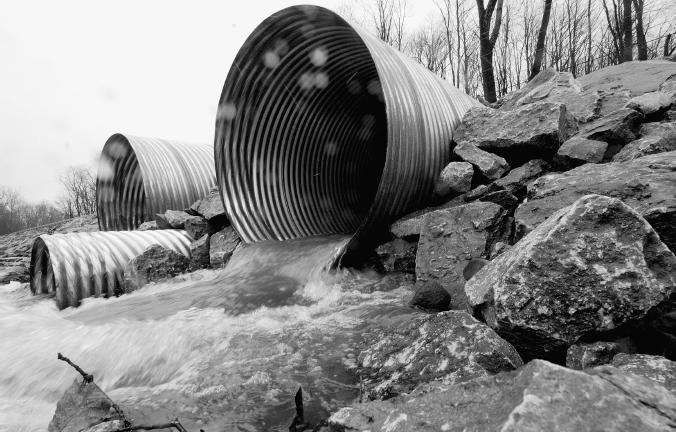
Drainage tubes installed along Route 30 in Blenheim, New York, diverting water during a heavy rainstorm on November 23, 2011. The tubes were part of mitigation work that was completed after flooding struck the area during Hurricane Irene in August 2011. Hazard mitigation techniques, such as this structural example, can reduce the vulnerability of the property or life exposed to the hazard.
Humans have been trying to mitigate hazards for centuries. Vincent Covello and Jeryl Mumpower suggested that virtually all great ancient civilizations (e.g., China, Maya, Egypt, and Mesopotamia) directly intervened to mitigate the effects of natural disasters and that governments have played a major role in developing and financing elaborate systems of flood control. Given the growing costs of disasters, public-private partnerships with the goal of mitigating hazards are gaining recognition as a potential way to share risk and costs of long-term investments in the resilience of communities and societies.
Researchers such as David Godschalk and colleagues in the United States and John Handmer
Case Study: Risk-Based Land Use Guide for Hazard Mitigation
Risk-based land use guides provide municipal staff with principles and tools to evaluate and recommend land use decisions that mitigate disasters. To be effective, the guides incorporate principles and tools recognized locally, nationally, and internationally as the most informed of our time (best practices). A land use guide targets municipal staff because they provide both the strategic and operational recommendations and decisions on land use for urban centers. Large urban centers, in general, are the most vulnerable land uses.
In recognition of the magnitude of responsibility that municipal staff carry in building safe communities, a consortium in southwest British Columbia, Canada, formed to assist municipal staff in consolidating informed risk-based land use practice into a practical guide. Its development is predicated on the inclusion of local and scientific informed practice. It is community focused, based on common economy, society (culture, governance), and geography. The southwest British Columbia example was driven by threats posed by its multihazard geography.
...
- Agencies, United Nations
- Bureau for Crisis Prevention and Recovery, UN (UNDP/BCPR)
- Environment Programme, UN (UNEP)
- Food and Agriculture Organization of the United Nations (FAO)
- International Children's Fund, UN (UNICEF)
- International Strategy for Disaster Reduction, UN (UNISDR)
- Interregional Crime and Justice Research Institute, UN (UNICRI)
- Office for the Coordination of Humanitarian Affairs (OCHA), UN
- World Health Organization (WHO), UN
- Agencies, U.S.
- Centers for Disease Control and Prevention (CDC)
- Department of Homeland Security (DHS)
- Emergency Management Agencies, City and County
- Federal Bureau of Investigation (FBI)
- Federal Emergency Management Agency (FEMA)
- National Oceanic and Atmospheric Administration (NOAA)
- State Emergency Management Agencies
- U.S. Geological Survey (USGS)
- Categories of Crises: Engineering and Technological
- Air Traffic Control
- Air Travel
- Biological Engineering Risk
- Bridges
- Buildings
- Chemical Risk
- Cyber Crime
- Cyber Security
- Cyber Warfare
- Dams, Levees, and Seawalls
- Electronics Waste
- Environmental Contamination
- Hazardous Materials
- Hazardous Waste Disposal
- Improvised Explosive Devices
- Manufacturing Risks
- Marine Shipping
- Marine Travel
- Mining
- Nanotechnology
- Nuclear Risks
- Ozone Layer Depletion
- Petrochemical Risk
- Sewage Spill
- Smog
- Spaceflight
- Transportation Systems, Vulnerability
- Y2K Bug
- Categories of Crises: Financial and Business
- Categories of Crises: Natural Disasters
- Categories of Crises: Politics, International Relations, and Civil Violence
- Arms Control
- Biological Weapons
- Border Disputes
- Cabinet Office, UK
- Chemical Weapons
- Civil War
- Ethnic Cleansing
- Failed States
- Foreign Policy Crises
- Hijackings
- Hostage Taking and Negotiation
- Human Trafficking
- Interstate War
- Land Mines
- Missiles
- Nuclear and Radiological Weapons
- Nuclear Proliferation
- Peacekeeping
- Protest
- Religious Violence
- Revolution
- Riots
- Suicide Bombings
- Terrorism
- Transportation Security
- War Crimes
- Weapons Trafficking
- Categories of Crises: Population and Demographics
- Disaster Information Databases
- Nongovernmental Organizations
- Risk Management Standards
- Theory, Issues, and Techniques: Civil
- Agency Notification and Mobilization
- Civil Protection
- Civilian Protection, Post-Conflict
- Contingency Planning
- Continuity of Government
- Crisis Information Management Systems
- Debris Management
- Decision Making
- Decision Support Tools
- Disaster Assessment
- Disaster Declaration
- Disaster Risk Reduction
- Documentation
- Emergency Alert Systems
- Emergency Management System
- Emergency Manager
- Emergency Support Functions
- Financial Risk Management in Higher Education
- Hazard Mitigation
- Incident Action Plans
- National Incident Management System (NIMS)
- National Preparedness Goal
- National Response Framework
- Operational Plans
- Operational Readiness
- Perimeter Control
- Policy Setting
- Political and Organizational Leadership
- Preparedness
- Prevention
- Protection
- Search and Rescue
- Situational Analysis
- Stafford Act
- Sustainability
- Threat Detection
- Theory, Issues, and Techniques: Corporate
- Alternate Site, Corporate
- Auditing
- Backup Facility
- Backup Media
- Backup Strategy
- Business Continuity Management
- Business Continuity Planning
- Business Continuity Planning Life Cycle
- Business Impact Analysis
- Business Resumption Planning
- Classification of Systems
- Cluster
- Cold Site
- Continual Improvement
- Critical Applications
- Critical Business Functions
- Criticality Assessment
- Data Mirroring
- Data Recovery
- Dedicated Site
- Disaster Declaration Officer
- Disaster Recovery
- Disaster Recovery Life Cycle
- Disaster Recovery Plan Test Cycle
- Downtime
- Electronic Vaulting
- Failover
- Fink's Crisis Life Cycle
- Impact Analysis
- Incident Management
- Incident Response
- Insurance
- Journaling
- Losses, Quantitative Versus Qualitative
- Maximum Acceptable Outage
- Minimum Business Continuity Objective
- Mirroring
- Mitroff's Five Stages of Crisis Management
- Mobile Recovery Site
- Reciprocal Agreement
- Reciprocal Site
- Recovery Time Objective
- Reinsurance
- Reputational Risk
- Response Team
- Strengths, Weaknesses, Opportunities, and Threat (SWOT) Analysis
- Supply Chain
- Vital Records
- Warm Site
- Theory, Issues, and Techniques: General
- All-Hazards
- Cascading Crisis
- Catastrophe, Definition of
- Climate Change Adaptation
- Collaboration
- Command and Control
- Contingent Coordination
- Coordination
- Coping Capacity and Response Capability
- Credibility
- Crisis Communications
- Crisis Management, Emerging Trends in
- Crisis Simulations
- Crisis, Definition of
- Critical Infrastructure
- Damage Assessment
- Damage Containment
- Debriefing
- Decision Making Under Stress
- Disaster Drills
- Disaster, Definition of
- Disruption of Organizations
- Early Warning Systems
- Electronic Media
- Emergency Management, Principles of
- Emergency Medical Care
- Emergency Operations Center
- Emergency Public Information
- Emergency Responders
- Emergency, Definition of
- Evacuation
- Exercises
- Fusion Center
- Hazard Vulnerability Analysis
- Hazard, Definition of
- Historical Analogies, Use of
- Impact, Definition of
- Improvising
- Incidents Versus Crises
- Interdependence
- Interoperability
- Legal Liability
- Logistics
- Mass Care
- Mass Fatality Management
- Mass Media
- Mental Models
- Methods, Qualitative
- Methods, Quantitative
- Multiple Disaster Problem
- News Media
- Nongovernmental Organizations
- Nonlinearity
- Panic, Nature and Conditions of
- Pre-Crisis Training and Planning
- Pre-Impact Planning Process
- Public Awareness and Education
- Public Image
- Public Relations
- Recovery
- Residual Risk
- Resiliency
- Resource Management
- Response
- Risk Analysis
- Risk Assessment
- Risk Treatment
- Routine Emergencies Versus True Crises
- Safety Policies
- Scapegoating
- Scenario Planning
- Shelter-in-Place
- Simulations
- Social Media
- Spokesperson, Designating and Utilizing
- Stakeholders
- Strategic Plans
- Training
- Trauma
- Trigger Events
- Uncertainty
- Volunteer Coordination
- Vulnerability
- Warning
- Whistle Blowers
- Worker Error
- Theory, Issues, and Techniques: Public Health
- Cholera
- Drug Resistance
- Ebola Virus
- Emergency Medicine
- Epidemics
- Health and Medical Response Scenarios
- HIV/AIDS Epidemic
- Hospital Emergency Room
- Infectious Disease
- Infestations, Parasite
- Influenza
- Living Modified Organisms
- Malaria
- Measles
- Mental Illness
- Noncommunicable Diseases
- Pandemics
- Post-Traumatic Stress Disorder
- Public Health Surveillance
- Public Safety Canada
- Quarantine
- Severe Acute Respiratory Syndrome (SARS)
- Smallpox
- Social Distancing
- Surge Capacity, Hospitals
- Triage
- Tuberculosis
- Vaccinations
- Theory, Issues, and Techniques: Social Sciences
- Blame, Politics of
- Bounded Rationality
- Bureaucracy
- Chaos Theory
- Cognitive Novelty, Engaging in
- Cosmology Episode
- Coupling
- Decision Making, Theories of
- Decision Stream
- Groupthink
- High Reliability Organization Theory
- Information Asymmetry
- Information Vacuums
- Normal Accident Theory
- Normalization of Deviance
- Organizational Failure
- Paradigm Blindness
- Practical Drift
- Risk Society
- Structural Secrecy
- Loading...
Get a 30 day FREE TRIAL
-
 Watch videos from a variety of sources bringing classroom topics to life
 -
Read modern, diverse business cases
-
Explore hundreds of books and reference titles

Read next

More like this
Sage Recommends
We found other relevant content for you on other Sage platforms.
Have you created a personal profile? Login or create a profile so that you can save clips, playlists and searches