
Entry
Reader's guide
Entries A-Z
Subject index
Cholera
Following every natural disaster, one of the most common and rapidly spreading outbreaks, affecting hundreds of people around the developing countries of Africa, Asia, and Latin America, is cholera, contracted after a person is infected by the Vibrio cholerae bacterium. Patients suffer from frequent diarrhea, which often escalates into dehydration and even death. Treatment options for the disease generally include oral rehydration and a course of antibiotics to reduce the effects of the disease. However, during any post-disastrous event, providing victims access to both can be challenging and requires proper management; coordination is needed before, during, and after an outbreak occurs.
Pre-Outbreak Management
In preparing for any disastrous situation, the key step that needs to be taken is to identify the people who will likely be affected by the disaster, the services and resources that are likely to be needed, and, finally, the responsible party who is willing and has the capacity to provide the required services. Before a cholera outbreak occurs in vulnerable areas, it is therefore necessary to first identify highly populated areas with possibly contaminated drinking water and poor sanitary conditions. Once these areas are identified, the next step is to form a monitoring team that can confirm possible outbreaks. Members of this team should include doctors, epidemiologists, microbiologists, and water contamination and sanitation experts. Using modern database and mapping software, including geographic information systems (GIS) and remote sensing, the team should try to identify the locations of the possible victims, locations of the contaminated water sources, and locations of sanitation facilities, as well as the nearest possible clinics and hospitals that are able to take care of patients in case an outbreak occurs. GIS can also be used to identify locations that would be suitable for setting up new treatment facilities. Although hospitals and clinics are ideal locations for treating cholera victims, sometimes larger facilities capable of handling large numbers of people (e.g., schools, churches, and mosques, etc.) would be more appropriate. These facilities should keep large quantities of safe running drinking water, good sanitation facilities, medicines, IV and rehydration fluids and energy drinks, and trained medical professionals (a full list of required resources can be found in the World Health Organization's (WHO) required cholera supply list). In situations where clean water supplies are not available, various types of on-site purification chemicals (such as chlorine) would need to be gathered and prepared for any possible outbreaks. Oftentimes, international and governmental organizations, along with local nongovernmental organizations (NGOs), are responsible for taking care of such mitigation and preventive measures.
Outbreak Management
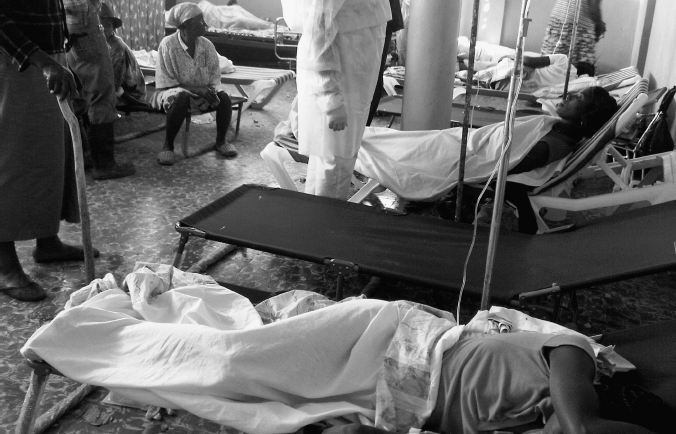
A Centers for Disease Control and Prevention Public Health Prevention Service cholera treatment center in Haiti, November 2010. Cholera is easily controlled in most settings, but because of the poor water quality and sanitation problems in the aftermath of the January 2010 earthquake, cholera had an ideal setting in which to spread. As a result, tens of thousands of Haitians contracted cholera.
Usually, a cholera outbreak is confirmed by epidemiologists and medical professionals once 10–20 cases are reported. Once confirmed, the first step is to notify the nearest health officials as well as the WHO. Emergency management teams need to be formed, and these teams need to collect data on the victims in terms of their locations, attack rate, areal extent of the patients, age, gender, and any other medical conditions they may be reporting. It is also essential that the general public be made aware of the outbreak. Various media outlets, including television and radio, newspapers, flyers, billboards, and loudspeakers, can all be used to notify the public. The public also needs to be notified of the symptoms and the actions they can take to save the lives of victims. The message needs to be clear, concise, and simple to understand so that poor and uneducated people (as this is often the case in developing countries) can understand and follow the instructions. As mentioned above, during the time of the outbreak, careful attention needs to be given to the purity of drinking water supplies. Separate male and female public toilets and latrines also need to be provided if they are not available, and they need to be cleaned on a regular basis. The users should also have access to antibacterial soaps and sanitizers so that the public can clean their hands after defecation. When preparing foods, kitchen areas should be clean, and raw fruits and vegetables should be separated from cooked foods to prevent contamination. The cholera bacterium grows very well in moist environments at room temperature; therefore, foods such as milk, potatoes, beans, and eggs should never be prepared more than an hour before eating. For babies, breastfeeding is the most hygienic choice for food during the outbreak. Victims who die during the outbreak should have proper funerals with preventive measures taken in order to avoid contaminating other people with the bacterium.
...
- Agencies, United Nations
- Bureau for Crisis Prevention and Recovery, UN (UNDP/BCPR)
- Environment Programme, UN (UNEP)
- Food and Agriculture Organization of the United Nations (FAO)
- International Children's Fund, UN (UNICEF)
- International Strategy for Disaster Reduction, UN (UNISDR)
- Interregional Crime and Justice Research Institute, UN (UNICRI)
- Office for the Coordination of Humanitarian Affairs (OCHA), UN
- World Health Organization (WHO), UN
- Agencies, U.S.
- Centers for Disease Control and Prevention (CDC)
- Department of Homeland Security (DHS)
- Emergency Management Agencies, City and County
- Federal Bureau of Investigation (FBI)
- Federal Emergency Management Agency (FEMA)
- National Oceanic and Atmospheric Administration (NOAA)
- State Emergency Management Agencies
- U.S. Geological Survey (USGS)
- Categories of Crises: Engineering and Technological
- Air Traffic Control
- Air Travel
- Biological Engineering Risk
- Bridges
- Buildings
- Chemical Risk
- Cyber Crime
- Cyber Security
- Cyber Warfare
- Dams, Levees, and Seawalls
- Electronics Waste
- Environmental Contamination
- Hazardous Materials
- Hazardous Waste Disposal
- Improvised Explosive Devices
- Manufacturing Risks
- Marine Shipping
- Marine Travel
- Mining
- Nanotechnology
- Nuclear Risks
- Ozone Layer Depletion
- Petrochemical Risk
- Sewage Spill
- Smog
- Spaceflight
- Transportation Systems, Vulnerability
- Y2K Bug
- Categories of Crises: Financial and Business
- Categories of Crises: Natural Disasters
- Categories of Crises: Politics, International Relations, and Civil Violence
- Arms Control
- Biological Weapons
- Border Disputes
- Cabinet Office, UK
- Chemical Weapons
- Civil War
- Ethnic Cleansing
- Failed States
- Foreign Policy Crises
- Hijackings
- Hostage Taking and Negotiation
- Human Trafficking
- Interstate War
- Land Mines
- Missiles
- Nuclear and Radiological Weapons
- Nuclear Proliferation
- Peacekeeping
- Protest
- Religious Violence
- Revolution
- Riots
- Suicide Bombings
- Terrorism
- Transportation Security
- War Crimes
- Weapons Trafficking
- Categories of Crises: Population and Demographics
- Disaster Information Databases
- Nongovernmental Organizations
- Risk Management Standards
- Theory, Issues, and Techniques: Civil
- Agency Notification and Mobilization
- Civil Protection
- Civilian Protection, Post-Conflict
- Contingency Planning
- Continuity of Government
- Crisis Information Management Systems
- Debris Management
- Decision Making
- Decision Support Tools
- Disaster Assessment
- Disaster Declaration
- Disaster Risk Reduction
- Documentation
- Emergency Alert Systems
- Emergency Management System
- Emergency Manager
- Emergency Support Functions
- Financial Risk Management in Higher Education
- Hazard Mitigation
- Incident Action Plans
- National Incident Management System (NIMS)
- National Preparedness Goal
- National Response Framework
- Operational Plans
- Operational Readiness
- Perimeter Control
- Policy Setting
- Political and Organizational Leadership
- Preparedness
- Prevention
- Protection
- Search and Rescue
- Situational Analysis
- Stafford Act
- Sustainability
- Threat Detection
- Theory, Issues, and Techniques: Corporate
- Alternate Site, Corporate
- Auditing
- Backup Facility
- Backup Media
- Backup Strategy
- Business Continuity Management
- Business Continuity Planning
- Business Continuity Planning Life Cycle
- Business Impact Analysis
- Business Resumption Planning
- Classification of Systems
- Cluster
- Cold Site
- Continual Improvement
- Critical Applications
- Critical Business Functions
- Criticality Assessment
- Data Mirroring
- Data Recovery
- Dedicated Site
- Disaster Declaration Officer
- Disaster Recovery
- Disaster Recovery Life Cycle
- Disaster Recovery Plan Test Cycle
- Downtime
- Electronic Vaulting
- Failover
- Fink's Crisis Life Cycle
- Impact Analysis
- Incident Management
- Incident Response
- Insurance
- Journaling
- Losses, Quantitative Versus Qualitative
- Maximum Acceptable Outage
- Minimum Business Continuity Objective
- Mirroring
- Mitroff's Five Stages of Crisis Management
- Mobile Recovery Site
- Reciprocal Agreement
- Reciprocal Site
- Recovery Time Objective
- Reinsurance
- Reputational Risk
- Response Team
- Strengths, Weaknesses, Opportunities, and Threat (SWOT) Analysis
- Supply Chain
- Vital Records
- Warm Site
- Theory, Issues, and Techniques: General
- All-Hazards
- Cascading Crisis
- Catastrophe, Definition of
- Climate Change Adaptation
- Collaboration
- Command and Control
- Contingent Coordination
- Coordination
- Coping Capacity and Response Capability
- Credibility
- Crisis Communications
- Crisis Management, Emerging Trends in
- Crisis Simulations
- Crisis, Definition of
- Critical Infrastructure
- Damage Assessment
- Damage Containment
- Debriefing
- Decision Making Under Stress
- Disaster Drills
- Disaster, Definition of
- Disruption of Organizations
- Early Warning Systems
- Electronic Media
- Emergency Management, Principles of
- Emergency Medical Care
- Emergency Operations Center
- Emergency Public Information
- Emergency Responders
- Emergency, Definition of
- Evacuation
- Exercises
- Fusion Center
- Hazard Vulnerability Analysis
- Hazard, Definition of
- Historical Analogies, Use of
- Impact, Definition of
- Improvising
- Incidents Versus Crises
- Interdependence
- Interoperability
- Legal Liability
- Logistics
- Mass Care
- Mass Fatality Management
- Mass Media
- Mental Models
- Methods, Qualitative
- Methods, Quantitative
- Multiple Disaster Problem
- News Media
- Nongovernmental Organizations
- Nonlinearity
- Panic, Nature and Conditions of
- Pre-Crisis Training and Planning
- Pre-Impact Planning Process
- Public Awareness and Education
- Public Image
- Public Relations
- Recovery
- Residual Risk
- Resiliency
- Resource Management
- Response
- Risk Analysis
- Risk Assessment
- Risk Treatment
- Routine Emergencies Versus True Crises
- Safety Policies
- Scapegoating
- Scenario Planning
- Shelter-in-Place
- Simulations
- Social Media
- Spokesperson, Designating and Utilizing
- Stakeholders
- Strategic Plans
- Training
- Trauma
- Trigger Events
- Uncertainty
- Volunteer Coordination
- Vulnerability
- Warning
- Whistle Blowers
- Worker Error
- Theory, Issues, and Techniques: Public Health
- Cholera
- Drug Resistance
- Ebola Virus
- Emergency Medicine
- Epidemics
- Health and Medical Response Scenarios
- HIV/AIDS Epidemic
- Hospital Emergency Room
- Infectious Disease
- Infestations, Parasite
- Influenza
- Living Modified Organisms
- Malaria
- Measles
- Mental Illness
- Noncommunicable Diseases
- Pandemics
- Post-Traumatic Stress Disorder
- Public Health Surveillance
- Public Safety Canada
- Quarantine
- Severe Acute Respiratory Syndrome (SARS)
- Smallpox
- Social Distancing
- Surge Capacity, Hospitals
- Triage
- Tuberculosis
- Vaccinations
- Theory, Issues, and Techniques: Social Sciences
- Blame, Politics of
- Bounded Rationality
- Bureaucracy
- Chaos Theory
- Cognitive Novelty, Engaging in
- Cosmology Episode
- Coupling
- Decision Making, Theories of
- Decision Stream
- Groupthink
- High Reliability Organization Theory
- Information Asymmetry
- Information Vacuums
- Normal Accident Theory
- Normalization of Deviance
- Organizational Failure
- Paradigm Blindness
- Practical Drift
- Risk Society
- Structural Secrecy
- Loading...
Get a 30 day FREE TRIAL
-
 Watch videos from a variety of sources bringing classroom topics to life
 -
Read modern, diverse business cases
-
Explore hundreds of books and reference titles

Read next

More like this
Sage Recommends
We found other relevant content for you on other Sage platforms.
Have you created a personal profile? Login or create a profile so that you can save clips, playlists and searches