
Entry
Reader's guide
Entries A-Z
Subject index
Learning Pathways Grid
The Learning Pathways Grid (LPG) is a visual template (see Figure 1) for a particular kind of conversation analysis. LPG analysis helps professionals discover links from cognition to action, to the effects of action and makes those links explicit; it then supports a pragmatic redesign of action. LPG analysis is a powerful action research tool. It allows professionals to develop reflective practice skills in a rigorous, structured and collaborative way. While ‘reflective practice’ may appear mysterious and unattainable, the LPG allows practitioners at any level to identify ways in which their espoused beliefs and actual actions conflict or are in sync, a key reflective practice skill.
Figure 1 The Learning Pathways Grid
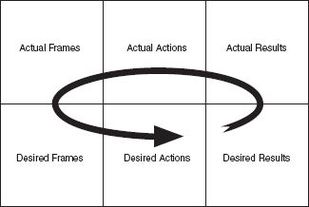
An LPG analysis is a stepwise process of reflection which guides inquiry into past conversational behaviour that has yielded undesirable results. It is done in a group. At each step in the LPG mapping and redesign, respectful inquiry and suggestions from group members can help an individual see past her or his inevitable biases and blind spots and empower the individual to adopt a new, more effective approach to a challenging situation. At the root of LPG analysis is the frame, a term applied loosely to encompass related concepts such as assumptions, cognitive schemas and mental models. The simple LPG conceptual model is that frames lead to behaviours, which in turn have consequences, as depicted by the left-to-right sequences in Figure 1. Frames both inform and limit actions; however, the individual has the power to imagine and adopt different frames that will lead him or her to more effective behaviours. LPG analysis supports this reframing. The LPG emerged from the interrelated traditions of Action Science, organizational learning, action inquiry and family systems therapy. It was developed initially by Diana McLain Smith and colleagues in the early 1990s for use in organizational development consulting. This entry explains the LPG and describes its application.
LPG Analysis Overview
LPG analysis begins with a case written by an individual whose actions failed to yield the desired outcomes. The focal behaviour is excerpted from an interpersonal interaction, which might be a meeting, a teaching or training session or a professional team effort, such as surgery or the work of a flight crew. LPG analysis is conducted ‘offline’ with trusted peers. The remainder of this entry refers to those conducting the analysis as ‘the group’ and to the focal individual who experienced the dilemma as the ‘case writer’.
LPG analysis follows the flow of the arrow in Figure 1. The case writer prepares a case about a conversation with problematic results. The case is presented to the group. The group and the case writer then use the LPG to map specific thoughts and actions that appear to have led to the undesired results. Group and case writer then use the LPG to craft alternative ways of thinking and acting, which hold the potential to bring about the desired results in the future. The steps are described below.
...
- Biographies
- Alinsky, Saul
- Argyris, Chris
- Bateson, Gregory
- Boal, Augusto
- Chataway, Cynthia Joy
- Dewey, John
- Emery, Fred
- Fals Borda, Orlando
- Freire, Paulo
- Gadamer, Hans-Georg
- Horton, Myles
- Kincheloe, Joe
- Lewin, Kurt
- marino, dian
- Martín-Baró, Ignacio
- Nielsen, Kurt Aagaard
- Noffke, Susan
- Schön, Donald
- Toulmin, Stephen
- Whyte, William Foote
- Wittgenstein, Ludwig
- Concepts
- Vivencia
- Academic Discourse
- Agency
- Appreciative Intelligence
- Authenticity
- Bakhtinian Dialogism
- Bildung
- Communities of Practice
- Community of Inquiry
- Conscientization
- Critical Friend
- Critical Reference Group
- Dialogue
- Double-Loop Learning
- Empowerment
- Engaged Scholarship
- Hegemony
- Heteroglossia
- Heutagogy
- Identity
- Knowledge Democracy
- Metaphor
- Non-Indigenous Ally
- Organizational Culture
- Positionality
- Subalternity
- Sustainability
- Systems Thinking
- Tacit Knowledge
- Taylorism
- Technical Action Research
- Tempered Radical
- Transformative Learning
- Voice
- Epistemology
- Ethics
- Goals
- Methods
- Action Evaluation
- Advocacy and Inquiry
- Autobiography
- Bricolage Process
- Case Study
- Citizen Report Card
- Citizens’ Juries
- Cognitive Mapping
- Collaborative Data Analysis
- Community Dialogue
- Community Mapping
- Computer-Based Instruction
- Concept Mapping
- Conflict Management
- Convergent Interviewing
- Critical Reflection
- Democratic Dialogue
- Descriptive Review
- Development Coalitions
- Dialogue Conferences
- Digital Storytelling
- Discourse Analysis
- Fishbone Diagram
- Focus Groups
- Interviews
- Journaling
- Listening Guide
- Microplanning
- Multi-Stakeholder Dialogue
- Narrative Inquiry
- Organizational Storytelling
- Participatory Monitoring
- Photovoice
- Research Circles
- Search Conference
- Social Audit
- Stakeholder Analysis
- Storytelling
- World Café, The
- Methodologies
- Action Learning
- Action Science
- Anti-Oppression Research
- Appreciative Inquiry and Research Methodology
- Appreciative Inquiry and Sustainable Value Creation
- Arts-Based Action Research
- Asset-Based Community Development
- Citizen Science
- Classroom-Based Action Research
- Clinical Inquiry
- Co-Operative Inquiry
- Collaborative Action Research
- Collaborative Developmental Action Inquiry
- Collaborative Management Research
- Community-Based Participatory Research
- Community-Based Research
- Comprehensive District Planning
- Critical Action Learning
- Critical Participatory Action Research
- Critical Utopian Action Research
- Dialogic Inquiry
- Ethnography
- Evaluative Inquiry
- Feminist Participatory Action Research
- First Person Action Research
- Grounded Theory
- Indigenist Research
- Indigenous Research Methods
- Interactive Research
- Intervention Research in Management
- Large-Group Action Research
- Learning History
- Living Life as Inquiry
- Narrative
- Oral History
- Participatory Action Research
- Participatory Design Programming
- Participatory Governance
- Participatory Learning and Action
- Participatory Rapid Appraisal
- Participatory Rural Appraisal
- Participatory Theatre
- Participatory Urban Planning
- Performed Ethnography
- Practice Development
- Practitioner Inquiry
- Pragmatic Action Research
- Process Consultation
- Qualimetrics Intervention Research
- Quantitative Methods
- Reflective Practice
- Second Person Action Research
- Soft Systems Methodology
- Strategic Planning
- Strengths-Based Approach
- Systemic Action Research
- Systems Psychodynamics
- Theatre of the Oppressed
- Third Person Action Research
- Transpersonal Inquiry
- Work-Based Learning
- Youth Participatory Action Research
- Methodological Issues
- Cycles of Action and Reflection
- Data Analysis
- Disseminating Action Research
- Gender Issues
- Generalizability
- Information and Communications Technology and Organizational Change
- Integrating Grounded Theory
- Intersubjectivity
- Meta-Methodology
- Mode 1 and Mode 2 Knowledge Production
- Quality
- Reliability
- Rigour
- Transferability
- Validity
- Organizations and Movements
- Gonogobeshona
- Antigonish Movement
- Centre for Action Research in Professional Practice
- Collaborative Action Research Network
- Community Design Centres
- Community-Campus Partnerships for Health
- Community-University Partnership Programme
- Community-University Research Partnerships
- Cornell Participatory Action Research Network
- Dig Where You Stand Movement
- Disabled People’s Organizations
- Global Alliance for Community-Engaged Research
- Grameen Bank
- Highlander Research and Education Center
- Institute of Development Studies
- International Council for Adult Education
- International Participatory Research Network
- Jipemoyo Project
- LGBT
- Maya Women of Chajul
- Mondragón Co-Operatives
- Norwegian Industrial Democracy Movement
- Office of Community-Based Research
- Research Initiatives, Bangladesh
- Social Movement Learning Movement
- Society for Participatory Research in Asia
- Tavistock Institute
- Work Research Institute, The
- World Congresses of Action Research
- Philosophical Underpinnings
- Settings
- Action Anthropology
- Adult Education
- Agriculture and Ecological Integrity
- Community Development
- Criminal Justice Systems
- Design Research
- Development Action Research
- Educational Action Research
- Environment and Climate Change
- Evaluation
- Health Care
- Health Education
- Health Promotion
- Higher Education
- HIV Prevention and Support
- Human Rights
- Information Systems
- Insider Action Research
- Inter-Organizational Action Research
- Labour-Managed Firms
- New Product Development
- Nursing
- Operations Management
- Organization Development
- Participatory Disaster Management
- Project Management
- Regional Development
- Subaltern Studies
- Voluntary Sector
- Work-Family Interventions
- Workers’ Participation in Occupational Health and Safety
- Skills
- Spirituality
- Theories
- Tools
- Loading...
Get a 30 day FREE TRIAL
-
 Watch videos from a variety of sources bringing classroom topics to life
 -
Read modern, diverse business cases
-
Explore hundreds of books and reference titles

Read next

More like this
Sage Recommends
We found other relevant content for you on other Sage platforms.
Have you created a personal profile? Login or create a profile so that you can save clips, playlists and searches