
Entry
Reader's guide
Entries A-Z
Subject index
Concept Mapping
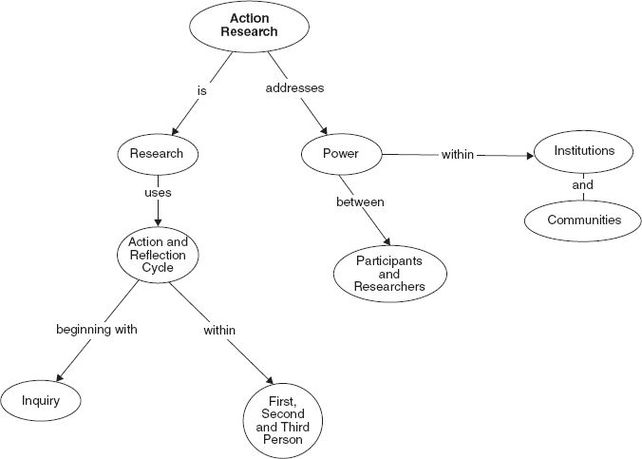
Concept mapping is a structured visual way to show the relationships among components within a knowledge domain. The map uses geometric shapes with connecting lines and words to diagram connections among the elements of a system. Concept maps give visual representation of the larger picture along with the more specific details. Words are used within the connecting lines to show the relationship between concepts. For example, if action research was the main concept at the top of the map, the connecting lines could say ‘addresses’, with links to the ideas of ‘power’, ‘collaborations’ and ‘ethics’ (see Figure 1). Mapping helps show how the construction of knowledge takes place by highlighting what individuals know about a topic in logical order, and it also highlights the relationship between themes. The linear progression between points on the map affords the ability to connect themes across disciplines, communities and constituents. Mapping is a versatile tool that can be used to show knowledge construction in all fields of learning. This entry explores the history of concept mapping and how it can be a useful tool for action researchers.
Figure 1 Concept Mapping
History of Concept Mapping
Concept maps were developed by Joseph Novak to shift learning in classrooms from rote learning to meaningful learning experiences rooted in a constructivist view of education. Concept maps in this context represent existing knowledge in addition to showing what students are currently learning. The process had the best results when students developed their own concept maps, compared with teachers’ pre-made maps. Concept mapping afforded an opportunity for students to take ownership of learning, investing more in the process of knowledge creation instead of just memorizing facts.
Concept mapping has been used in various disciplines and settings, including programme planning and evaluation, educational settings, computer science, community health, business development and community planning. The process is useful in group settings to help all involved see a topic or project in its entirety and therefore identify areas of strength and concern. Concept maps can also show what information is missing in learning and collaboration. In addition, mapping fosters creativity by helping people think about connections and relationships in a new way.
Action Research and Concept Mapping
As a tool for researchers and participants, concept mapping is useful in both individual and group action research projects to explore the development and relationships of various concepts, themes and ideas within the research. Concept mapping can be used to help refine and focus a project as well as to develop a general theme, sub-themes and a concept and/or question that relates to the research.
In collaborative settings, concept mapping can be used as a facilitation tool of knowledge construction within action research. Groups can use concept maps to develop questions and assessments, show knowledge generation and the development of ideas and highlight relationships among the ideas explored in the research. Concept mapping can be used in all the stages of an action research project, from planning to implementation of findings and reflection, to show what questions the research will examine, the voices of researcher-participants, outcomes and analysis of process. Concept mapping in the pre-stages of an action research project could help document the knowledge that the researcher or participants will bring to the project, helping to construct learning onto previous knowledge. Therefore, concept mapping can help with planning in action research by building on an idea and former knowledge to form areas of development and inquiry. The individually developed concept maps can help create a shared vision of the project as well as show the diversity of knowledge among the constituents.
...
- Biographies
- Alinsky, Saul
- Argyris, Chris
- Bateson, Gregory
- Boal, Augusto
- Chataway, Cynthia Joy
- Dewey, John
- Emery, Fred
- Fals Borda, Orlando
- Freire, Paulo
- Gadamer, Hans-Georg
- Horton, Myles
- Kincheloe, Joe
- Lewin, Kurt
- marino, dian
- Martín-Baró, Ignacio
- Nielsen, Kurt Aagaard
- Noffke, Susan
- Schön, Donald
- Toulmin, Stephen
- Whyte, William Foote
- Wittgenstein, Ludwig
- Concepts
- Vivencia
- Academic Discourse
- Agency
- Appreciative Intelligence
- Authenticity
- Bakhtinian Dialogism
- Bildung
- Communities of Practice
- Community of Inquiry
- Conscientization
- Critical Friend
- Critical Reference Group
- Dialogue
- Double-Loop Learning
- Empowerment
- Engaged Scholarship
- Hegemony
- Heteroglossia
- Heutagogy
- Identity
- Knowledge Democracy
- Metaphor
- Non-Indigenous Ally
- Organizational Culture
- Positionality
- Subalternity
- Sustainability
- Systems Thinking
- Tacit Knowledge
- Taylorism
- Technical Action Research
- Tempered Radical
- Transformative Learning
- Voice
- Epistemology
- Ethics
- Goals
- Methods
- Action Evaluation
- Advocacy and Inquiry
- Autobiography
- Bricolage Process
- Case Study
- Citizen Report Card
- Citizens’ Juries
- Cognitive Mapping
- Collaborative Data Analysis
- Community Dialogue
- Community Mapping
- Computer-Based Instruction
- Concept Mapping
- Conflict Management
- Convergent Interviewing
- Critical Reflection
- Democratic Dialogue
- Descriptive Review
- Development Coalitions
- Dialogue Conferences
- Digital Storytelling
- Discourse Analysis
- Fishbone Diagram
- Focus Groups
- Interviews
- Journaling
- Listening Guide
- Microplanning
- Multi-Stakeholder Dialogue
- Narrative Inquiry
- Organizational Storytelling
- Participatory Monitoring
- Photovoice
- Research Circles
- Search Conference
- Social Audit
- Stakeholder Analysis
- Storytelling
- World Café, The
- Methodologies
- Action Learning
- Action Science
- Anti-Oppression Research
- Appreciative Inquiry and Research Methodology
- Appreciative Inquiry and Sustainable Value Creation
- Arts-Based Action Research
- Asset-Based Community Development
- Citizen Science
- Classroom-Based Action Research
- Clinical Inquiry
- Co-Operative Inquiry
- Collaborative Action Research
- Collaborative Developmental Action Inquiry
- Collaborative Management Research
- Community-Based Participatory Research
- Community-Based Research
- Comprehensive District Planning
- Critical Action Learning
- Critical Participatory Action Research
- Critical Utopian Action Research
- Dialogic Inquiry
- Ethnography
- Evaluative Inquiry
- Feminist Participatory Action Research
- First Person Action Research
- Grounded Theory
- Indigenist Research
- Indigenous Research Methods
- Interactive Research
- Intervention Research in Management
- Large-Group Action Research
- Learning History
- Living Life as Inquiry
- Narrative
- Oral History
- Participatory Action Research
- Participatory Design Programming
- Participatory Governance
- Participatory Learning and Action
- Participatory Rapid Appraisal
- Participatory Rural Appraisal
- Participatory Theatre
- Participatory Urban Planning
- Performed Ethnography
- Practice Development
- Practitioner Inquiry
- Pragmatic Action Research
- Process Consultation
- Qualimetrics Intervention Research
- Quantitative Methods
- Reflective Practice
- Second Person Action Research
- Soft Systems Methodology
- Strategic Planning
- Strengths-Based Approach
- Systemic Action Research
- Systems Psychodynamics
- Theatre of the Oppressed
- Third Person Action Research
- Transpersonal Inquiry
- Work-Based Learning
- Youth Participatory Action Research
- Methodological Issues
- Cycles of Action and Reflection
- Data Analysis
- Disseminating Action Research
- Gender Issues
- Generalizability
- Information and Communications Technology and Organizational Change
- Integrating Grounded Theory
- Intersubjectivity
- Meta-Methodology
- Mode 1 and Mode 2 Knowledge Production
- Quality
- Reliability
- Rigour
- Transferability
- Validity
- Organizations and Movements
- Gonogobeshona
- Antigonish Movement
- Centre for Action Research in Professional Practice
- Collaborative Action Research Network
- Community Design Centres
- Community-Campus Partnerships for Health
- Community-University Partnership Programme
- Community-University Research Partnerships
- Cornell Participatory Action Research Network
- Dig Where You Stand Movement
- Disabled People’s Organizations
- Global Alliance for Community-Engaged Research
- Grameen Bank
- Highlander Research and Education Center
- Institute of Development Studies
- International Council for Adult Education
- International Participatory Research Network
- Jipemoyo Project
- LGBT
- Maya Women of Chajul
- Mondragón Co-Operatives
- Norwegian Industrial Democracy Movement
- Office of Community-Based Research
- Research Initiatives, Bangladesh
- Social Movement Learning Movement
- Society for Participatory Research in Asia
- Tavistock Institute
- Work Research Institute, The
- World Congresses of Action Research
- Philosophical Underpinnings
- Settings
- Action Anthropology
- Adult Education
- Agriculture and Ecological Integrity
- Community Development
- Criminal Justice Systems
- Design Research
- Development Action Research
- Educational Action Research
- Environment and Climate Change
- Evaluation
- Health Care
- Health Education
- Health Promotion
- Higher Education
- HIV Prevention and Support
- Human Rights
- Information Systems
- Insider Action Research
- Inter-Organizational Action Research
- Labour-Managed Firms
- New Product Development
- Nursing
- Operations Management
- Organization Development
- Participatory Disaster Management
- Project Management
- Regional Development
- Subaltern Studies
- Voluntary Sector
- Work-Family Interventions
- Workers’ Participation in Occupational Health and Safety
- Skills
- Spirituality
- Theories
- Tools
- Loading...
Get a 30 day FREE TRIAL
-
 Watch videos from a variety of sources bringing classroom topics to life
 -
Read modern, diverse business cases
-
Explore hundreds of books and reference titles

Read next

More like this
Sage Recommends
We found other relevant content for you on other Sage platforms.
Have you created a personal profile? Login or create a profile so that you can save clips, playlists and searches