
Entry
Entries A-Z
Whistle Stop
In the language of elections, the phrase whistle stop means to campaign by making brief appearances in many small communities. It originated with President Harry S. Truman's nationwide campaign by train in 1948.
Railroaders had long used the word whistle stop to mean a town too small for a regularly scheduled stop. To let passengers off, the conductor would have to pull the steam whistle cord to signal the engineer to stop.
Writer and former House member Ken Hechler, a West Virginia Democrat, recalled in his book Working with Truman: A Personal Memoir of the White House Years, that in Butte, Montana, Truman made one of his usual attacks on the Republican Congress. He particularly targeted one of its leaders, Sen. Robert A. Taft of Ohio, who had urged people to fight inflation by eating less. “I guess he would let you starve, I don't know,” Truman said.
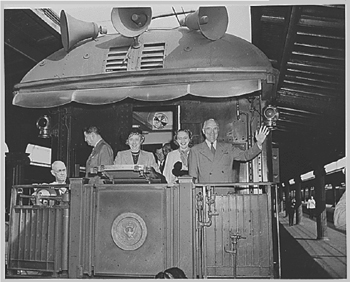
President Harry S. Truman popularized the whistle stop during the 1948 campaign. National Archives and Records Administration
Reported by the press, the remark stung Taft into responding with a speech castigating Truman for “blackguarding Congress at every whistle station in the West.” Truman and the Democrats struck back, accusing Taft of insulting Truman's campaign stops by implying they were backward, rural communities. In Los Angeles, Truman joked that the city was the biggest whistle stop he had made. He changed Taft's “whistle station” to “whistle stop” and the phrase stuck.
Truman went on to score an upset victory over New York governor Thomas A. Dewey, a Republican who according to the polls was almost certain to win.
Truman did not invent campaigning by train, however. In 1896 Democrat William Jennings Bryan traveled 18,000 miles and made 600 speeches while his opponent, Republican William McKinley, campaigned from his front porch in Canton, Ohio. McKinley won the election, though.
Tactics such as whistle-stop tours could be an effective means of communicating with voters even as late as 1948, before mass communication truly transformed the nature of campaigning. From inner-city wards to small rural communities, candidate visits, rallies, and parades were a form of entertainment as well as civic engagement.
The rise of the age of television, which was occurring even as Truman was campaigning, offered Americans other diversions and candidates a faster and more effective means of communicating with mass audiences. Since air transportation became the norm for presidential candidates, the whistle-stop tour has been supplanted by an exhausting travel schedule in which the candidates' stops often are no more than news conferences or small rallies at airports, held to provide footage for local television news stations rather than to engage individual voters.
In modern campaigning, most ground-transportation excursions are aimed at invoking a sense of nostalgia, political populism, or both. In 1992 buses replaced trains as the transportation mode of choice by Bill Clinton and his running mate, Al Gore. After the Democrats' national party convention, the candidates took off on an intercity bus version of Truman's whistle-stop tour. Boosted more by media attention to the tour than by its impact on the campaign trail, the Clinton-Gore ticket gained in the polls. Ultimately, the Democrats defeated the Republican ticket of President George H. W. Bush and Vice President Dan Quayle.
...
Get a 30 day FREE TRIAL
-
 Watch videos from a variety of sources bringing classroom topics to life
 -
Read modern, diverse business cases
-
Explore hundreds of books and reference titles

Read next

More like this
Sage Recommends
We found other relevant content for you on other Sage platforms.
Have you created a personal profile? Login or create a profile so that you can save clips, playlists and searches