
Entry
Entries A-Z
Voting Machines
For many years, there were essentially two methods for voting at polling places: the paper ballot, which voters marked and placed in a ballot box, and the mechanical voting booth, in which voters closed a curtain and registered their preferences by pushing levers.
The relatively recent advent of the electronic age has produced a series of computerized voting machines, each billed as more efficient, easier to use, and more effective at rapidly counting votes than the one before. But each technological innovation has brought with it a new set of complications and controversies, leaving election officials searching for the right solution through the early years of the twenty-first century.
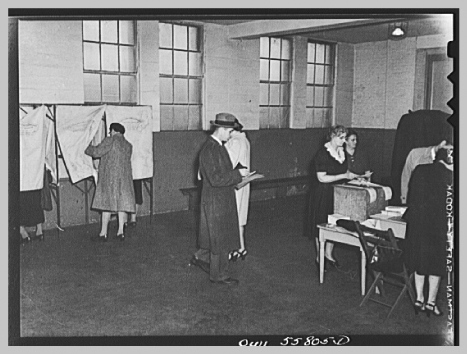
Voters in Arlington, Virginia, enter “Douglas collapsible” booths to cast their ballots in the 1944 national presidential election. Library of Congress
The search for reliable technology began in earnest following the close and controversial 2000 presidential election that discredited paper punch-card ballots, which in their day had been widely viewed as a great innovation. With the outcome of the extremely close vote in Florida set to determine the winner of the contest between Republican George W. Bush and Democrat Al Gore, voters across the nation watched as Florida election officials gazed at individual paper ballots, trying to determine whether a voter had attempted but failed to completely dislodge the tiny paper rectangle known as a “chad” that would enable his or her intended vote to be counted.
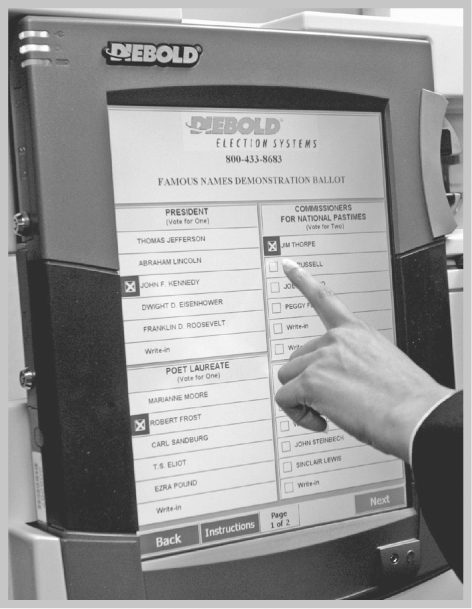
A Diebold Election Systems electronic voting machine is tested for touch-screen sensitivity. AP Images/Rogelio Solis
Controversy also arose over a poorly designed “butterfly ballot” used that year in Florida's Palm Beach County. The confusing layout and close proximity of the punch marks for different candidates led a number of voters to complain later that they had accidentally cast their ballots for the wrong candidate.
In response to these problems that threatened the integrity of the American election system and citizens' confidence that their votes would be counted accurately, Congress passed the Help America Vote Act of 2002, known by its acronym HAVA.
HAVA provided grants to states to voluntarily retire their paper-based punch-card and lever-machine voting systems and replace them with more reliable systems. In their haste to replace their machines, however, many states made expensive investments in electronic touch-screen devices that were new to the market and had not been thoroughly tested in actual elections. Moreover, some critics worried that the machines could be programmed by manufacturers or technicians or taken over by outside “hackers” to produce a desired partisan result.
Predictions of election-day disasters in 2006—of massive computer breakdowns or outright fraud—proved greatly exaggerated, leading manufacturers of electronic voting machines and many public officials to declare vindication. But across the nation there were thousands of reports of problems and glitches, many of them caused by unfamiliarity with the new technology among voters and poll workers (most of whom were volunteers and many of whom were elderly).
Two years later in the national elections of 2008, the nation experienced a drop in the use of electronic voting equipment, according to a study by Election Data Services, a political consulting firm in Washington, D.C. The percentage of registered voters using electronic voting equipment declined from 37.3 percent in 2006 to 32.6 percent in 2008. However, the use of optically scanned paper ballots continued to grow. In total, EDS said, 60 percent of the nation's counties in 2008 used optical scan systems, covering about 56 percent of registered voters. In 2000, only about 30 percent of registered voters used optical scan systems.
...
Get a 30 day FREE TRIAL
-
 Watch videos from a variety of sources bringing classroom topics to life
 -
Read modern, diverse business cases
-
Explore hundreds of books and reference titles

Read next

More like this
Sage Recommends
We found other relevant content for you on other Sage platforms.
Have you created a personal profile? Login or create a profile so that you can save clips, playlists and searches