
Entry
Entries A-Z
Voter Turnout
Voting participation by Americans is lower than in most democratic nations. Much was made after President Bill Clinton's relatively easy 1996 reelection victory of the fact that just 49 percent of the nation's voting-age population (the standard measure of turnout for many years) had actually cast votes. Participation in midterm congressional elections might be as low as a third of the voting-age population. Voting in local elections can often amount to a tiny fraction of the electorate.
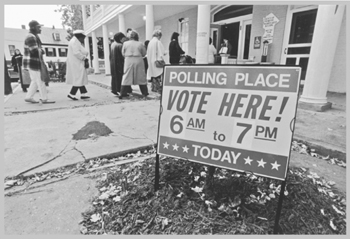
In the 2004 presidential elections, 60.3 percent of eligible voters cast ballots. CQ Photo/Scott J. Ferrell
Many political activists and analysts describe low voter turnout as a critical problem for the nation, a sign of a dangerous disconnect between Americans and their governing institutions. Nonprofit, nonpartisan groups alone spend millions of dollars on voter education and awareness drives to urge people to exercise their patriotic duty and preserve their self-interest by participating in the processes of democratic self-governance. And that is in addition to candidates' and partisans' exertions targeted at persuading people sympathetic to their causes to get out and vote.
There is a sizable faction among political scientists and others, however, that disagrees about the statistical dimensions of voter turnout and how big a problem it is. Some researchers have determined that using voting-age population as the baseline for measuring turnout provides an inaccurate and unnecessarily dire view of voting participation, because it includes millions of U.S. residents, such as noncitizens and most felons, who are not eligible to vote.
Closer Look

Scholars, journalists, and voting analysts have for years lamented what appeared to be a declining rate of voter turnout in elections, which they feared showed a national lack of interest in politics and in deciding which party would control governmental powers. Not everyone agrees.
Declining turnout analyses have traditionally used actual vote counts compared to the voting-age population (VAP), persons eighteen years and older. But the VAP number increasingly came under scrutiny as one of its components—immigrants of age but not U.S. citizens and therefore not eligible to vote—grew rapidly in the 1990s and after 2000. Scholars began to look at a turnout rate that showed votes cast in terms of the voter eligible population (VEP). To get a VEP, analysts removed from the VAP persons of legal age who are not eligible to vote because they are not citizens. Increasingly, the largest group was immigrants, but included others in prison, on probation, or mentally incapacitated. With this approach the turnout rate is higher than calculations using VAP.1
The figures in the table below were prepared by Professor Michael P. McDonald of George Mason University. He estimates that the average midterm turnout rate from 1974 to 2002 was 39.4 percent. His calculations include votes for House and Senate seats and for governor depending on which drew the highest number of votes.
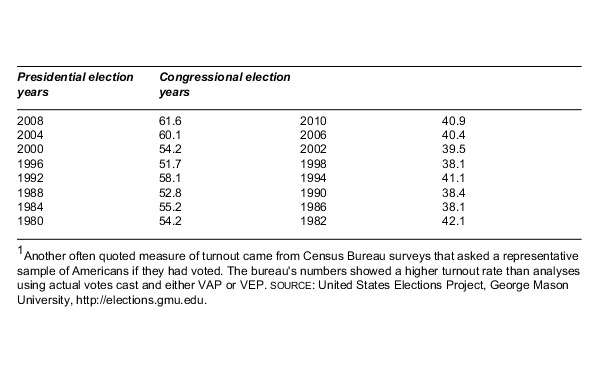
George Mason University political science professor Michael P. McDonald, who heads the United States Election Project, is prominent among those who believe that turnout should be measured as a percentage of the voting-eligible population, which excludes those who could not vote even if they wanted to. His calculations for the 2010 midterm elections showed that turnout was 40.9 percent of the voting-eligible population, compared with 36.8 percent of the voting-age population. The comparable figures for the 2008 presidential election were 61.6 percent of voting-eligible versus 56.8 percent of the voting-age population.
...
Get a 30 day FREE TRIAL
-
 Watch videos from a variety of sources bringing classroom topics to life
 -
Read modern, diverse business cases
-
Explore hundreds of books and reference titles

Read next

More like this
Sage Recommends
We found other relevant content for you on other Sage platforms.
Have you created a personal profile? Login or create a profile so that you can save clips, playlists and searches