
Entry
Entries A-Z
Running Mate
The wait for a presidential nominee to announce the name of a running mate has lost much of its suspense in recent years. Sometimes the person chosen was a rival in the primaries and caucuses where the top spot on the ticket was won. And the nominee may disclose the name early to gain maximum benefit from the announcement.
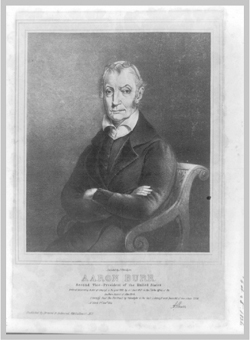
Aaron Burr became Thomas Jefferson's vice president by decision of the House of Representatives after the two candidates found themselves in a tie for electoral votes. The Twelfth Amendment was ratified soon thereafter, ushering in a new system of balloting for presidents and vice presidents. Library of Congress
But even a little suspense is more than there originally was in the completion of a presidential team. During the country's first years, the runner-up for the presidency automatically became the vice president.
That system did not last long. In 1800 Thomas Jefferson and Aaron Burr, though running together on the Democratic-Republican Party ticket, found themselves in a tie for electoral votes. Neither man's supporters were willing to settle for the lesser office. The deadlock went to the House of Representatives, where Jefferson needed thirty-six ballots to clinch the presidency, making Burr his vice president.
The unintended misfire of the Constitution's original method of presidential selection led to the Twelfth Amendment to the U.S. Constitution, ratified in 1804, providing for separate electoral college balloting for presidents and vice presidents. With the emergence of political parties by 1800, candidates ran as teams. Once national party conventions began in 1831, delegates, with the guidance of party bosses, began to do the choosing.
It was only in 1940 that presidential nominees began regularly handpicking their running mates. That year Democratic incumbent Franklin D. Roosevelt—the only president ever to run for a third and later a fourth term—rejected his two-term vice president, John Nance Garner, with whom he had a falling out. After failing to persuade Secretary of State Cordell Hull to run in Garner's place, Roosevelt forced Secretary of Agriculture Henry A. Wallace on a reluctant Democratic convention by threatening to refuse his own nomination if Wallace were rejected.
The only exception to the practice Roosevelt established came in 1956, when Democrat Adlai E. Stevenson left the choice up to the convention, which chose Sen. Estes Kefauver of Tennessee.
In an otherwise unique situation that in one way resembled Roosevelt's dropping Garner, President Gerald R. Ford found a new running mate in his unsuccessful 1976 election against Jimmy Carter. Neither Ford nor his vice president, Nelson A. Rockefeller, had been elected by popular vote. Both were elected by Congress under the Twenty-fifth Amendment—Ford as vice president when Spiro T. Agnew resigned in 1973 and Rockefeller as vice president in 1974 after Ford became president following Richard M. Nixon's resignation. To appease the party's right wing, with whom he had been unpopular, moderate Republican Rockefeller did not seek the vice presidency in 1976. Ford then chose a new partner, Sen. Bob Dole of Kansas, for the race to succeed himself in the presidency to which he had not been nationally elected.
...
Get a 30 day FREE TRIAL
-
 Watch videos from a variety of sources bringing classroom topics to life
 -
Read modern, diverse business cases
-
Explore hundreds of books and reference titles

Read next

More like this
Sage Recommends
We found other relevant content for you on other Sage platforms.
Have you created a personal profile? Login or create a profile so that you can save clips, playlists and searches