
Entry
Entries A-Z
Progressive Party (1948)
The iteration of the Progressive Party that emerged after World War II was founded by the strongly liberal Henry A. Wallace, vice president during Democrat Franklin D. Roosevelt's third term (1941–1945). The party resulted from the dissatisfaction of liberal elements in the democratic party with the leadership of President Harry S. Truman, particularly in the realm of foreign policy.
Truman, formerly a senator from Missouri, had replaced Wallace on the Democratic ticket when Roosevelt ran successfully for a fourth term in 1944. Roosevelt died in April 1945, and Truman succeeded him.
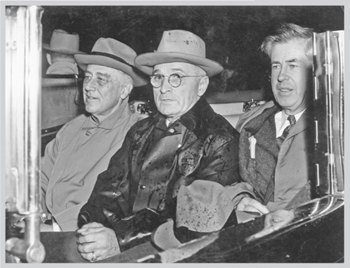
Henry A. Wallace, considered one of the most liberal idealists in the administration of Franklin Roosevelt, founded the Progressive Party because of dissatisfaction with the Democratic Party. Here, Wallace (right) appears with President Roosevelt (left) and Harry S. Truman in 1944. Harry S. Truman Library and Museum
The Democratic Party essentially split in three in 1948. Truman was nominated for a full term by the Democrats; liberals alienated by Truman's policy of using U.S. military power to contain the influence of the communist Soviet Union fostered Wallace's Progressive Party effort; while conservative southern elements, in a reaction to the early shifting of the Democratic Party toward a position of favoring civil rights advances for blacks, withdrew to form the segregationist states' rights democratic party, which nominated South Carolina governor Strom Thurmond for president.
Despite these impediments and poor poll numbers, Truman stunned political experts by winning reelection over Republican Thomas Dewey, with Thurmond and Wallace running well behind.
Wallace was secretary of agriculture before he served as vice president and was secretary of commerce afterward under President Franklin Roosevelt. He was considered one of the most liberal idealists in the Roosevelt administration. Fired from the Truman cabinet in 1946 after breaking with administration policy and publicly advocating peaceful coexistence with the Soviet Union, Wallace began to consider the idea of a liberal third-party candidacy. Supported by the American Labor Party, the Progressive Citizens of America, and other progressive organizations in California and Illinois, Wallace announced his candidacy in December 1947.
The Progressive Party was launched formally the following July at a convention in Philadelphia, which ratified the selection of Wallace for president and Sen. Glen H. Taylor, D-Idaho, as his vice presidential running mate. The party adopted a platform that emphasized foreign policy—opposing the Cold War anticommunism of the Truman administration and specifically urging abandonment of the Truman Doctrine of containment and the Marshall Plan that provided massive U.S. aid to rebuild noncommunist Europe. On domestic issues, the Progressives stressed humanitarian concerns and equal rights for both sexes and all races.
Particularly active in the party were members of groups—women, youth, blacks, Jews, Hispanics—who felt excluded or underrepresented in the political process. But the openness of the Progressives brought Wallace a damaging endorsement from the communist party, which had direct ties to the Soviet-directed international communist movement and favored the overthrow of the American government and capitalist system.
Professing that the two parties could work together, Wallace accepted the endorsement while characterizing his philosophy as “progressive capitalism.” But at a time of rising anticommunist agitation across the nation, this tacit alliance gave Wallace's critics ammunition to portray the Progressive Party as a left-wing front.
...
Get a 30 day FREE TRIAL
-
 Watch videos from a variety of sources bringing classroom topics to life
 -
Read modern, diverse business cases
-
Explore hundreds of books and reference titles

Read next

More like this
Sage Recommends
We found other relevant content for you on other Sage platforms.
Have you created a personal profile? Login or create a profile so that you can save clips, playlists and searches