
Entry
Entries A-Z
Political Party Development
Political parties are organizations that seek to gain control of government to further their social, economic, or ideological goals. The United States has usually had a two-party system, dominated since 1860 by the democratic and republican parties. Yet more than eighty political parties have formed since the 1790s, and third parties have occasionally had a decisive impact on presidential elections. For example, in 1912 the progressive–bull moose party of former president Theodore Roosevelt siphoned enough Republican votes from incumbent William Howard Taft to enable Democrat Woodrow Wilson to win the election.

“If I could not go to heaven but with a party, I would not go there at all.”
—Thomas Jefferson, 1789
The United States did not start out with a two-party system—or any parties at all. Initially there were no formal parties, and in the early 1820s the nation had in effect only one party. The founders did not anticipate parties—which they derisively called factions—and this central aspect of American politics was unplanned and had no formal constitutional or legal status. Indeed, having seen the ill effects of overzealous parties in monarchical England and (beginning in 1789) revolutionary France, the founders hoped to avoid similar pitfalls in the fledgling nation. Accordingly, in Federalist No. 10, James Madison bragged that one of the Constitution's great virtues was that it would head off “the mischiefs of faction.” In 1789 Thomas Jefferson declared: “If I could not go to heaven but with a party, I would not go there at all.” Similarly, in his farewell address in 1796, George Washington warned that in elective popular governments the dangers of excess in the “spirit of party” demanded “a uniform vigilance to prevent its bursting into a flame.”
By the time Washington issued his warning, he was the titular head of the federalist party, which faded after 1800 and, except for some local officeholders, was dead by 1821. Meanwhile, since 1794 Madison and Jefferson had been the leaders of another party, variously called the democratic-republicans, the Jeffersonian Democrats, and the Jeffersonian Republicans, but today understood as the kernel of what became the modern Democratic Party.
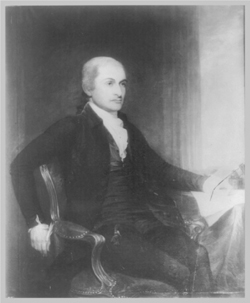
John Jay was a leader of the Federalist Party, one of the first two major political parties in the United States. The Federalists favored a centralized government and the creation of a national bank. Library of Congress
Political Issues and the Emergence of Parties
The debate over ratification of the Constitution led to the organization of factions but not parties. Future Democratic-Republicans and Federalists, such as Madison and Alexander Hamilton, worked together for ratification, just as future Democratic-Republicans and Federalists, such as James Monroe and Samuel Chase, worked against ratification of the Constitution. Ratification brought about a new national government, where parties were unknown. Presidential electors unanimously elected Washington as the first president, and nearly half of them supported Adams, who was easily elected vice president. Washington's cabinet included future leaders of the nation's first two parties: the future Federalist leader Alexander Hamilton and the future leader of the Democratic-Republicans, Thomas Jefferson.
By the end of Washington's administration, two parties were fully engaged in politics. The parties differed over the nature of public policy and the interpretation of the Constitution. The Federalists, led by Hamilton, John Adams, and John Jay, favored a national government vigorously involved in economic development. Key to the Federalist program was the establishment of a national bank, federal funding at face value of all state and national bonds issued during the Revolution, and a flexible interpretation of the Constitution. The Federalists also wanted to strengthen diplomatic and commercial ties with England.
...
Get a 30 day FREE TRIAL
-
 Watch videos from a variety of sources bringing classroom topics to life
 -
Read modern, diverse business cases
-
Explore hundreds of books and reference titles

Read next

More like this
Sage Recommends
We found other relevant content for you on other Sage platforms.
Have you created a personal profile? Login or create a profile so that you can save clips, playlists and searches