
Entry
Entries A-Z
One Person, One Vote
State legislatures had no constitutional obligation before 1960 to aim at equal populations in drawing legislative and congressional districts. In a series of rulings in the 1960s, however, the Supreme Court held that “substantially equal legislative representation” was a “fundamental principle” under the Constitution. The doctrine, at first known as “one man, one vote” even though the opinion says “one person, one vote,” forced legislatures and federal courts to be precise in adjusting the populations of legislative and congressional districts.
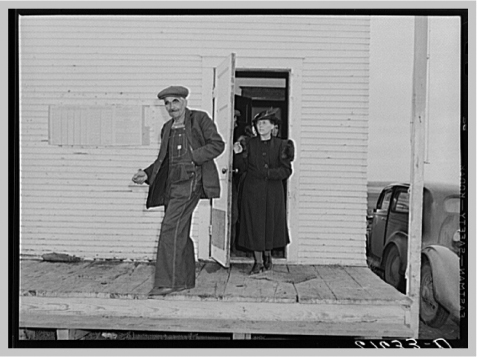
A voter leaves a schoolhouse in rural North Dakota after voting in 1940. Prior to the one person, one vote rulings of the 1960s, state legislatures were not required to draw election districts based on population, and certain districting systems afforded more weight to a rural vote than its counterpart in the city. Library of Congress
The rulings answered the question left open in the Court's first modern reapportionment decision, baker v. carr , in 1962: What standard do federal courts apply in judging the constitutionality of legislative districts? A year later, the Court articulated the one-person, one-vote doctrine in a Georgia case, Gray v. Sanders, that challenged the state's county-unit primary system for electing statewide officials.
Georgia officials insisted that the system—which weighted votes to give advantage to rural districts—was analogous to the Electoral College system for choosing the president. But the Court rejected the argument.
In 1964, the Court applied the same principle to congressional and legislative districting. The first of the decisions came in another Georgia case, Wesberry v. Sanders. Voters in the congressional district that included Atlanta claimed in the suit that the population of their district was more than twice the ideal state average. Writing for a 6–3 majority, Justice Hugo L. Black said that the provision in Article I of the Constitution that members of the House of Representatives be chosen “by the People of the several States” implicitly established the principle of “equal representation for equal numbers.”

“The conception of political equality from the Declaration of Independence, to Lincoln's Gettysburg Address, to the Fifteenth, Seventeenth, and Nineteenth Amendments can mean only one thing—one person, one vote.”
—Justice William O. Douglas, in Gray v. Sanders (1963)
Four months later, on June 15, 1964, the Court held that the same principle also applied, under the Equal Protection Clause, to both chambers of bicameral state legislatures. The ruling in Reynolds v. Sims rejected the argument that a state, by analogy to the federal system, could constitute one house of its legislature on the basis of population and the other on an area basis. “Legislators represent people, not trees or acres,” Chief Justice Earl Warren wrote. Harlan was the lone dissenter.
Over the next few years, the Court interpreted the principle to require legislatures to be “as nearly as practicable” equal. In 1969, for example, the Court rejected a Missouri congressional districting plan with a 3.1 percent population variance between districts.
In recent years, particularly since computer technology advances have permitted exacting precision in drawing district lines, the courts have come to demand nearly perfect population equality among congressional districts. The degree to which this principle has become enshrined was evident in 2002, when a federal district court ruled that officials in Pennsylvania—a state that had a population of 12,291,054 according to the 2000 census—had violated the one person, one vote principle, even though the differential between the most populous and least populous among the state's nineteen congressional districts was just nineteen people.
...
Get a 30 day FREE TRIAL
-
 Watch videos from a variety of sources bringing classroom topics to life
 -
Read modern, diverse business cases
-
Explore hundreds of books and reference titles

Read next

More like this
Sage Recommends
We found other relevant content for you on other Sage platforms.
Have you created a personal profile? Login or create a profile so that you can save clips, playlists and searches