
Entry
Entries A-Z
National Party Conventions
National conventions remain major public relations and mobilizing events for the political parties. They conclude the presidential nominating process with extravaganzas of color, socializing, and occasional—though increasingly rare—drama, sometimes centering on the nominees' selection of their vice presidential running mate.
What the conventions have not had for more than four decades is a consequential role in choosing the major parties' presidential nominees—which was the major role of these gatherings from their emergence in the 1830s through the 1960s.
presidential selection reforms that emerged from the political ferment of the 1960s aimed at shifting the power to select nominees from party bosses to rank-and-file voters by making primaries and open caucuses the main modes of allocating delegates among the candidates seeking the nomination. While it remains technically possible for candidates to split the delegate votes evenly enough to deprive any one candidate of a sure majority—thus sending the contest to the convention for the final decision—it has yet to happen. The increasing practice of crowding primaries and caucuses into the earliest weeks of the nominating process, known as front-loading, has consistently provided huge advantages to the best-known and best-funded candidates. Winning in the early contests usually tends to give the front-runner momentum, or a bandwagon effect, that quickly becomes unstoppable.
In 2000, when the nomination was up for grabs in both parties, Republican George W. Bush and Democrat Al Gore each had enough delegates to win their nominations by early March. The same was true of Democrat John Kerry in 2004, a year in which Bush, seeking a second term, had no competition for the Republican nod.
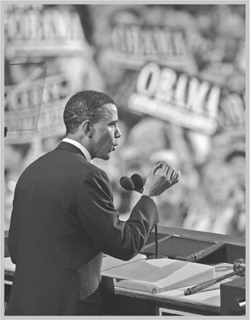
Barack Obama, then a candidate for the U.S. Senate, delivers the keynote address to delegates during the 2004 Democratic National Convention in Boston. AP Images/Kevork Djansezian
In 2008—when the nomination for both parties was open—Republicans settled early on their nominee, Arizona senator John McCain. Democrats, however, went through the full primary and caucus season, from January to June, before the selection of Barack Obama as nominee was fully settled. Obama was engaged in a spirited competition was former first lady and New York senator Hillary Rodham Clinton throughout the period. Although the contest ran into June, analysts noted that by late winter Obama had gathered enough convention delegates—in both primaries and caucuses—that he had all but locked up the nomination because not enough delegates remained in the later contests to give Clinton a realistic chance to catch up.
Obama then was nominated on the first ballot when Clinton asked the convention to suspend voting by state and name him by acclamation. In fact, since 1952 every Democratic and Republican nominee for president has been nominated on the first ballot.
The delegates to the modern conventions do perform some substantive business—such as ratifying the presidential nominee's vice presidential choice, agreeing upon a statement of party principles and issue stances or platform, and voting on various changes to national party rules.
Occasionally a new political star will emerge from the dozens of speeches that pack each convention's schedule. A recent example of this was Obama, who gave the keynote address to the 2004 Democratic National Convention in Boston. Then a state senator and the Democratic nominee for an open U.S. Senate seat, Obama delivered a dynamic and moving speech that electrified television audiences; that November, he won a landslide victory in his Senate race. Still riding the wave of popularity and publicity that his convention speech generated, he entered and eventually won the 2008 contest for the party's presidential nomination even though at the start he was considered an underdog to Clinton.
...
Get a 30 day FREE TRIAL
-
 Watch videos from a variety of sources bringing classroom topics to life
 -
Read modern, diverse business cases
-
Explore hundreds of books and reference titles

Read next

More like this
Sage Recommends
We found other relevant content for you on other Sage platforms.
Have you created a personal profile? Login or create a profile so that you can save clips, playlists and searches