
Entry
Entries A-Z
Fusionism
In modern American politics the term fusionism—meaning candidates running under several party labels at the same time—is associated chiefly with New York. State law there permitted multiple-party nominations after other states prohibited them.
For most of the twentieth century the Democratic machine known as Tammany Hall so dominated New York City politics that reform candidates had little chance of election unless they formed a coalition with other parties. Between 1901 and 1933 New Yorkers elected three fusion mayors, in addition to two elected in the late 1800s.
The most famous of the five was Fiorello La Guardia, a Republican who won in 1933 with 446,833 votes in the Republican column and 421,689 in the City Fusion Party column; under New York's recognition of fusion candidates, his votes on those separate lines were tallied together. La Guardia was reelected in 1937 and 1941, but in those elections the City Fusion Party votes added insignificantly to his victory margin.
Though the last Fusion Party candidate appeared on New York mayoral ballots in 1957, the state has maintained a tradition of active alternative parties by continuing to allow votes cast for major-party nominees endorsed by those third parties to be included in their vote totals. For example, the state's Conservative Party gives its line on the ballot for most offices to the nominee of the Republican Party.
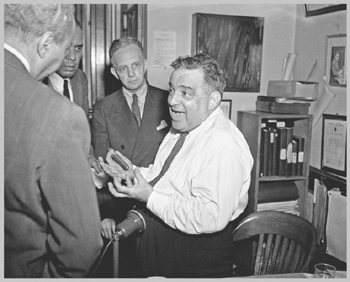
Fusion Party candidate Fiorello La Guardia, right, served as mayor of New York City from 1934 to 1945. AP Images
It is unclear whether those codesignations add a significant number of votes to the candidate's bottom line, or if they mainly provide another symbolic option for voters who would have supported that major-party candidate anyway.
As in New York, third parties find it advantageous to ally themselves with another party in nominating a candidate. But because cross-filing and fusionism tend to weaken party identification by voters, the political parties that dominate the American two-party system often exert pressure to have state legislatures prohibit such practices.
The Supreme Court, however, has upheld an antifusion statute similar to those on the books in most states. The Court ruled in a 1997 Minnesota case, McKenna v. Twin Cities Area New Party, that the state's ban on fusionism does not interfere with the free association rights of third-party members. A federal district court had held that the prohibition on multiple-party nominations violated the First Amendment.
Fusionism is related to the practices of cross-filing (seeking the nomination of more than one party) and cross-endorsing (a party's endorsing of another party's candidate). (See party endorsement of candidates.)

California permitted cross-filing until 1959. In 1946, for example, Republican governor Earl Warren also won the Democratic nomination and easily won reelection.
Fusionism has made some rare appearances in presidential politics. In 1900 the Democratic nominee for president, William Jennings Bryan, was also the candidate of the Populist (People's) Party's Fusionist Faction. The Populists' Anti-Fusionist Faction opposed joining with the Democrats in 1896 and ran its own candidate, Wharton Barker, in 1900. Republican William McKinley defeated Bryan in both elections.
...
Get a 30 day FREE TRIAL
-
 Watch videos from a variety of sources bringing classroom topics to life
 -
Read modern, diverse business cases
-
Explore hundreds of books and reference titles

Read next

More like this
Sage Recommends
We found other relevant content for you on other Sage platforms.
Have you created a personal profile? Login or create a profile so that you can save clips, playlists and searches