
Entry
Entries A-Z
Delegates
The process of selecting delegates to the national party conventions has changed dramatically since 1968. Most delegates of both major parties now win their seats through presidential primary elections—a development that has vastly enhanced the influence of rank-and-file voters in choosing the party's nominee and greatly diminished the influence of party leaders.
Although the democratic party spearheaded the transformation with formal rules changes requiring broader representation of women and minorities, the proliferation of primaries also has affected the republican party's delegate selection process.
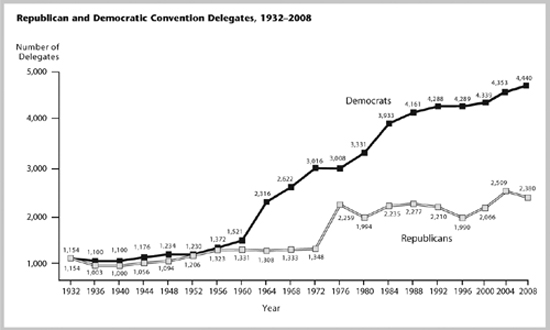
Only 116 delegates from thirteen states attended the first national nominating convention held by the anti-masonic party in 1831, but with the addition of more states and the adoption of increasingly complex voting-allocation formulas by the major parties, the size of conventions spiraled, especially since the 1960s. The expanded size reflected the democratization of modern conventions, with less command by a few party leaders and dramatic growth among youth, women, and minority delegations. (See Republican and Democratic Convention Delegates, 1932–2008, this page.)
With the larger size of conventions has come a formalization in the method of delegate selection, which at first was often haphazard. At the Democratic convention in 1835, for example, Maryland had 188 delegates to cast the state's ten votes. In contrast, Tennessee's fifteen votes were cast by a traveling businessman who happened to be in the convention city at the time.
In those days delegates were handpicked by party leaders, and nomination deals often were made in so-called smoke-filled rooms off the convention floor. More recently, under the caucus system, delegates were named at state party conventions. Some states, notably Iowa, still hold caucuses, but since the early twentieth century the trend has been toward the use of primaries to choose delegates and allow party members to vote their presidential preference. (See iowa caucus.) Nevertheless, the continued dominance of conventions by party bosses prompted calls for changes in the way delegations were formed.
Democratic Rules Changes
The presidential selection reforms were an aftermath of the violence-marred 1968 Democratic convention in Chicago. That convention nominated Vice President Hubert H. Humphrey over antiwar activist Sen. Eugene J. McCarthy of Minnesota even though Humphrey had not participated in a single primary. State delegations that opposed Humphrey felt excluded. They complained that the delegate-selection process was unfair and that party leaders had manipulated the outcome of the convention.
As a result, in February 1969 the party established the Commission on Party Structure and Delegate Selection, chaired by Sen. George S. McGovern of South Dakota and later by Rep. Donald M. Fraser of Minnesota. (The commission came to be known as the McGovern-Fraser Commission.) A little more than a year later, the commission issued eighteen detailed guidelines to be followed in the state delegate-selection process.
The mandatory guidelines condemned discrimination due to race, color, creed, sex, or age and required that affirmative steps be taken to give delegate slots to women, minorities, and young people in proportion to their population in each state. They also barred restrictive fees and petition requirements for delegate candidates. The guidelines banned the unit rule, followed by the party since its inception, under which all delegates representing a state had to vote as the majority of their delegation voted. They also limited the influence of party committees in the selection of convention delegates.
...
Get a 30 day FREE TRIAL
-
 Watch videos from a variety of sources bringing classroom topics to life
 -
Read modern, diverse business cases
-
Explore hundreds of books and reference titles

Read next

More like this
Sage Recommends
We found other relevant content for you on other Sage platforms.
Have you created a personal profile? Login or create a profile so that you can save clips, playlists and searches