
Entry
Entries A-Z
Blue Dog Democrats
The Blue Dog Coalition of conservative and centrist House Democrats was formed in the wake of the party's sweeping losses in the 1994 midterm elections, in which the Republican Party took control of both the House of Representatives—for the first time in forty years—and the Senate.
The 1994 elections took a particular toll on Democrats from conservative-voting areas, especially in the South, a region where the Republicans had already eroded the Democrats' long-standing dominance. Republicans widely targeted Democrats in these areas by seeking to tie them to a national Democratic Party that the GOP described as too liberal.
The Blue Dogs emerged as part of an effort to stem that trend. They attempted to impress upon voters that there was a viable conservative wing of the congressional Democratic Party and persuade the more liberal party leadership that conservatives needed to play a bigger role in Democratic agenda setting.
The coalition took its name from a series of quirky paintings by New Orleans artist George Rodrigue featuring a wide-eyed blue dog; a piece showing the blue dog in front of the U.S. Capitol became the group's logo. But the name also was a play on “yellow dog Democrat,” an old expression from the days of the Democratic “Solid South.” The label referred to a party loyalist who would vote for a yellow dog rather than a Republican, whose party was reviled for decades in the South because of its association with Abraham Lincoln and the Civil War.
The Blue Dog Coalition faced an almost immediate setback, as five of its initial twenty-one members switched parties in 1995 to join the new House Republican majority. The Blue Dogs also struggled to achieve the bipartisan outreach on issues such as a balanced federal budget that they had hoped would temper some of the more hard-line conservative objectives of the congressional Republican leadership.
Republican gains in the South played a major role in the party's takeovers of the U.S. House and Senate in the 1994 election and subsequent dominance over the next dozen years. The diminished numbers of southern Democrats in Congress also dramatically altered the once-formidable conservative coalition they had formed with Republicans. The GOP determined it could achieve most of its goals without the votes of the Blue Dogs and other conservative Democrats and focused its efforts on maintaining party unity rather than reaching out to potentially sympathetic Democrats. That marginalization led some political scientists to dismiss the conservative coalition as a remnant of the era when the South was largely a one-party Democratic monolith.
Closer Look

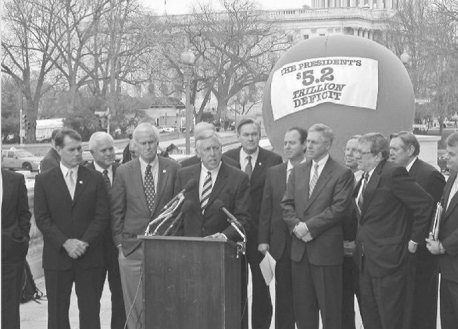
Democratic whip Steny Hoyer and the Blue Dog Coalition denounce the ballooning federal deficit on March 18, 2004. Office of the Majority Leader, Steny Hoyer
The Blue Dog Coalition of Democrats, founded in 1995, had a strongly southern cast in its early years. But as members reached out to other Democratic colleagues who shared their core value of fiscal responsibility, the coalition's roster took on a more national perspective. Its lineup of forty-three members in mid-2007—shortly after the Democrats took control of the House following their victory in the 2006 elections—included just eighteen members from southern states. The group increased to more than fifty with the next election but suffered catastrophic losses in 2010 when Republicans, winning a net of sixty-three seats and House control, reduced its membership to twenty-six.
...
Get a 30 day FREE TRIAL
-
 Watch videos from a variety of sources bringing classroom topics to life
 -
Read modern, diverse business cases
-
Explore hundreds of books and reference titles

Read next

More like this
Sage Recommends
We found other relevant content for you on other Sage platforms.
Have you created a personal profile? Login or create a profile so that you can save clips, playlists and searches