
Entry
Entries A-Z
Absentee Voting
Absentee voting is the term that describes casting a ballot by some means other than in the polling booth on election day. The procedure is increasingly referred to as early voting, which involves two main types of voter choice: early in-person (EIP) and voting by mail (VBM). Both are intended to allow a voter who cannot be at a voting booth on election day to cast a ballot that can be verified as legitimate.
Absentee voting began during the Civil War when Union soldiers were caught up in the political struggle and, with President Abraham Lincoln's encouragement, wanted to participate in the elections back home. But until quite recently, the practice of absentee voting was quite limited in the United States.
Seeking in many cases to maintain the tradition of a single voting day, and concerned about the possibility of fraud in ballots marked without oversight by election officials, many states required voters to explain why they would be unable to get to the polls on election day—excuses could include business travel, illness, military duty, and vacation—and some even required voters to sign affidavits.
Such requirements no longer exist in most states. With many states and voting participation advocates seeking ways to reverse a long-term decline in turnout, there has been a major expansion and liberalization of absentee voting, in which voters mail in their marked ballots or drop them off with state election officials by a designated date, and early voting, in which states and localities set up designated sites where voters can cast their votes in the weeks before election day.
However, by 2011 some states were changing their election laws to restrict voting outside the polling booths on election day. In legislative sessions in 2011 some states approved or were debating shortening the time period in which absentee voting could occur. The changes were aimed principally at early voting procedures by allowing fewer days before the regularly scheduled election. Florida, for example, reduced early voting days to seven from fourteen and Georgia to twenty-one from forty-five.
Closer Look

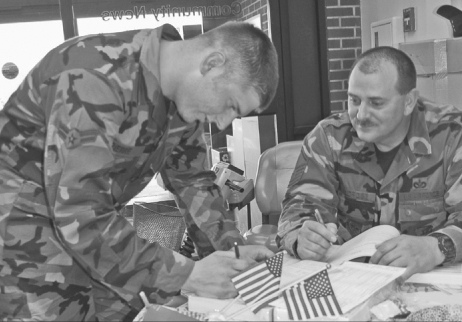
Airmen at the Grand Forks Air Force Base request absentee ballots on September 7, 2006. Courtesy photo, Grand Forks Air Force Base website
Absentee voting in the United States began during the Civil War, when President Abraham Lincoln supported Union soldiers in their desire to participate in elections. Absentee voting procedures for active-duty military personnel were essentially ad hoc until World War II, which ended the nation's isolationist foreign policy tendencies and led—at the time and in the following decades—to the stationing of large numbers of American troops overseas. This led to legislation to protect the absentee voting rights of military personnel under the Federal Voting Assistance Act of 1955 and the Uniformed and Overseas Citizens Absentee Voting Act. In 2009 Congress passed the Military and Overseas Voter Empowerment Act following reports of lost or late ballots and burdensome procedures to register and obtain ballots.
Advocates of the changes said tighter restrictions were needed to protect against voting fraud, but critics charged they were designed largely to limit ballot access by certain voter groups, especially ones who typically voted Democratic. The critics, primarily Democrats, said the changes were initiated largely by Republican-controlled legislatures with support from GOP governors to make voting more difficult for Democratic constituencies.
...
Get a 30 day FREE TRIAL
-
 Watch videos from a variety of sources bringing classroom topics to life
 -
Read modern, diverse business cases
-
Explore hundreds of books and reference titles

Read next

More like this
Sage Recommends
We found other relevant content for you on other Sage platforms.
Have you created a personal profile? Login or create a profile so that you can save clips, playlists and searches