
Entry
Entries A-Z
Voting Rights Act
Passage of the Voting Rights Act of 1965 authorized direct federal action to help African Americans register and vote. Earlier black suffrage legislation required affected groups or individuals to seek court action to obtain the rights being protected.
Other than the Fourteenth Amendment to the Constitution, which guaranteed equal protection of the laws, perhaps no single document matched the Voting Rights Act in righting the wrongs of discrimination against the descendants of slaves. Within months of the act's passage, a million southern black voters had been added to the rolls. And within a few years black elected officials numbered in the thousands, mostly in the South.
President Lyndon B. Johnson pushed through the bill over the strenuous states' rights opposition of southern delegations in Congress. He signed it into law on August 6, 1965.
The act suspended the use of literacy tests and similar devices that had been used to keep African Americans from voting. It authorized the U.S. attorney general to supervise elections in states and their political subdivisions where voting registration had fallen below 50 percent or where the voter turnout was below that level in the 1964 presidential election.
Initially, the act brought the federal machinery to bear in seven states, mostly in the South—Alabama, Georgia, Louisiana, Mississippi, South Carolina, and Virginia; the seventh was Alaska. Parts of Arizona, Idaho, and North Carolina were included, and other states were later brought under the act's provisions. By 1989 it covered all or parts of sixteen states.
AP photo
Pressure for Enactment
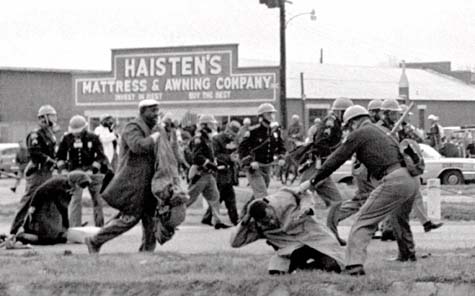
Impetus for the Voting Rights Act came from events in Selma, Alabama, on March 7, 1965, when state and local election officials interfered with African American demonstrations against discriminatory voting practices. Led by Martin Luther King Jr., civil rights activists set out to march from Selma to the capital at Montgomery. They hoped to dramatize their drive to register voters in Dallas County, where only 2.1 percent of the eligible black voters were on the rolls.
Six blocks into the fifty-mile march the civil rights demonstrators were confronted by police and white protesters. When the marchers tried to retreat, they were clubbed and teargassed as national news media televised the scene.
Ten days later, on March 17, President Johnson went before Congress to deliver a tough new voting rights bill. Adopting the slogan of the civil rights movement, Johnson vowed, “We will overcome.”
Johnson and his predecessor, John F. Kennedy, had been under pressure from black leaders since the 1960 election. Kennedy's narrow victory over Richard Nixon had been achieved with crucial help from black voters, who were growing impatient for help in return. The 1963 assassinations of Mississippi civil rights leader Medgar Evers and Kennedy himself added impetus to the black leaders' efforts.
The Kennedy and Johnson administrations had won passage of civil rights acts banning discrimination in areas of public accommodation such as hotels, restaurants, and theaters. The new laws also brought minorities somewhat closer to realization of their right to vote. For example, a 1960 law authorized the appointment of federal officials to monitor elections. And the 1964 Civil Rights Act eased procedures for federal authorities to look into voting rights cases. Also, the Twenty-fourth Amendment (1964) banned the use of poll taxes in federal elections.
...
Get a 30 day FREE TRIAL
-
 Watch videos from a variety of sources bringing classroom topics to life
 -
Read modern, diverse business cases
-
Explore hundreds of books and reference titles

Read next

More like this
Sage Recommends
We found other relevant content for you on other Sage platforms.
Have you created a personal profile? Login or create a profile so that you can save clips, playlists and searches