
Entry
Entries A-Z
Voter Registration
To guard against abuses of the American electoral system, states employ a number of devices designed to restrict voting within their jurisdictions to persons legally entitled to do so. Chief among these protections is the voter registration process.
The need for such a system is a reflection of America's growth in population and diversity. According to the Federal Election Commission (FEC), there were 156.4 million registered voters in 2000, or 76.0 percent of the voting-age population. However, just more than two-thirds of registered voters actually went to the polls in the presidential election.
When the United States was primarily a rural nation, its scattered communities were small and most people knew each other. Voting was a relatively simple matter: a voter simply had to show up at the polls, be recognized by the election judges, and cast his ballot. If he were challenged, he could either sign or mark an affidavit that swore to his qualifications or produce other voters who were recognized from the area to attest to his standing. (At that time, women's suffrage had not come into existence, so all voters were men.)
But toward the end of the nineteenth century, the country had ceased to be rural in nature. The growth of cities and their concentrations of people made the simple system of voter recognition and approval, while still workable in some places, impractical and highly susceptible to fraudulent voting practices.
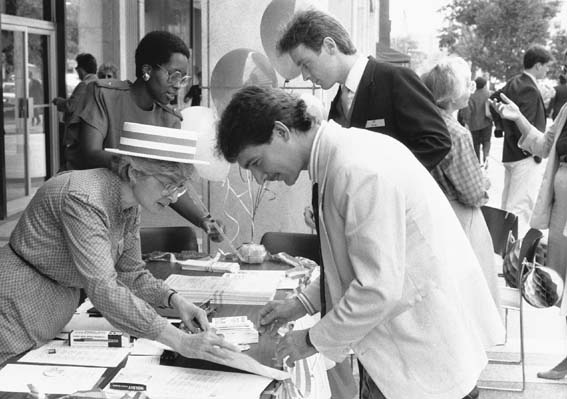
Courtesy of League of Women Voters
In the urban areas, practices such as “repeating” (casting ballots at multiple polling places) and “voting the graveyard” (using the names of dead people to cast ballots) became commonplace. As the franchise grew, sheer numbers of voters outweighed the ability of election judges to know who was eligible to vote and who was not. States began to turn to systems of registering voters, and by the beginning of the twentieth century, all the states had a type of registration in place and working. When women gained the right to vote, more names were added to the burgeoning rolls.
Fraud Protection
The overriding purpose of the registration systems, whatever their particularities, is to ensure that votes are cast only by eligible voters. To thwart the election day schemes of the unscrupulous, all the systems provided a register, prepared in advance, of all voters in a given district eligible to vote in that election. This roster, while not a complete protection against election fraud or corrupt election judges, offers some assurance that, in almost every situation, eligibility questions have been answered and that a voter duly listed on the rolls can vote when he or she reaches the polls. With passage of the voting rights act of 1965, virtually all bars to voting eligibility disappeared. (See Black suffrage.)
The states employ a variety of registration systems, but all follow one of two basic approaches. The first is the periodic system, in which the existing voting rolls are cast aside at certain stipulated periods and new lists are drawn up, requiring voters to reregister. The second is the permanent system, under which the same list of voters is used indefinitely, with legally specified types of updates regarding additions and deletions of voters' names. Because the permanent system offers states some savings in time and money, and also because it appears to be more immune to fraudulent practices, it is the preferred choice.
...
Get a 30 day FREE TRIAL
-
 Watch videos from a variety of sources bringing classroom topics to life
 -
Read modern, diverse business cases
-
Explore hundreds of books and reference titles

Read next

More like this
Sage Recommends
We found other relevant content for you on other Sage platforms.
Have you created a personal profile? Login or create a profile so that you can save clips, playlists and searches