
Entry
Entries A-Z
Third Parties
Despite heavy odds, third parties have tried from time to time to make headway against the United States' two-party system. For the most part, it has been a losing cause. The system favors the dominant political organizations, which for more than a century have been the Democratic and Republican Parties.
Never in that time has an independent or third-party candidate won the presidency. Only twice since 1832 have third parties or independents won more than 20 percent of the popular vote in presidential elections. Eight times they have won 10 percent or more, most recently in 1992.
Third parties and independents have been somewhat more successful at lower levels, electing some members of Congress, governors, mayors, and other state or local officials.
Ballot access and campaign finance laws, the electoral college system, as well as tradition and mainstream party loyalties all make it difficult for third parties to organize and survive. Most are born of short-term conflict and dissatisfaction with the major parties, and most die quickly.
The biggest exception to this rule occurred in the 1850s, when antislavery sentiments helped the Republican Party to grow quickly from a new third party in the 1850s into the second major party, replacing the Whigs. Six years after its founding the GOP elected a president, Abraham Lincoln, in 1860. The older Democratic Party traces its origins back to Thomas Jefferson's Democratic-Republican Party.

David Alfaya
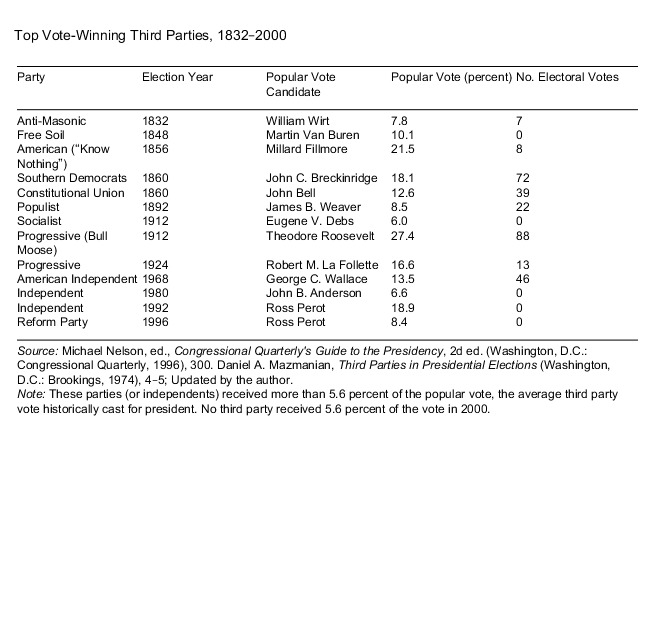
Third parties occasionally have influenced elections despite their small share of the vote. For example, in 1848 the Liberty Party, a movement dedicated to the abolition of slavery, received less than 3 percent of the popular vote and no electoral votes. Yet the party drained enough votes from the whig Party to guarantee the election of Democratic candidate James K. Polk.
In 1912 Theodore Roosevelt's Bull Moose Party divided Republicans, enabling Woodrow Wilson to capture the presidency despite receiving just 41.8 percent of the vote. And in 2000 Green Party nominee Ralph Nader—supported by just 2.7 percent of the electorate—apparently diverted enough Democratic voters to give the election to George W. Bush.
From time to time, there has been concern that a third-party presidential candidate would attract enough votes to throw the election into the House of Representatives. When none of the presidential candidates wins a majority of the votes in the electoral college, the election automatically goes to the House for decision. In 1968, when Alabama governor George C. Wallace ran as the standard bearer of the American Independent Party, it was feared that he would win enough southern states to deny either of the major-party candidates victory in the electoral college. But the Republican candidate, Richard Nixon, managed to outpoll Wallace in several southern states and win a solid electoral vote majority. (See Campaign strategies.)
More recently, in 1992, it seemed that the independent presidential candidacy of Texas billionaire Ross Perot might draw enough votes from President George Bush or Democratic challenger Bill Clinton to throw the election to the House. Perot himself gave that as one of his reasons for temporarily dropping out of the race. In the end Perot drew 18.9 percent of the popular vote, the largest ever for an individual, but he won no electoral votes.
...
Get a 30 day FREE TRIAL
-
 Watch videos from a variety of sources bringing classroom topics to life
 -
Read modern, diverse business cases
-
Explore hundreds of books and reference titles

Read next

More like this
Sage Recommends
We found other relevant content for you on other Sage platforms.
Have you created a personal profile? Login or create a profile so that you can save clips, playlists and searches