
Entry
Entries A-Z
Recount
Most elections produce decisive results. In the relatively few that do not, the apparent loser may demand a recount, officially creating a contested election.
Recount procedures vary by state, often by county, and sometimes by voting precincts within counties. Close elections in about a dozen states automatically trigger a recounting of the regular and absentee ballots, a process that can take many weeks in a large state. Unlike voting machine ballots that can be tallied quickly, ballots that are marked in other ways can be difficult to retally. Absentee ballots must be verified as genuine and counted one by one.
Not everyone can initiate a recount. In most cases where they are not automatic, recounts can be requested only by the defeated candidate, as the interested party. State officials or the courts may order a recount if there is a possibility that election fraud corrupted the results.
Because states share the conduct of presidential and congressional elections with the federal government, state policies vary concerning jurisdiction over federal elections. Some states assert their authority over them, others prefer minimal involvement. For its part, the federal government generally leaves all the procedural aspects of elections to the states—voter registration, preparation of the ballot, operation of the polling places, counting of the votes, and recounts if necessary. In the Voting Rights Act of 1965, however, the federal government asserted its power to supervise elections in states where discrimination against minority voters is indicated. (See State and federal election responsibilities.)
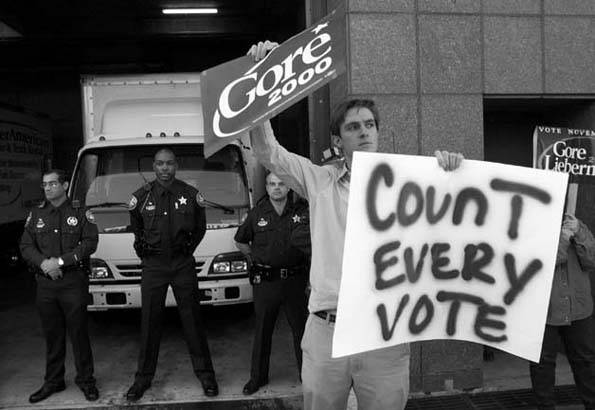
Tami Chappell, Reuters
Federal authorities do not recount the popular vote, even in disputes over congressional races. The states do the recounting and certify the winner to the House or the Senate. If the certified result is still in dispute, the affected body may investigate under its constitutional power to judge the qualifications of its own members. (See House of Representatives, qualifications; Senate, qualifications.)
The complexity of recounting votes became front-page news in the presidential election of 2000. Many counties in Florida, a state key to the electoral fortunes of both Vice President Al Gore and Texas governor George W. Bush, used a punch-card voting system, which meant voters had to use a stylus to punch chad from their ballots in the space next to the name or their preferred candidate. Some voters did not press firmly enough with the stylus to fully detach the chad. Because the vote was so close—the initial tally showed Gore trailing by fewer than 2,000 votes out of almost six million cast—these “undervotes” had the potential to determine the winner of the state's twenty-five electoral votes and, therefore, the next president.
The close vote and punch card controversy sparked a series of high-profile court battles over how to interpret ballots in which the chad was not fully detached. Some county election officials sought to divine the voters' intent from the condition of the chad, but the lack of consistent, statewide guidelines for doing so ultimately doomed Gore's request for a manual recount in four counties. A Florida supreme court decision ordering a recount of undervotes was overturned on appeal by the U.S. Supreme Court five weeks after election day. The Court held that the absence of uniform guidelines based in state law rendered the recount a violation of the equal protection of all Florida voters.
...
Get a 30 day FREE TRIAL
-
 Watch videos from a variety of sources bringing classroom topics to life
 -
Read modern, diverse business cases
-
Explore hundreds of books and reference titles

Read next

More like this
Sage Recommends
We found other relevant content for you on other Sage platforms.
Have you created a personal profile? Login or create a profile so that you can save clips, playlists and searches