
Entry
Entries A-Z
Progressive Party (Wallace) (1948)
Henry A. Wallace's Progressive Party resulted from the dissatisfaction of liberal elements in the Democratic Party with the leadership of President Harry S. Truman, particularly in the realm of foreign policy. The Progressive Party was one of two groups that bolted from the Democratic Party in 1948; conservative southern elements withdrew to form the States' Rights Democratic Party.
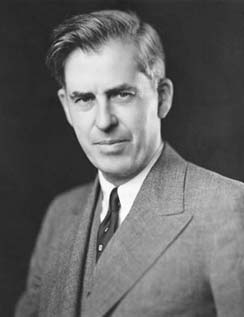
Library of Congress
Henry Wallace, the founder of the Progressive Party, was secretary of agriculture, vice president, and finally secretary of commerce under President Franklin Roosevelt. He was considered one of the most liberal idealists in the Roosevelt administration. Fired from the Truman cabinet in 1946 after breaking with administration policy and publicly advocating peaceful coexistence with the Soviet Union, Wallace began to consider the idea of a liberal third-party candidacy. Supported by the American Labor Party, the Progressive Citizens of America, and other progressive organizations in California and Illinois, Wallace announced his third-party candidacy in December 1947.
The Progressive Party was launched formally the following July at a convention in Philadelphia, which ratified the selection of Wallace for president and Sen. Glen H. Taylor, D-Idaho, as his running mate. The party adopted a platform that emphasized foreign policy—opposing the cold war anticommunism of the Truman administration and specifically urging abandonment of the Truman Doctrine and the Marshall Plan. These measures were designed to bolster noncommunist nations and contain the spread of communism. On domestic issues the Progressives stressed humanitarian concerns and equal rights for both sexes and all races.
Minority groups—women, youth, African Americans, Jews, Hispanic Americans—were active in the new party, but the openness of the Progressives brought Wallace a damaging endorsement from the Communist Party. Believing the two parties could work together, Wallace accepted the endorsement while characterizing his philosophy as “progressive capitalism.”
In 1948 the Progressives appeared on the presidential ballot in forty-five states, but the Communist endorsement helped keep the party on the defensive the entire campaign. In the November election Wallace received only 1,157,326 votes (2.4 percent of the national popular vote), with nearly half of the votes from the state of New York. Not only were the Progressives unable to carry a single state, but in spite of their defection from the Democratic Party, President Truman won reelection. The Progressives had poor results in the congressional races, failing to elect one representative or senator.
The Progressive Party's opposition to the Korean War in 1950 drove many moderate elements out of the party, including Henry Wallace. The party ran a national ticket in 1952 but received only 140,023 votes nationwide or 0.2 percent of the national popular vote. The party crumbled completely after the election.
- Progressive Party
- Democratic Party
- voting
- foreign policy
- third parties
- communism
- administration
Get a 30 day FREE TRIAL
-
 Watch videos from a variety of sources bringing classroom topics to life
 -
Read modern, diverse business cases
-
Explore hundreds of books and reference titles

Read next

More like this
Sage Recommends
We found other relevant content for you on other Sage platforms.
Have you created a personal profile? Login or create a profile so that you can save clips, playlists and searches