
Entry
Entries A-Z
Pocketbook Voting
Pocketbook voting means making electoral choices according to one's perceived economic interest. In the United States, the class conflict that pocketbook voting often implies has been tempered by many other voter concerns and by the political process itself. Nevertheless, public concerns about issues such as taxation and government spending have been evident since the founding of the country.
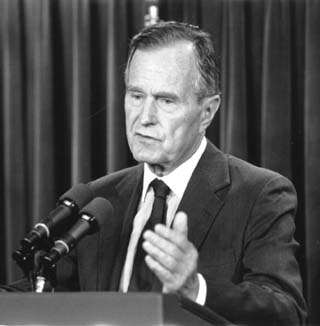
Bush Presidential Materials Project
At times, class differences clearly affected U.S. elections. In the early years of the nineteenth century, the Jeffersonians, many from lower economic strata, successfully challenged the economic power of supporters of the Federalist Party. Later in the century Andrew Jackson won the presidency with the broad support of poorer members of the electorate.
After the Civil War many workers became affiliated with the Knights of Labor, which, in the 1880s, entered slates of candidates in numerous state and local elections. But workers' political parties never found a real footing in American politics.
Role of the Economy
In the twentieth century pocketbook voting reached a high-water mark with President Franklin D. Roosevelt's New Deal. In the midst of the Great Depression, Roosevelt's economic proposals had strong appeal to the jobless and working poor.
Similarly, in 1960 John F. Kennedy promised to “get the country moving again,” and in 1980 Ronald Reagan, citing double-digit inflation, asked, “Are you better off today than you were four years ago?” In 1992 the phrase “It's the economy, stupid,” originally meant as a reminder to Bill Clinton's campaign staffers, became his de facto campaign slogan. But the prosperous economy of 2000 failed to help Clinton's vice president, Al Gore, who lost the White House to Republican George W. Bush in a campaign in which Republicans focused on such issues as strong leadership and trustworthiness.
Closer to home, in state and local elections, people repeatedly vote their pocketbooks on issues such as income and property taxes, bond issues for highway and other public works projects, and land-use and zoning plans. The issue of the annual property tax on automobiles dominated political advertising in the 1997 Virginia gubernatorial race, which was won by the candidate promising repeal. Most states, California especially, regularly put pocketbook issues before the voters in initiative and referendum form.
Polling has shown consistently that in public opinion the Republican Party, at least to some extent, favors the rich over the poor. The Democratic Party generally wins the support of Americans on the lowest rungs of the economic ladder. Political beliefs and opinions, however, are associated with a number of variables besides income. They include education, occupation, race, gender, ethnicity, age, religion, and region. (See Party identification.)
Income disparities may account for differences in voters' perspectives on economic issues, as illustrated by a 1995 Gallup poll. Respondents were asked whether they thought it was more important to reduce the federal budget deficit or to prevent cuts in the federal welfare program. Results indicated that 74 percent of Americans in households with annual incomes above $50,000 thought reducing the deficit was the more important course, compared with 23 percent at that income level who thought it was more important to avoid a cut in welfare. People with annual household incomes under $20,000 were more evenly divided: 52 percent for reducing the deficit and 40 percent for preventing a welfare cut.
...
Get a 30 day FREE TRIAL
-
 Watch videos from a variety of sources bringing classroom topics to life
 -
Read modern, diverse business cases
-
Explore hundreds of books and reference titles

Read next

More like this
Sage Recommends
We found other relevant content for you on other Sage platforms.
Have you created a personal profile? Login or create a profile so that you can save clips, playlists and searches