
Entry
Entries A-Z
Majority-Minority District
The term majority-minority district is relatively new in the lexicon of politics. It came into general usage in the 1990s to describe electoral districts specifically drawn to have majority populations of African American or Hispanic minorities.
As of 2000, sixty-two congressional districts had majority black, Hispanic, or—in the case of two Hawaiian districts—Asian populations. All but eleven of the districts were represented by a nonwhite person.
Racial redistricting to create majority-minority congressional districts took place in many areas of the country following the 1990 census as legislators tried to comply with the antidiscriminatory provisions of the Voting Rights Act of 1965. The efforts had some success, resulting in unprecedented numbers of minority members in the U.S. House of Representatives.
White candidates, however, particularly in the South, challenged some of the oddly shaped districts as illegal forms of racial gerrymandering and reverse discrimination. In several decisions in the 1990s the Supreme Court agreed with the challengers and ordered the districts redrawn. (In 2001, however, the justices upheld a heavily black district in North Carolina, contending that it had been drawn for the political purpose of creating a Democratic district rather than for a racial purpose. See judicial systems and racial redistricting.)
Six majority-minority districts in Florida, Georgia, Louisiana, and Texas that had elected African Americans were redistricted to have white majorities. Nevertheless, five of the six redistricted black members (all Democrats) were reelected in 1996 and 1998. The sixth did not seek another term in 1996 and was succeeded by a white Republican who won reelection in 1998.
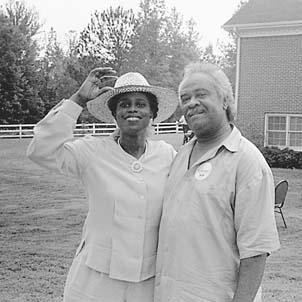
Deborah Kalb, Congressional Quarterly
Critics pointed to the 1996 and 1998 results as evidence that majority-minority districts are not needed to ensure minority representation in Congress. The reelected black incumbents, however, took issue with that conclusion. They said their earlier election from majority-black districts gave them the name recognition and financial support needed to retain their seats in districts that were changed to mostly white.
“My victory says more about the power of incumbency than anything,” said Rep. Cynthia A. McKinney, Democrat, of Georgia's Fourth District. “Proof of this lies in the fact that all of Georgia's incumbents were reelected” (including House Speaker Newt Gingrich, who resigned his seat before the beginning of the 106th Congress).
McKinney's old Eleventh District, 60 percent black, was changed to the Fourth, making her the only black woman in the South to win from a 65 percent majority-white district.
McKinney, however, lost the 2002 Democratic primary to an African American political newcomer after a series of controversial statements, such as implying that members of the Bush administration had prior knowledge of the September 11, 2001, terrorist attacks.
- majority-minority district
- redistricting
- districting
- minority/majority
- Georgia
- incumbent
- African Americans
Get a 30 day FREE TRIAL
-
 Watch videos from a variety of sources bringing classroom topics to life
 -
Read modern, diverse business cases
-
Explore hundreds of books and reference titles

Read next

More like this
Sage Recommends
We found other relevant content for you on other Sage platforms.
Have you created a personal profile? Login or create a profile so that you can save clips, playlists and searches