
Entry
Entries A-Z
Landslide
A lopsided election victory that buries the defeated candidate under the winner's votes is called a landslide. What constitutes a landslide is not precisely known, but in presidential politics it generally means 60 percent or more of the popular vote.
By that measure only four presidents can claim landslide victories: Republican Warren G. Harding in 1920, Democrat Franklin D. Roosevelt in 1936, Democrat Lyndon B. Johnson in 1964, and Republican Richard Nixon in 1972.
Johnson's landslide was the largest. He polled 61.1 percent of the vote to Republican Barry Goldwater's 38.5 percent and won by about 15.9 million votes. Johnson's margin surpassed the previous record set in 1936 when Franklin Roosevelt defeated Republican challenger Alfred M. Landon, 60.8 percent to 36.5 percent for an 11.1 million-vote margin.
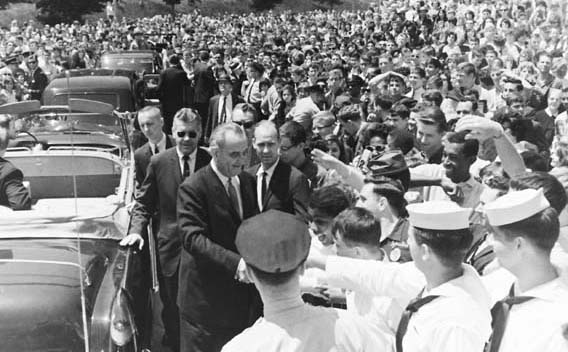
U.S. Lyndon Baines Johnson Library
Harding received 60.3 percent of the popular vote for a margin of 7.0 million over Democrat James M. Cox. Nixon took 60.7 percent for a 17.9 million-vote margin over Democrat George S. McGovern. Nixon's popular vote margin was the largest ever.
Roosevelt's 523 electoral college vote total in 1936 (out of the total 531 at the time, when there were only forty-eight states) remains the largest electoral vote percentage (98.5) after George Washington's 100 percent in 1789.
Republican Ronald Reagan won 525 electoral votes in his 1984 defeat of Democrat Walter F. Mondale, but Reagan's 97.6 percent of the 538 electoral vote total still ranked behind Roosevelt's 98.5 percent.
Reagan's two presidential victories are often called landslides, but both fell short of the 60 percent benchmark. Reagan defeated incumbent Democrat Jimmy Carter with 50.7 percent or a margin of 8.4 million in 1980, and he was reelected with 58.8 percent in 1984, for a margin of 16.8 million votes over Mondale.
The electoral college system, which requires an absolute majority for presidential election, tends to exaggerate the margin of success. The right combination of large-state victories can turn a popular vote plurality into an electoral vote landslide. For example, in 1996 Democrat Bill Clinton won reelection over Republican Robert J. Dole with only 49.2 percent of the popular vote. But Clinton won 379 of the 538 electoral votes, or 70.4 percent.
Landslide presidents sometimes claim a mandate from the voters to carry out whatever program they promised during the campaign. Frequently, however, the mandate is not clear or the victory turns sour for some reason, cutting short the president's tenure. This was the case with Johnson, who decided against seeking another term in 1968, and Nixon, who resigned two years after being reelected in 1972. Had Harding not died in office in 1923, the scandals during his administration likely would have denied him a second term.
- landslides
- voting
- plurality vote
- electoral college
- Lyndon Johnson
- mandate
- elections
Get a 30 day FREE TRIAL
-
 Watch videos from a variety of sources bringing classroom topics to life
 -
Read modern, diverse business cases
-
Explore hundreds of books and reference titles

Read next

More like this
Sage Recommends
We found other relevant content for you on other Sage platforms.
Have you created a personal profile? Login or create a profile so that you can save clips, playlists and searches