
Entry
Entries A-Z
District of Columbia
Throughout most of the history of the District of Columbia, residents have been deprived of voting rights enjoyed by citizens of all the states of the Union. In the post-World War II era, largely as a result of unrelenting political pressure, District residents regained the right to vote for president and vice president and for mayor and other local officials. They also won the right once again to send a nonvoting delegate to the U.S. House of Representatives.
In the same period, however, District residents failed in their push to achieve the right to elect a full congressional delegation. A constitutional amendment providing for that advance in suffrage, although approved by Congress, failed when presented to the states for ratification.
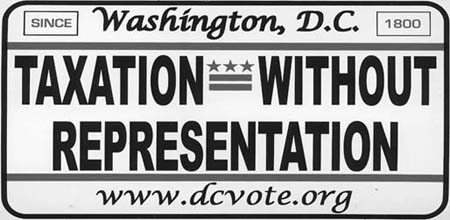
The unique status of the District of Columbia with respect to both voting and governance was established under Article I, section 8, clause 17 of the U.S. Constitution. The clause says it is in the power of Congress “to exercise exclusive Legislation in all Cases whatsoever, over such District… as may, by Cession of particular States, and the Acceptance of Congress, become the Seat of Government of the United States.”
Moreover, after the Civil War issues of race and partisan politics were impediments to the enlargement of suffrage. African American residents constituted about one-third of the population in 1870, and that proportion increased in coming decades. In the latter part of the twentieth century, there were far more Democrats registered to vote in the District than Republicans, leading to a belief that if residents could vote they would elect only Democratic candidates.
Nineteenth Century
In the very early years of the nineteenth century, voters in the area now covered by the District of Columbia had the right to vote in many elections. For example, they voted in the presidential election of 1800, though not for electors in the electoral college. Also in the early years, although the mayor was appointed by the president, voters in the City of Washington (at the heart of the District of Columbia) cast ballots for a twelve-member council and an eight-member board of aldermen. In 1820 Congress permitted them to elect the mayor.
Black suffrage was established in the District of Columbia in 1867, three years before ratification of the Fifteenth Amendment, which prohibits voting discrimination on the basis of race. Congress granted suffrage at that time “without any distinction on account of color or race” to male citizens twenty-one years of age and older who had resided in the District of Columbia for at least one year. President Andrew Johnson vetoed the legislation, but both houses of Congress overrode his veto.
African Americans quickly became influential in local politics, and in a short time they controlled both the city council and the board of aldermen. With the support of African American voters, the Republican candidate for mayor won a narrow victory in 1868. When projects initiated by the mayor resulted in heavy debt and when his successor also ran into difficulties, Congress looked for another way to govern the federal city.
...
Get a 30 day FREE TRIAL
-
 Watch videos from a variety of sources bringing classroom topics to life
 -
Read modern, diverse business cases
-
Explore hundreds of books and reference titles

Read next

More like this
Sage Recommends
We found other relevant content for you on other Sage platforms.
Have you created a personal profile? Login or create a profile so that you can save clips, playlists and searches