
Entry
Entries A-Z
Democratic Party (1832– )
There is no precise birth date for the Democratic Party—the oldest political organization in the United States. The party traces its roots to the factionalism that began with dissent over the Federalist policies of Alexander Hamilton in the first administration of George Washington.
Opposition to Federalist policies, organized by Rep. James Madison and Secretary of State Thomas Jefferson, first coalesced around Hamilton's proposal for a national bank, which Congress passed and Washington signed over the objection of Jefferson and Madison. The Federalists, led by Hamilton and John Adams, favored a strong central government and a flexible interpretation of the Constitution.
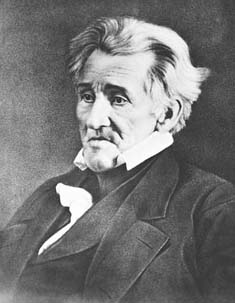
Library of Congress
Jefferson's Democratic-Republicans advocated “strict construction” of the Constitution and opposed a national bank as unconstitutional. From the 1790s to the late 1820s, various terms—Democratic-Republicans, Jeffersonian Republicans, Jeffersonian Democrats, and National Republicans—were applied to the people who opposed the Federalists, but they gradually became known as Democrats.
The Democratic-Republicans grew stronger as the Federalists began to fade during John Adams's presidency. A new alliance of agrarian southerners and urban northerners helped Jefferson defeat Adams in 1800 and win reelection in 1804. After Jefferson the presidency went to his friends and allies, James Madison (1809–1817) and James Monroe (1817–1825). By 1820 the Federalist Party had all but disappeared and Monroe won reelection with no opposition.
In 1811 the twenty-year charter of the Bank of the United States expired, and the Democrats who controlled Congress and the presidency did not renew it. By 1816, however, Madison supported the creation of a new bank and renounced his former opposition on constitutional grounds. Congress, controlled by Democrats, passed the bill.
The inherent instability of one-party politics became clear in 1824 as four candidates—Andrew Jackson, John Quincy Adams, William Crawford, and Henry Clay, all claiming to represent the Jeffersonian tradition—ran for president. No candidate received a majority of popular or electoral votes, and the House of Representatives chose Adams although Andrew Jackson had received more popular votes and electoral votes. After 1824 the old Jeffersonian party unraveled. Adams had had broken with the Federalist Party during the War of 1812 and had served as Monroe's secretary of state, but he was never a true “Jeffersonian.” By the end of his administration in 1829, he and his supporters, such as Henry Clay, emerged as members of a faction that eventually became the Whig Party.
War of 1812 hero Jackson defeated Adams in 1828 and became the first president to represent the “Democratic Party.” The party has maintained that name ever since, although it often divided over issues such as slavery, economic policy, and national unity in the nineteenth century, and foreign policy, civil rights, and economic policy in the twentieth.
The new party encouraged and benefited from the increasing democratization of American politics that began in the 1820s. Andrew Jackson became a symbol of this mass democracy, and when he was elected in 1828 a period of Democratic dominance began that lasted until the Civil War.
The Democrats were a national party, with a particular appeal among workers, immigrants, and settlers west of the Alleghenies. The party's success in the pre-Civil War period was due in part to a national organization stronger than that of its rivals. In 1832 the Democrats were the first major party to hold a national party convention, and in 1848 they became the first party to establish an ongoing national committee.
...
Get a 30 day FREE TRIAL
-
 Watch videos from a variety of sources bringing classroom topics to life
 -
Read modern, diverse business cases
-
Explore hundreds of books and reference titles

Read next

More like this
Sage Recommends
We found other relevant content for you on other Sage platforms.
Have you created a personal profile? Login or create a profile so that you can save clips, playlists and searches