
Entry
Entries A-Z
Ballot Access
Being listed on the ballot is the basic first step in winning an election, but for third parties, getting on the ballot is not easy. Controversies over ballot access erupt constantly in the United States.
Under the U.S. two-party system, the Democratic and Republican Parties are ensured a place on the ballot in every partisan election for office. They also control the election bureaucracy in most jurisdictions and frequently resist the listing of splinter groups that could siphon votes from their candidates.
Since the advent of the ballot type known as the secret or Australian ballot in the late 1800s, states rather than parties have compiled the official election ballots. This task is one of the major functions of the states in the elections process shared with the federal government. (See State and federal election responsibilities.)
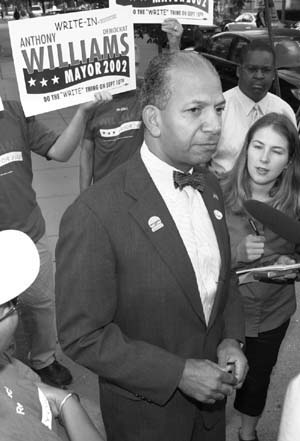
D.C. Lateef Mangum, Office of the Mayor
Access Requirements
Ballot access rules vary from state to state, but all states have requirements to keep the ballot from becoming unwieldy and to discourage frivolous candidacies. Usually a third-party or independent candidate must submit petitions with valid voters' signatures, which can range from as few as twenty-five in Tennessee to as many as 5 percent of the state's registered voters, which can run into several hundred thousands.
In Florida, for example, a third-party or independent candidate for governor needs petitions from 3 percent of the voters registered in the previous election, which for 2002 meant nearly 200,000 signatures. Because many signatures are likely to be judged invalid, the candidate must obtain several thousand more than the minimum to ensure placement on the ballot. New parties must pay for the validation (ten cents per signature in Florida), which poses another hurdle to candidates outside of the major parties.
Florida is one of the states where reformers have tried for years to ease what they call “unfair and restrictive election laws.” No independent candidate for governor of Florida has ever amassed the required number of signatures, according to the state's Fair Ballot Access Committee.
Third parties also complain that in many states they are forced to file too early, weeks or months before they know who their candidates will be. Some states require all parties to hold primaries to nominate candidates, which small third parties often are not prepared to do, especially early in the election year where the major parties have clustered their primaries. (See front-loading.)
The states' right to require petitions for ballot access was upheld by the Supreme Court in Jenness v. Fortson (1971). The Court ruled that a state could require separate petitions for each candidate of a new party, with a maximum of signatures from 5 percent of the number of voters registered in the previous election for the office.
States also may specify how the signatures are gathered, such as a minimum percentage from each congressional district; signatures unacceptable from persons who voted in the major-party primaries; no solicitation by persons living outside the district; signers required to pledge that they intend to vote for the new party; a limited time period for the signatures collection; or signers required to provide information they are not likely to know, such as their registration number or voting precinct designation.
...
Get a 30 day FREE TRIAL
-
 Watch videos from a variety of sources bringing classroom topics to life
 -
Read modern, diverse business cases
-
Explore hundreds of books and reference titles

Read next

More like this
Sage Recommends
We found other relevant content for you on other Sage platforms.
Have you created a personal profile? Login or create a profile so that you can save clips, playlists and searches