
Entry
Entries A-Z
Baker v. Carr
The Supreme Court's decision in Baker v. Carr (1962) began a historic transformation of state legislatures throughout the country. The ruling, which dealt with a Tennessee case, established only the narrow principle that federal courts have jurisdiction to review claims of unconstitutional apportionment of legislative districts. Within two years, however, the Court laid down a sweeping constitutional rule—the one-person, one-vote doctrine—that forced every state legislature in the country except one (Oregon) to redraw legislative districts and give urban and suburban dwellers a proportional voice in legislatures that had been dominated by rural interests because of improper reapportionment and redistricting.
Tennessee's legislature had not reapportioned itself in sixty years despite a provision in the state constitution requiring that reapportionment be done every ten years. By the 1950s the population shift from the farms to the cities had produced dramatic disparities in the pattern of representation for seats in the Tennessee house and senate. Underrepresented urban dwellers tried but failed to get state courts to enforce the provision. They then filed suit in federal district court in 1959, alleging that the legislature's failure to reapportion itself violated their right to equal protection of the laws under the Fourteenth Amendment. Charles W. Baker, chairman of the Shelby County (Memphis) legislative body, was the lead plaintiff; Secretary of State Joe Carr was the first-named defendant.
The Supreme Court had ruled in a similar case in 1946 that federal courts had no jurisdiction over the “political question” of legislative reapportionment. Following the precedent in Colegrove v. Green, the federal district court in Nashville unanimously dismissed the suit. The Tennessee plaintiffs asked the Supreme Court to review the case and reconsider the precedent. The Justice Department, in a brief written by Solicitor General Archibald Cox, supported their plea.
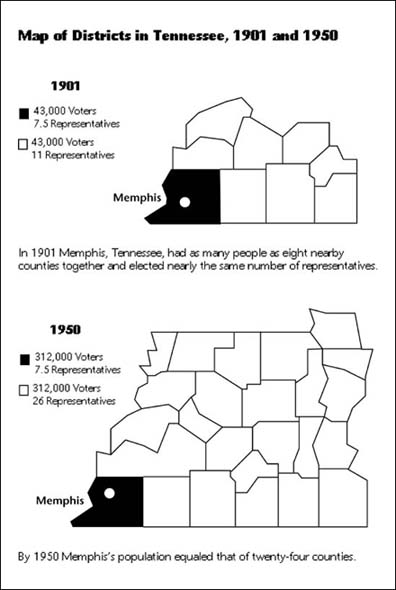
Equal Justice Under Law (Washington, D.C.: Foundation of the Federal Bar Association, 1965), 108.
The Court moved cautiously in scrapping the precedent. By a 6–2 vote it held that the plaintiffs' constitutional claims were “justiciable” despite the political-question doctrine. “The mere fact that the suit seeks protection of a political right does not mean it presents a political question,” Justice William J. Brennan Jr. wrote in the March 26, 1962, decision. Brennan said the holding did not require the Court to address the merits of the plaintiffs' claim. Three justices—William O. Douglas, Tom C. Clark, and Potter Stewart—wrote concurring opinions. Clark said he would have granted relief to the plaintiffs but also said he would allow some “rational” departures from equal-population districts.
In a dissenting opinion, Justice Felix Frankfurter, who had written the opinion in Colegrove, decried the new decision. “There is not under our Constitution a judicial remedy for every political mischief,” he wrote. Justice John Marshall Harlan, the second dissenter, called the ruling “an adventure in judicial experimentation.”
Within a year, similar reapportionment suits were filed in thirty-six states. Years later, Chief Justice Earl Warren listed Baker v. Carr as the most important case decided by the Warren Court.
- reapportionment
- courts
- Tennessee
- legislature
- precedent
- districting
- Supreme Court
Get a 30 day FREE TRIAL
-
 Watch videos from a variety of sources bringing classroom topics to life
 -
Read modern, diverse business cases
-
Explore hundreds of books and reference titles

Read next

More like this
Sage Recommends
We found other relevant content for you on other Sage platforms.
Have you created a personal profile? Login or create a profile so that you can save clips, playlists and searches