
Entry
Reader's guide
Entries A-Z
Subject index
School Violence and Disruption
Concerns over school violence in the United States date from the late 1970s, with the issuance of the 1978 report, Violent Schools—Safe Schools: The Safe School Study Report to Congress. That report found that (a) about 25% of U.S. schools experienced vandalism, (b) 1.3% of students were victims of personal attack, (c) 11% of students were victims of theft, and (d) 8% of secondary students missed a day of school per month out of fear for personal safety. Widespread dissemination of these statistics led to increased public and policymaker focus on school violence. A subsequent federal report in 1984, Disorder in Our Public Schools, cited continuing problems with school disorder nationally, leading to the passage of the Safe and Drug-Free Schools Act of 1986. By the early 1990s, school violence in the United States was perceived to have reached epidemic proportions. National attention was riveted on increasingly disturbing statistics in the early 1990s showing rising school violence, and seemingly endless school shootings throughout the 1990s, culminating with the Columbine High School shootings of April 1999. These developments, as well as events in the first 6 years of the new century, may be considered in terms of a complex nexus of issues and influences.
This entry begins with an overview of data on school violence from the early 1990s through the early 2000s. Issues of data collection and measurement are discussed with primary attention to national-level data. Dimensions of school violence and disruption (e.g., bullying) are examined, followed by a summary of research on school violence prevention. The entry concludes with a discussion of key controversies and ongoing challenges to the field.
Trends in School Violence and Disruption
There has been a pronounced decline in several measures of school violence and disruption from the mid-1990s through the early 2000s according to several measures, including data from the National Crime Victimization Survey (see Figure 1).
Some indicators suggest that a new, albeit lower level of violence has been reached. Other measures suggest a lesser decline over the years. The Centers for Disease Control and Prevention (CDC) Youth Risk Behavior Survey (YRBS) reports a significant reduction from 1993 to 2005 in students fighting in school and bringing weapons to school (see Figure 2).
A slightly different picture of stable, or slightly increasing, trends emerges, looking at the percentage of students who reported being threatened or injured with a weapon at school, and missing school due to safety concerns (see Figure 3).
In sum, the data suggest that school violence and disruption diminished over the period of 1993–2005, but that serious problems remain.
Figure 1 Rate of Student-Reported Violent Crimes Against Students at and Away From School
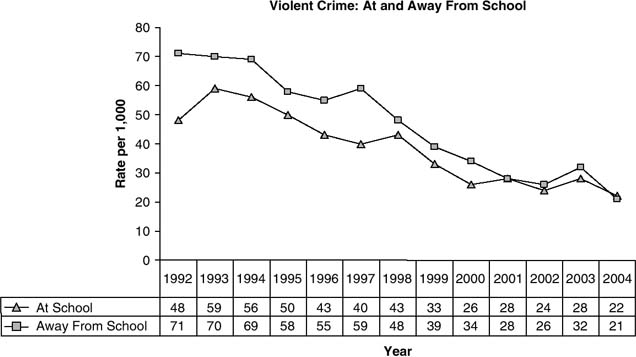
Source: Indicators of School Crime and Safety 2006, National Center for Education Statistics.
Figure 2 Percentage of Respondents Reporting Fights at School or Weapons Brought to School
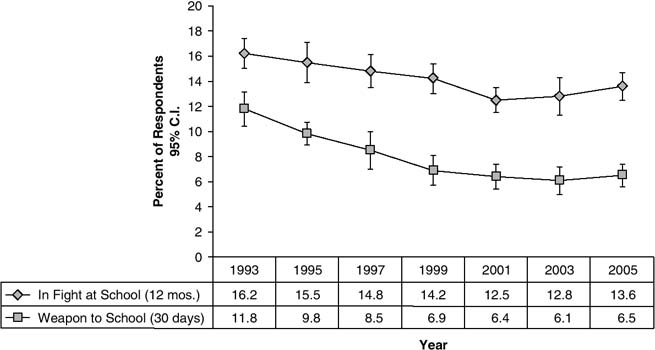
Source: Youth Risk Behavior Survey (1993–2005): Fights at School; Weapons Brought to School. Centers for Disease Control and Prevention.
Figure 3 Percentage of Respondents Reporting Being Threatened/Injured With a Weapon or Having Missed School Due to Safety Concerns
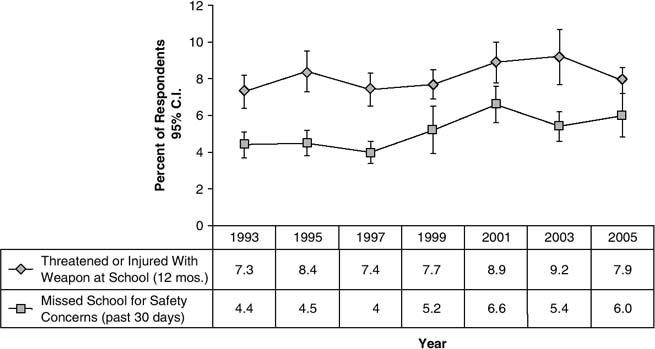
Source: Youth Risk Behavior Survey (1993–2005): Threatened/Injured With Weapon; Missed School Due to Safety Concerns. Centers for Disease Control and Prevention.
...
- Classroom Achievement
- Acceleration
- Alternative Academic Assessment
- Bell Curve
- Direct Instruction
- Educational Technology
- Failure, Effects of
- Gifted and Talented Students
- Goals
- Grade Retention
- Grading
- Halo Effect
- Home Environment and Academic Intrinsic Motivation
- Homework
- Intelligence and Intellectual Development
- Intelligence Quotient (IQ)
- Intelligence Tests
- Literacy
- Media Literacy
- Parental Expectations
- Personalized System of Instruction
- Precision Teaching
- Reading Comprehension Strategies
- Rubrics
- Spelling
- Test Anxiety
- Classroom Management
- Calculator Use
- Cheating
- Contingency Contracts
- Cooperative Learning
- Curriculum Development
- Discovery Learning
- Distance Learning
- Early Intervention Programs
- Educational Technology
- Effective Teaching, Characteristics of
- Mainstreaming
- Montessori Schools
- School Design
- School Resources
- Students' Rights
- Time-Out
- Token Reinforcement Programs
- Virtual Schools
- Vocational Education
- Cognitive Development
- Cognitive Development and School Readiness
- Conservation
- Deductive Reasoning
- Egocentrism
- Equilibration
- Field Independence–Field Dependence
- Flashbulb Memories, the Nature of
- Inductive Reasoning
- Intelligence and Intellectual Development
- Literacy
- Long-Term Memory
- Measurement and Cognitive Development
- Metacognition and Learning
- Moral Development
- Motivation and Emotion
- Object Permanence
- Perceptual Development
- Piaget's Theory of Cognitive Development
- Schemas
- Short-Term Memory
- Spelling
- Vygotsky's Cultural-Historical Theory of Development
- Zone of Proximal Development
- Ethnicity, Race, and Culture
- African Americans
- American Indians and Alaska Natives
- Asian Americans
- Bilingual Education
- Bilingualism
- Communication Disorders
- Cultural Deficit Model
- Cultural Diversity
- Culture
- Diversity
- Ethnicity and Race
- Head Start
- Hispanic Americans
- Identity Development
- Immigration
- Multicultural Classrooms
- Multicultural Education
- Families
- Gender and Gender Development
- Health and Well-Being
- Abstinence Education
- Athletics
- Attention Deficit Hyperactivity Disorder
- Autism Spectrum Disorders
- Behavior Disorders
- Brain-Relevant Education
- Communication Disorders
- Conduct Disorders
- Diagnostic and Statistical Manual of Mental Disorders
- Disabilities
- Drug Abuse
- Dyslexia
- Eating Disorders
- Extracurricular Activities
- HIV/AIDS
- Learning Disabilities
- Malnutrition and Development
- Mental Health Care in Schools
- Mental Retardation
- Obesity
- School Counseling
- Sex Education
- Special Education
- Suicide
- Human Development
- Acculturation
- Aggression
- Androgyny
- Anxiety
- Aptitude
- Athletics
- Attachment
- Attachment Disorder
- Autism Spectrum Disorders
- Behavior Disorders
- Creativity
- Early Intervention Programs
- Egocentrism
- Emotion and Memory
- Emotional Development
- Empathy
- Equilibration
- Erikson's Theory of Psychosocial Development
- Extracurricular Activities
- Friendship
- Gifted and Talented Students
- Head Start
- Identity Development
- Individual Differences
- Individuals with Disabilities Education Act
- Intelligence and Intellectual Development
- Intrinsic versus Extrinsic Motivation
- Kohlberg's Stages of Moral Development
- Mainstreaming
- Maslow's Hierarchy of Basic Needs
- Maturation
- Mental Retardation
- Metacognition and Learning
- Moral Development
- Motivation
- Motivation and Emotion
- Motor Development
- Myelination
- Neuroscience
- Peer Influences
- Perceptual Development
- Physical Development
- Piaget's Theory of Cognitive Development
- Risk Factors and Development
- School Violence and Disruption
- Self-Determination
- Self-Efficacy
- Self-Esteem
- Special Education
- Test Anxiety
- Vygotsky's Cultural-Historical Theory of Development
- Intelligence and Intellectual Development
- Language Development
- Learning and Memory
- Adult Learning
- Assistive Technology
- Aversive Stimuli
- Behavior Modification
- Bloom's Taxonomy of Educational Objectives
- Brain-Relevant Education
- Classical Conditioning
- Cognitive and Cultural Styles
- Cognitive View of Learning
- Cooperative Learning
- Discovery Learning
- Discrimination
- Distance Learning
- Divergent Thinking
- Educational Technology
- Emotion and Memory
- Episodic Memory
- Explicit Memory
- Flashbulb Memories, the Nature of
- Habituation
- Intrinsic versus Extrinsic Motivation
- Learning
- Learning Communities
- Learning Disabilities
- Learning Strategies
- Learning Style
- Lifelong Learning
- Long-Term Memory
- Malnutrition and Development
- Maturation
- Memory
- Metacognition and Learning
- Mnemonics
- Motivation and Emotion
- Observational Learning
- Older Learners
- Operant Conditioning
- Peer-Assisted Learning
- Perceptual Development
- Premack Principle
- Reinforcement
- Rosenthal Effect
- Shaping
- Short-Term Memory
- Social Learning Theory
- Stimulus Control
- Working Memory
- Organizations
- Peers and Peer Influences
- Public Policy
- Abstinence Education
- Assistive Technology
- Bilingual Education
- Charter Schools
- Child Abuse
- Early Child Care and Education
- English as a Second Language
- Ethics and Research
- Gangs
- Grade Retention
- Head Start
- High-Stakes Testing
- Home Education
- Immigration
- Inclusion
- Individualized Education Program
- Individuals with Disabilities Education Act
- Institutional Review Boards
- Intelligence Tests
- Least Restrictive Placement
- Mainstreaming
- No Child Left Behind
- Poverty
- School Design
- School Violence and Disruption
- Sex Education
- Special Education
- Students' Rights
- Testing
- Tracking
- Vouchers
- Research Methods and Statistics
- T Scores
- Case Studies
- Confidence Interval
- Correlation
- Cross-Sectional Research
- Descriptive Statistics
- Ethics and Research
- Ethnography
- Experimental Design
- External Validity
- Field Experiments
- Frequency Distribution
- Generalizability Theory
- Inferential Statistics
- Internal Validity
- Longitudinal Research
- Mean
- Median
- Meta-Analysis
- Mode
- Naturalistic Observation
- Normal Curve
- Percentile Rank
- Qualitative Research Methods
- Quantitative Research Methods
- Random Sample
- Regression
- Scientific Method
- Standard Deviation and Variance
- Standard Scores
- Stanine Scores
- Statistical Significance
- Social Development
- Teaching
- Aptitude Tests
- Constructivism
- Contingency Contracts
- Criterion-Referenced Testing
- Curriculum Development
- Direct Instruction
- Educational Technology
- Effective Teaching, Characteristics of
- Emotion and Memory
- English as a Second Language
- Evaluation
- Expert Teachers
- Explicit Teaching
- Goals
- Grade Retention
- Grade-Equivalent Scores
- Grading
- Home Education
- Homework
- Instructional Objectives
- Learning Objectives
- Parent–Teacher Conferences
- Personalized System of Instruction
- PRAXIS™
- Precision Teaching
- Rubrics
- Scaffolding
- School Readiness
- Sex Education
- Students' Rights
- Teaching Strategies
- Tracking
- Testing, Measurement, and Evaluation
- Acceleration
- Alternative Academic Assessment
- Aptitude Tests
- Assessment
- Bell Curve
- Certification
- Criterion-Referenced Testing
- Essay Tests
- Evaluation
- External Validity
- Generalizability Theory
- Grade Retention
- Grade-Equivalent Scores
- Grading
- High-Stakes Testing
- Intelligence Tests
- Measurement
- Measurement of Cognitive Development
- Mental Age
- Multiple-Choice Tests
- Norm-Referenced Tests
- Percentile Rank
- Personality Tests
- Reliability
- Rubrics
- Standardized Tests
- Stanford–Binet Test
- Test Anxiety
- Testing
- Validity
- Theory
- Applied Behavior Analysis
- Behavior Modification
- Bloom's Taxonomy of Educational Objectives
- Classical Conditioning
- Cognitive Behavior Modification
- Cognitive View of Learning
- Constructivism
- Continuity and Discontinuity in Learning
- Cultural Deficit Model
- Dynamical Systems
- Erikson's Theory of Psychosocial Development
- Generalizability Theory
- Kohlberg's Stages of Moral Development
- Learned Helplessness
- Maslow's Hierarchy of Basic Needs
- Neuroscience
- Piaget's Theory of Cognitive Development
- Premack Principle
- Psychoanalytic Theory
- Psychosocial Development
- Reciprocal Determinism
- Rosenthal Effect
- Schemas
- Social Learning Theory
- Theory of Mind
- Vicarious Reinforcement
- Loading...
Get a 30 day FREE TRIAL
-
 Watch videos from a variety of sources bringing classroom topics to life
 -
Read modern, diverse business cases
-
Explore hundreds of books and reference titles

Read next

More like this
Sage Recommends
We found other relevant content for you on other Sage platforms.
Have you created a personal profile? Login or create a profile so that you can save clips, playlists and searches