
Entry
Reader's guide
Entries A-Z
Subject index
Regression
Research in educational psychology is often interested in examining the relationship between one or more variables and using this relationship to predict future behavior. Regression is the process of modeling the relationship between variables. In statistical form, regression models can be used to predict the outcome of a particular variable given knowledge of the value of one or more other variables.
Regression can be used to answer questions related to performance on standardized examinations in subject areas such as mathematics, reading, and science. For instance, student performance on a mathematics assessment is likely related to performance in a mathematics-related class such as algebra or geometry. The relationship between these variables can be used to devise a regression equation that allows a prediction to be made. That is, given knowledge of performance in an algebra class, the regression equation can be used to predict (with error) performance on the mathematics assessment. The regression equation also explains a certain amount of variability in the outcome measure.
Regression models take many forms, but linear models are most common. Linear regression models refer to a pattern of change where the outcome measure or dependent variable (DV), Y, increases (decreases) as the independent variable (IV), X, increases (decreases). Theoretically, the linear regression equation can be expressed as

where a and b are estimated values for the intercept and slope, respectively, and e represents measurement error or the amount of unexplained variability in the DV. The intercept is defined as the value of the DV when the IV is equal to zero, and the slope provides information on the direction and magnitude of the relationship between the IV and DV.
The goal in formulating regression models is to minimize the amount of measurement error by explaining as much variability in the DV as possible. This can be accomplished through either a simple regression model or a multiple regression model. The aforementioned example is considered a simple regression model using a single IV, performance in an algebra class, to predict performance on the mathematics assessment. Including an additional variable, such as performance in a geometry class, would likely result in a better explanation of the variability in mathematics assessment scores. Theoretically, the multiple regression equation takes the same form as the simple regression equation but contains an additional slope value:

The slope in a simple linear regression equation is calculated as

where sXY is the covariance between X and Y and s2X is the total amount of variability in X. The y intercept is
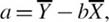
where Y¯ is the mean of Y and X¯ is the mean of X. The slope is reported in either standardized or unstandardized form. Unstandardized values of b explain the magnitude in the relationship between the independent variable and dependent variable in the original units of the variables. However, if the data are normalized, standardized values for the slope can be calculated. Using standardized values for the slope results in interpreting the relationship between X and Y in standard deviation units. Standardized values are useful for determining which IV is contributing more toward explaining the variance in the DV.
...
- Classroom Achievement
- Acceleration
- Alternative Academic Assessment
- Bell Curve
- Direct Instruction
- Educational Technology
- Failure, Effects of
- Gifted and Talented Students
- Goals
- Grade Retention
- Grading
- Halo Effect
- Home Environment and Academic Intrinsic Motivation
- Homework
- Intelligence and Intellectual Development
- Intelligence Quotient (IQ)
- Intelligence Tests
- Literacy
- Media Literacy
- Parental Expectations
- Personalized System of Instruction
- Precision Teaching
- Reading Comprehension Strategies
- Rubrics
- Spelling
- Test Anxiety
- Classroom Management
- Calculator Use
- Cheating
- Contingency Contracts
- Cooperative Learning
- Curriculum Development
- Discovery Learning
- Distance Learning
- Early Intervention Programs
- Educational Technology
- Effective Teaching, Characteristics of
- Mainstreaming
- Montessori Schools
- School Design
- School Resources
- Students' Rights
- Time-Out
- Token Reinforcement Programs
- Virtual Schools
- Vocational Education
- Cognitive Development
- Cognitive Development and School Readiness
- Conservation
- Deductive Reasoning
- Egocentrism
- Equilibration
- Field Independence–Field Dependence
- Flashbulb Memories, the Nature of
- Inductive Reasoning
- Intelligence and Intellectual Development
- Literacy
- Long-Term Memory
- Measurement and Cognitive Development
- Metacognition and Learning
- Moral Development
- Motivation and Emotion
- Object Permanence
- Perceptual Development
- Piaget's Theory of Cognitive Development
- Schemas
- Short-Term Memory
- Spelling
- Vygotsky's Cultural-Historical Theory of Development
- Zone of Proximal Development
- Ethnicity, Race, and Culture
- African Americans
- American Indians and Alaska Natives
- Asian Americans
- Bilingual Education
- Bilingualism
- Communication Disorders
- Cultural Deficit Model
- Cultural Diversity
- Culture
- Diversity
- Ethnicity and Race
- Head Start
- Hispanic Americans
- Identity Development
- Immigration
- Multicultural Classrooms
- Multicultural Education
- Families
- Gender and Gender Development
- Health and Well-Being
- Abstinence Education
- Athletics
- Attention Deficit Hyperactivity Disorder
- Autism Spectrum Disorders
- Behavior Disorders
- Brain-Relevant Education
- Communication Disorders
- Conduct Disorders
- Diagnostic and Statistical Manual of Mental Disorders
- Disabilities
- Drug Abuse
- Dyslexia
- Eating Disorders
- Extracurricular Activities
- HIV/AIDS
- Learning Disabilities
- Malnutrition and Development
- Mental Health Care in Schools
- Mental Retardation
- Obesity
- School Counseling
- Sex Education
- Special Education
- Suicide
- Human Development
- Acculturation
- Aggression
- Androgyny
- Anxiety
- Aptitude
- Athletics
- Attachment
- Attachment Disorder
- Autism Spectrum Disorders
- Behavior Disorders
- Creativity
- Early Intervention Programs
- Egocentrism
- Emotion and Memory
- Emotional Development
- Empathy
- Equilibration
- Erikson's Theory of Psychosocial Development
- Extracurricular Activities
- Friendship
- Gifted and Talented Students
- Head Start
- Identity Development
- Individual Differences
- Individuals with Disabilities Education Act
- Intelligence and Intellectual Development
- Intrinsic versus Extrinsic Motivation
- Kohlberg's Stages of Moral Development
- Mainstreaming
- Maslow's Hierarchy of Basic Needs
- Maturation
- Mental Retardation
- Metacognition and Learning
- Moral Development
- Motivation
- Motivation and Emotion
- Motor Development
- Myelination
- Neuroscience
- Peer Influences
- Perceptual Development
- Physical Development
- Piaget's Theory of Cognitive Development
- Risk Factors and Development
- School Violence and Disruption
- Self-Determination
- Self-Efficacy
- Self-Esteem
- Special Education
- Test Anxiety
- Vygotsky's Cultural-Historical Theory of Development
- Intelligence and Intellectual Development
- Language Development
- Learning and Memory
- Adult Learning
- Assistive Technology
- Aversive Stimuli
- Behavior Modification
- Bloom's Taxonomy of Educational Objectives
- Brain-Relevant Education
- Classical Conditioning
- Cognitive and Cultural Styles
- Cognitive View of Learning
- Cooperative Learning
- Discovery Learning
- Discrimination
- Distance Learning
- Divergent Thinking
- Educational Technology
- Emotion and Memory
- Episodic Memory
- Explicit Memory
- Flashbulb Memories, the Nature of
- Habituation
- Intrinsic versus Extrinsic Motivation
- Learning
- Learning Communities
- Learning Disabilities
- Learning Strategies
- Learning Style
- Lifelong Learning
- Long-Term Memory
- Malnutrition and Development
- Maturation
- Memory
- Metacognition and Learning
- Mnemonics
- Motivation and Emotion
- Observational Learning
- Older Learners
- Operant Conditioning
- Peer-Assisted Learning
- Perceptual Development
- Premack Principle
- Reinforcement
- Rosenthal Effect
- Shaping
- Short-Term Memory
- Social Learning Theory
- Stimulus Control
- Working Memory
- Organizations
- Peers and Peer Influences
- Public Policy
- Abstinence Education
- Assistive Technology
- Bilingual Education
- Charter Schools
- Child Abuse
- Early Child Care and Education
- English as a Second Language
- Ethics and Research
- Gangs
- Grade Retention
- Head Start
- High-Stakes Testing
- Home Education
- Immigration
- Inclusion
- Individualized Education Program
- Individuals with Disabilities Education Act
- Institutional Review Boards
- Intelligence Tests
- Least Restrictive Placement
- Mainstreaming
- No Child Left Behind
- Poverty
- School Design
- School Violence and Disruption
- Sex Education
- Special Education
- Students' Rights
- Testing
- Tracking
- Vouchers
- Research Methods and Statistics
- T Scores
- Case Studies
- Confidence Interval
- Correlation
- Cross-Sectional Research
- Descriptive Statistics
- Ethics and Research
- Ethnography
- Experimental Design
- External Validity
- Field Experiments
- Frequency Distribution
- Generalizability Theory
- Inferential Statistics
- Internal Validity
- Longitudinal Research
- Mean
- Median
- Meta-Analysis
- Mode
- Naturalistic Observation
- Normal Curve
- Percentile Rank
- Qualitative Research Methods
- Quantitative Research Methods
- Random Sample
- Regression
- Scientific Method
- Standard Deviation and Variance
- Standard Scores
- Stanine Scores
- Statistical Significance
- Social Development
- Teaching
- Aptitude Tests
- Constructivism
- Contingency Contracts
- Criterion-Referenced Testing
- Curriculum Development
- Direct Instruction
- Educational Technology
- Effective Teaching, Characteristics of
- Emotion and Memory
- English as a Second Language
- Evaluation
- Expert Teachers
- Explicit Teaching
- Goals
- Grade Retention
- Grade-Equivalent Scores
- Grading
- Home Education
- Homework
- Instructional Objectives
- Learning Objectives
- Parent–Teacher Conferences
- Personalized System of Instruction
- PRAXIS™
- Precision Teaching
- Rubrics
- Scaffolding
- School Readiness
- Sex Education
- Students' Rights
- Teaching Strategies
- Tracking
- Testing, Measurement, and Evaluation
- Acceleration
- Alternative Academic Assessment
- Aptitude Tests
- Assessment
- Bell Curve
- Certification
- Criterion-Referenced Testing
- Essay Tests
- Evaluation
- External Validity
- Generalizability Theory
- Grade Retention
- Grade-Equivalent Scores
- Grading
- High-Stakes Testing
- Intelligence Tests
- Measurement
- Measurement of Cognitive Development
- Mental Age
- Multiple-Choice Tests
- Norm-Referenced Tests
- Percentile Rank
- Personality Tests
- Reliability
- Rubrics
- Standardized Tests
- Stanford–Binet Test
- Test Anxiety
- Testing
- Validity
- Theory
- Applied Behavior Analysis
- Behavior Modification
- Bloom's Taxonomy of Educational Objectives
- Classical Conditioning
- Cognitive Behavior Modification
- Cognitive View of Learning
- Constructivism
- Continuity and Discontinuity in Learning
- Cultural Deficit Model
- Dynamical Systems
- Erikson's Theory of Psychosocial Development
- Generalizability Theory
- Kohlberg's Stages of Moral Development
- Learned Helplessness
- Maslow's Hierarchy of Basic Needs
- Neuroscience
- Piaget's Theory of Cognitive Development
- Premack Principle
- Psychoanalytic Theory
- Psychosocial Development
- Reciprocal Determinism
- Rosenthal Effect
- Schemas
- Social Learning Theory
- Theory of Mind
- Vicarious Reinforcement
- Loading...
Get a 30 day FREE TRIAL
-
 Watch videos from a variety of sources bringing classroom topics to life
 -
Read modern, diverse business cases
-
Explore hundreds of books and reference titles

Read next

More like this
Sage Recommends
We found other relevant content for you on other Sage platforms.
Have you created a personal profile? Login or create a profile so that you can save clips, playlists and searches