
Entry
Reader's guide
Entries A-Z
Subject index
Calculator Use
Creativity is a type of learning process where the teacher and pupil are located in the same individual.
Computers, four-function calculators, and graphing calculators have assisted in the development of significant advances in the field of mathematics. For example, the famous 4-color theorem went unsolved for more than 100 years until 1976, when the calculation and visualization powers of computers were utilized to derive a mathematical proof. Advances in production speed, manipulation, and representation of data through the use of calculators and computers have also benefited the field of statistics, including the specific area of educational statistics. Educational psychology has taken advantage of these advancements in product technologies to support research and theory in the field, particularly in regard to these technologies' abilities to support statistical computation and manipulation.
Although the first desktop calculators were available in the 1960s, their commercial availability did not emerge until the early 1970s. These early ‘four-function’ calculators were limited in scope in that they were able to perform only the basic mathematical operations of addition, subtraction, multiplication, and division. In the late 1970s, companies such as Casio, Hewlett-Packard, Sharp, and Texas Instruments began to produce programmable calculators. These models had small memory chips capable of storing a limited number of preprogrammed algorithms, including square root, exponents, and basic statistics. Some of these models also allowed users to input basic computer code and program their own algorithms.
In the early 1990s, graphing calculators greatly expanded the user capabilities of the handheld devices. The ability to compute fixed algorithms, represent functions and data in multiple ways, and support simple computer codes, made the graphing calculator a prime example of a product technology that allows for an enormous amount of mathematical power, speed, and visual representation. Graphing calculators readily support the production and use of educational statistics through the calculation of statistical tools such as mean, standard deviation, and quartiles, allowing researchers an efficient and thorough view of quantitative data. However, educational psychologists have extended the power of calculators beyond the computing of statistics. Graphing calculators can support statistical research through plotting two-variable statistics; looking for patterns in two-variable situations to determine an underlying model to interpolate or extrapolate; and conducting various hypothesis-testing procedures, including t-tests, regressions, and analysis of variance (ANOVA).
To illustrate, let us suppose an instructor believes that attendance is an important factor in student motivation. A survey is given at the beginning of the course to determine beginning motivation levels (0–100 scale). The data are gathered, organized into a list, and entered into the calculator. Various statistics can be quickly produced, including mean, standard deviation, and quartile boundary values. These numbers provide a clear picture of students' self-perception of motivation levels at the beginning of the course. In Figure 1, the middle column shows the mean (55.96) and standard deviation (14.87), whereas the right-hand column shows the five quartile values, including the minimum (20), median (58), and maximum (77).
Figure 1 Students' Self-Perception of Motivation Levels at the Beginning of the Course
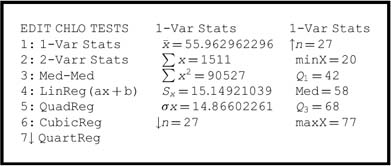
Although a four-function calculator could also produce these statistics, users would need to know the algorithms for computing the statistics, and input the quantities and operations in a lengthy, step-by-step process for each one. The built-in algorithms available in graphing calculators (or any calculator with these preprogrammed functions) allow users to produce these statistics quite easily.
...
- Classroom Achievement
- Acceleration
- Alternative Academic Assessment
- Bell Curve
- Direct Instruction
- Educational Technology
- Failure, Effects of
- Gifted and Talented Students
- Goals
- Grade Retention
- Grading
- Halo Effect
- Home Environment and Academic Intrinsic Motivation
- Homework
- Intelligence and Intellectual Development
- Intelligence Quotient (IQ)
- Intelligence Tests
- Literacy
- Media Literacy
- Parental Expectations
- Personalized System of Instruction
- Precision Teaching
- Reading Comprehension Strategies
- Rubrics
- Spelling
- Test Anxiety
- Classroom Management
- Calculator Use
- Cheating
- Contingency Contracts
- Cooperative Learning
- Curriculum Development
- Discovery Learning
- Distance Learning
- Early Intervention Programs
- Educational Technology
- Effective Teaching, Characteristics of
- Mainstreaming
- Montessori Schools
- School Design
- School Resources
- Students' Rights
- Time-Out
- Token Reinforcement Programs
- Virtual Schools
- Vocational Education
- Cognitive Development
- Cognitive Development and School Readiness
- Conservation
- Deductive Reasoning
- Egocentrism
- Equilibration
- Field Independence–Field Dependence
- Flashbulb Memories, the Nature of
- Inductive Reasoning
- Intelligence and Intellectual Development
- Literacy
- Long-Term Memory
- Measurement and Cognitive Development
- Metacognition and Learning
- Moral Development
- Motivation and Emotion
- Object Permanence
- Perceptual Development
- Piaget's Theory of Cognitive Development
- Schemas
- Short-Term Memory
- Spelling
- Vygotsky's Cultural-Historical Theory of Development
- Zone of Proximal Development
- Ethnicity, Race, and Culture
- African Americans
- American Indians and Alaska Natives
- Asian Americans
- Bilingual Education
- Bilingualism
- Communication Disorders
- Cultural Deficit Model
- Cultural Diversity
- Culture
- Diversity
- Ethnicity and Race
- Head Start
- Hispanic Americans
- Identity Development
- Immigration
- Multicultural Classrooms
- Multicultural Education
- Families
- Gender and Gender Development
- Health and Well-Being
- Abstinence Education
- Athletics
- Attention Deficit Hyperactivity Disorder
- Autism Spectrum Disorders
- Behavior Disorders
- Brain-Relevant Education
- Communication Disorders
- Conduct Disorders
- Diagnostic and Statistical Manual of Mental Disorders
- Disabilities
- Drug Abuse
- Dyslexia
- Eating Disorders
- Extracurricular Activities
- HIV/AIDS
- Learning Disabilities
- Malnutrition and Development
- Mental Health Care in Schools
- Mental Retardation
- Obesity
- School Counseling
- Sex Education
- Special Education
- Suicide
- Human Development
- Acculturation
- Aggression
- Androgyny
- Anxiety
- Aptitude
- Athletics
- Attachment
- Attachment Disorder
- Autism Spectrum Disorders
- Behavior Disorders
- Creativity
- Early Intervention Programs
- Egocentrism
- Emotion and Memory
- Emotional Development
- Empathy
- Equilibration
- Erikson's Theory of Psychosocial Development
- Extracurricular Activities
- Friendship
- Gifted and Talented Students
- Head Start
- Identity Development
- Individual Differences
- Individuals with Disabilities Education Act
- Intelligence and Intellectual Development
- Intrinsic versus Extrinsic Motivation
- Kohlberg's Stages of Moral Development
- Mainstreaming
- Maslow's Hierarchy of Basic Needs
- Maturation
- Mental Retardation
- Metacognition and Learning
- Moral Development
- Motivation
- Motivation and Emotion
- Motor Development
- Myelination
- Neuroscience
- Peer Influences
- Perceptual Development
- Physical Development
- Piaget's Theory of Cognitive Development
- Risk Factors and Development
- School Violence and Disruption
- Self-Determination
- Self-Efficacy
- Self-Esteem
- Special Education
- Test Anxiety
- Vygotsky's Cultural-Historical Theory of Development
- Intelligence and Intellectual Development
- Language Development
- Learning and Memory
- Adult Learning
- Assistive Technology
- Aversive Stimuli
- Behavior Modification
- Bloom's Taxonomy of Educational Objectives
- Brain-Relevant Education
- Classical Conditioning
- Cognitive and Cultural Styles
- Cognitive View of Learning
- Cooperative Learning
- Discovery Learning
- Discrimination
- Distance Learning
- Divergent Thinking
- Educational Technology
- Emotion and Memory
- Episodic Memory
- Explicit Memory
- Flashbulb Memories, the Nature of
- Habituation
- Intrinsic versus Extrinsic Motivation
- Learning
- Learning Communities
- Learning Disabilities
- Learning Strategies
- Learning Style
- Lifelong Learning
- Long-Term Memory
- Malnutrition and Development
- Maturation
- Memory
- Metacognition and Learning
- Mnemonics
- Motivation and Emotion
- Observational Learning
- Older Learners
- Operant Conditioning
- Peer-Assisted Learning
- Perceptual Development
- Premack Principle
- Reinforcement
- Rosenthal Effect
- Shaping
- Short-Term Memory
- Social Learning Theory
- Stimulus Control
- Working Memory
- Organizations
- Peers and Peer Influences
- Public Policy
- Abstinence Education
- Assistive Technology
- Bilingual Education
- Charter Schools
- Child Abuse
- Early Child Care and Education
- English as a Second Language
- Ethics and Research
- Gangs
- Grade Retention
- Head Start
- High-Stakes Testing
- Home Education
- Immigration
- Inclusion
- Individualized Education Program
- Individuals with Disabilities Education Act
- Institutional Review Boards
- Intelligence Tests
- Least Restrictive Placement
- Mainstreaming
- No Child Left Behind
- Poverty
- School Design
- School Violence and Disruption
- Sex Education
- Special Education
- Students' Rights
- Testing
- Tracking
- Vouchers
- Research Methods and Statistics
- T Scores
- Case Studies
- Confidence Interval
- Correlation
- Cross-Sectional Research
- Descriptive Statistics
- Ethics and Research
- Ethnography
- Experimental Design
- External Validity
- Field Experiments
- Frequency Distribution
- Generalizability Theory
- Inferential Statistics
- Internal Validity
- Longitudinal Research
- Mean
- Median
- Meta-Analysis
- Mode
- Naturalistic Observation
- Normal Curve
- Percentile Rank
- Qualitative Research Methods
- Quantitative Research Methods
- Random Sample
- Regression
- Scientific Method
- Standard Deviation and Variance
- Standard Scores
- Stanine Scores
- Statistical Significance
- Social Development
- Teaching
- Aptitude Tests
- Constructivism
- Contingency Contracts
- Criterion-Referenced Testing
- Curriculum Development
- Direct Instruction
- Educational Technology
- Effective Teaching, Characteristics of
- Emotion and Memory
- English as a Second Language
- Evaluation
- Expert Teachers
- Explicit Teaching
- Goals
- Grade Retention
- Grade-Equivalent Scores
- Grading
- Home Education
- Homework
- Instructional Objectives
- Learning Objectives
- Parent–Teacher Conferences
- Personalized System of Instruction
- PRAXIS™
- Precision Teaching
- Rubrics
- Scaffolding
- School Readiness
- Sex Education
- Students' Rights
- Teaching Strategies
- Tracking
- Testing, Measurement, and Evaluation
- Acceleration
- Alternative Academic Assessment
- Aptitude Tests
- Assessment
- Bell Curve
- Certification
- Criterion-Referenced Testing
- Essay Tests
- Evaluation
- External Validity
- Generalizability Theory
- Grade Retention
- Grade-Equivalent Scores
- Grading
- High-Stakes Testing
- Intelligence Tests
- Measurement
- Measurement of Cognitive Development
- Mental Age
- Multiple-Choice Tests
- Norm-Referenced Tests
- Percentile Rank
- Personality Tests
- Reliability
- Rubrics
- Standardized Tests
- Stanford–Binet Test
- Test Anxiety
- Testing
- Validity
- Theory
- Applied Behavior Analysis
- Behavior Modification
- Bloom's Taxonomy of Educational Objectives
- Classical Conditioning
- Cognitive Behavior Modification
- Cognitive View of Learning
- Constructivism
- Continuity and Discontinuity in Learning
- Cultural Deficit Model
- Dynamical Systems
- Erikson's Theory of Psychosocial Development
- Generalizability Theory
- Kohlberg's Stages of Moral Development
- Learned Helplessness
- Maslow's Hierarchy of Basic Needs
- Neuroscience
- Piaget's Theory of Cognitive Development
- Premack Principle
- Psychoanalytic Theory
- Psychosocial Development
- Reciprocal Determinism
- Rosenthal Effect
- Schemas
- Social Learning Theory
- Theory of Mind
- Vicarious Reinforcement
- Loading...
Get a 30 day FREE TRIAL
-
 Watch videos from a variety of sources bringing classroom topics to life
 -
Read modern, diverse business cases
-
Explore hundreds of books and reference titles

Read next

More like this
Sage Recommends
We found other relevant content for you on other Sage platforms.
Have you created a personal profile? Login or create a profile so that you can save clips, playlists and searches