
Entry
Entries A-Z
Subject index
Stratification, in Organizations
Stratification in organizations generally refers to the difference in status between higher and lower levels in an organization's hierarchy, which are also connected to and represented by differences in salary, prestige, privileges, and mobility among position occupants
Social Systems: The Basic Building Blocks of Organizations
Stratification occurs as organizations increase in size (the one-room school had only two levels: teacher and students). The underlying mechanism is that as people interact in organizations, they inevitably develop subgroups called social systems, that is, any two or more people interacting meaningfully. As a matter of fact, a small group of five people generates 22 different social systems. Social systems comprise the basic building blocks of organizations. Obviously, then, as organizations increase in size, so do the number of their social systems. In 1938, Chester I. Barnard was an early observer who noted that the informal systems, that is, the social systems, have considerable impact on governance and on the processes that organizations must develop to function.
With the increase of social systems comes increased stratification, since humans have limited spans of control; that is, being able to handle a number of subordinates reporting directly to a supervisor. At lower levels, spans can be larger than at higher levels. The implication of this is that with increased complexity and size comes greater hierarchical structure, greater stratification.
Mintzberg's Pulls
Henry Mintzberg's logo (see Figure 1) provides intriguing insights into the impact of stratification on the functioning of organizations. In 1979, Mintzberg identified five basic structural configurations in complex organizations. The Strategic Apex comprises those running the operation (top management), while middle management (principals and assistant principals) is considered the Middle Line. The Operating Core in school organizations would be teachers, while computer experts, budgetary, and other analysts compose the Technostructure. Last, Support Staff consists of secretaries, custodians, aides, and similar personnel.
Figure 1. The Five Basic Parts of Organizations
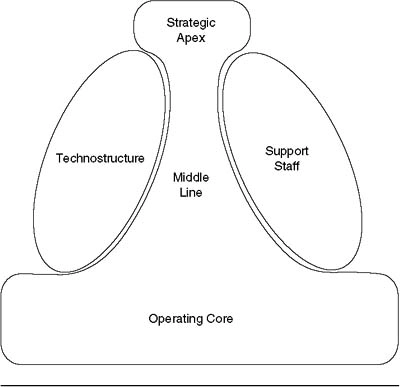
Figure 2. Five Pulls on the Organization
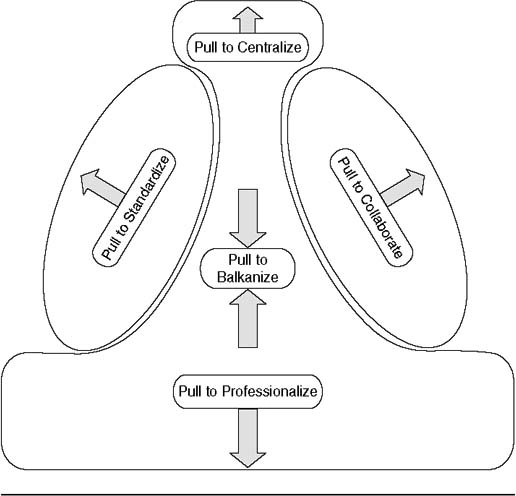
Figure 2, depicting Mintzberg's five organizational “pulls,” provides insights into the dynamics of complex organizations, certainly borne out by empirical evidence. All five basic social systems work to maximize their power, control, influence, and autonomy. The Strategic Apex clearly is interested in controlling, with their efforts focusing on pulling to centralize decision making. Middle Line managers generally try to maximize their autonomy in decision making, thus striving to Balkanize. The Operating Core struggles to control its own destiny by pulling to professionalize, as is evident in the decadeslong efforts of both teachers and nurses to professionalize. (Recently, we have seen the National Board for Teacher Certification established for teachers as evidence of high levels of professional accomplishment.)
As for the Technostructure, this social system pulls to standardize work processes, which can be seen by computer experts insisting on using the same models of computers everywhere, or in standardizing high school scheduling in districts with several high schools. Last, to gain influence and control, Support Staff press to collaborate.
By using Mintzberg's insights into organizational structure and pulls, we can describe, analyze, and predict a considerable range of behavior, thereby flushing out hitherto hidden and puzzling agendas relating to stratification and other organizational phenomena.
...
- Loading...
Get a 30 day FREE TRIAL
-
 Watch videos from a variety of sources bringing classroom topics to life
 -
Read modern, diverse business cases
-
Explore hundreds of books and reference titles

Read next

More like this
Sage Recommends
We found other relevant content for you on other Sage platforms.
Have you created a personal profile? Login or create a profile so that you can save clips, playlists and searches