
Entry
Entries A-Z
Subject index
Personnel Management
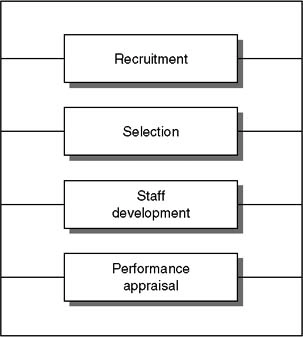
The personnel management process consists of the following steps: (a) recruitment, (b) selection, (c) staff development, and (d) performance appraisal. Figure 1 illustrates these steps. The figure also indicates that all of these various activities are affected by legislative constraints and union demands
Recruitment
Recruitment is the process of attracting a pool of qualified applicants to replenish or expand a school's human resources. To effectively recruit applicants, leaders must (a) have a thorough analysis of job requirements, (b) know the legal constraints that influence recruiting efforts, and (c) cultivate the sources of potential employees. To recruit appropriate personnel to fill vacant positions, the leader must know in detail what tasks are to be performed and the personal characteristics necessary to perform the tasks. These determinations are derived through job analysis. The information obtained through job analysis is used in most subsequent personnel decisions, such as selection, staff development, and performance appraisal. But its most immediate use is to prepare job descriptions and job specifications.
Figure 1. Personnel Management Process
The job description is a written statement of the duties and responsibilities, relationships, and results expected of the job incumbent. It generally includes job title, the person to whom the job incumbent reports, and a statement of the job goal. The job specification, also based on job analysis, specifies the minimum acceptable qualification that an incumbent must possess to perform the job successfully. It identifies the degree of education required, the desirable amount of previous experience, and the skills, abilities, and physical requirements needed to do the job effectively.
Every leader is affected to some extent by federal laws governing the recruitment and selection of employees. The laws governing equal employment opportunity (EEO) have had an especially long history in the United States; the laws prohibit employment decisions based on race, color, religion, sex, national origin, age, or disability. This legal environment has increased the need for high-caliber leaders who can deal with the complex legal requirements in personnel management.
School districts have a number of sources available for obtaining personnel. The first place that most leaders look when attempting to fill a position is within the school district. Policies for promotion from within are widely used, because they tend to increase employee morale and motivation while reducing recruitment costs.
External sources of potential employees are used when specialized skills, such as those of teachers, counselors, social workers, and computer programmers, are required. Some of the most frequently used external sources include college and university placement offices, state employment services, private employment agencies, newspaper and radio advertisements, professional journals, employee referrals, and professional meetings and conventions.
School districts that are committed to equal employment opportunities and affirmative action programs typically take additional steps to ensure that available positions are provided the broadest possible publicity, for example: (a) advertising in publications designed specifically for minority candidates, (b) contacting colleges and universities that specialize in educating women or minorities, (c) contacting employment agencies that specialize in placing women and minority candidates, and (d) contacting neighborhood groups or national organizations, such as the Urban League or the National Organization for Women, to reach minorities and women. These organizations, and groups like them, have newsletters or other media for contacting minority and female prospects.
...
- Loading...
Get a 30 day FREE TRIAL
-
 Watch videos from a variety of sources bringing classroom topics to life
 -
Read modern, diverse business cases
-
Explore hundreds of books and reference titles

Read next

More like this
Sage Recommends
We found other relevant content for you on other Sage platforms.
Have you created a personal profile? Login or create a profile so that you can save clips, playlists and searches