
Entry
Entries A-Z
Subject index
Perceptual Control Theory
Perceptual control theory (PCT) is a systems model for the regulation of actions based on negative feedback loops as used in engineering control theory developed by William T. Powers. The PCT model of behavior is a radical departure from previous theories about why the observed behavior of an individual occurs. The process of perception plays a central role in this theory.
Perceptual processes in PCT can be thought of, in some respects, as being the process that monitors the signals being generated about controlled variables. Most controlled variables reside in the environment, that is, events in the environment that are important to an individual, but some reside within the organism, that is, biological variables such as hunger and cognitive variables such as self-image. One is not aware of all perceptual processes as they take place, nor even most of them. Awareness is usually present only when control of a variable is being organized, when there is a disturbance of a controlled variable that requires a choice between response programs or after a programmed response fails to produce congruence between the reference value for a controlled variable and the perception of that controlled variable. In most cases, a disturbance of a controlled variable automatically initiates a previously developed and successful programmed response and does not require conscious awareness. Perception in the PCT model is hierarchical and includes 11 levels of perception (see Figure 1). Higher levels in the hierarchy set reference values for lower levels in the hierarchy. With each step up the hierarchy, the processing time for perceptual input slows down, so that processing at the highest level in the hierarchy proceeds at the slowest rate.
Figure 1. Perceptual Hierarchy and Feedback Loop Based on the 11-Level PCT Model
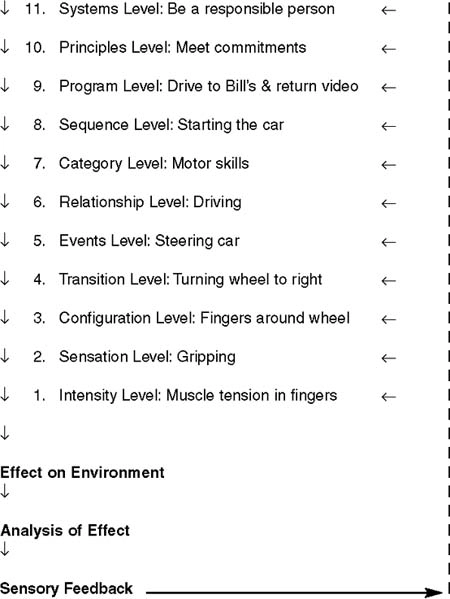
The top three levels are of most immediate interest in this discussion. It is at the systems level that reference values are set, not to be confused with personal values or standards that come from the principles level. Reference values can also be thought of as goals or wants. Reference values may be established in several ways. Reference values may have a biological basis, as in the case of physical needs; a social basis, as in the case of beliefs; and a personal basis, as in personal preferences. At the principles level, standards are developed to detect discrepancies between perceptual signals originating from controlled variables and the reference value or values related to a controlled variable. At the program level there is a repertoire of neurologically programmed actions that are available to reduce or eliminate any perceived discrepancy (error signal). Actions, according to PCT, are not responses caused by environmental stimuli but are caused by an individual's intent to reduce an error signal and thereby achieve congruence between a goal or reference value and the perception of some related controlled variable. In other words, the actions have a purpose, and the purpose behind the actions resides not in the environment but within the individual. Purpose in PCT becomes an important causal variable in human behavior or actions.
...
- Loading...
Get a 30 day FREE TRIAL
-
 Watch videos from a variety of sources bringing classroom topics to life
 -
Read modern, diverse business cases
-
Explore hundreds of books and reference titles

Read next

More like this
Sage Recommends
We found other relevant content for you on other Sage platforms.
Have you created a personal profile? Login or create a profile so that you can save clips, playlists and searches