
Entry
Reader's guide
Entries A-Z
Subject index
Johnson Administration, Lyndon
Lyndon Johnson assumed the presidency of the United States under trying circumstances. Having inherited the office in the wake of John Kennedy's assassination, Johnson was immediately thrust into the combined fires of a grieving nation, an escalating war in southeast Asia and domestic unrest in the form of civil rights protests and a rising crime rate. Adding to these mounting pressures, the problem of illegal narcotics was steadily growing.
The early part of Johnson's administration was characterized by events set in place under Kennedy. Perhaps the most notable of these was the report from the White House Conference on Narcotic and Drug Abuse, more commonly known as the Petty-man Commission (in reference to its chair, Judge E. Barrett Pettyman). A primary effect of the Pettyman report was to provide federal policymakers with the proper justification for expanded federal-level involvement in a problem heretofore the virtually exclusive province of state and local law enforcement. It did so by identifying the international and cross-jurisdictional mechanisms by which most illegal narcotics were produced and distributed.
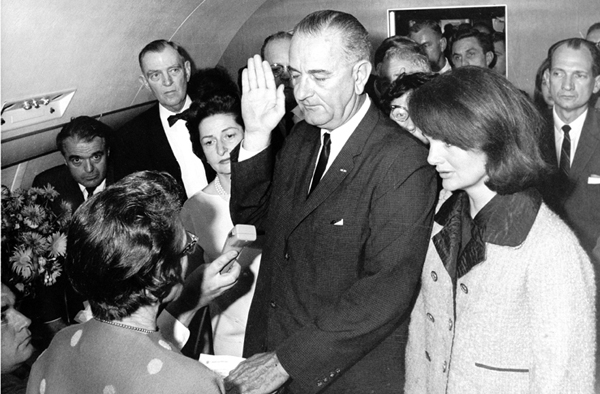
Lyndon Johnson taking the oath of office on board Air Force One on November 22,1963, after the assassination of John F. Kennedy. Johnson's administration eventually changed some drug policies based on the recommendations of the Pettyman Commission.
With this as its basis for intervention, the Johnson administration began what was essentially a three-pronged approach to the nation's growing drug problem. Johnson established strategies that would dominate well into the Nixon administration, including a body of domestic legislative reforms tailored to the particular challenges of the drug problem (both as a criminal and public health concern). The administration also made diplomatic overtures toward source countries with a goal of reduction or elimination of drug crops as well as disruption of their production and distribution structures. Lastly, the Johnson administration completed the wholesale bureaucratic reorganization of federal narcotics law enforcement and drug policy begun under Kennedy.
It bears noting that all of these system-level changes took place in the shadow of broad social upheaval. As American military commitments to the war in southeast Asia increased, antiwar protests likewise rose. Similarly, the civil rights movement fomented an often violent and fundamental reordering of race relations in America. Youth culture in its various guises challenged conventional attitudes about the place and acceptability of drug use in society. All of this occurred in the context of deeply divided debate among policymakers, the legal community, and medical experts, and social, religious, and academic leaders. As these varied constituencies argued the greater social implication of drugs in society, all aspects of the issue were considered: the size and scope of the problem; the nature of drug use among the public; moral and ethical implications; and the appropriate place of public policy as a means to reconcile emerging trends.
Context
To better understand the climate in which the Johnson administration was obliged to operate, one must look back beyond even the Kennedy administration. In the mid-1950s, members of the medical and legal profession levied criticisms of the government's approach to the growing problem of drugs in American society. The American Bar Association (ABA) and the American Medical Association (AMA) published a joint report titled “Interim Report” in 1958. Contrary to the monolithic law enforcement approach spearheaded by Harry Anslinger and the Federal Bureau of Narcotics (FBN), the ABA-AMA report supported outpatient treatment for drug addicts, legal reform related to drug crime and greater research to better understand drug use and addiction. Perhaps the greatest point of divergence from the Anslinger-approved line was the contention by ABA-AMA Committee Chairman Judge Morris Ploscowe that not all drug users were necessarily drug addicts and that the connection between drug use and other crime was not as clear-cut as some would contend.
...
- Employment Division v. Smith (1990)
- Gonzales v. O Centro Espirita Beneficente União do Vegetal (2006)
- Gonzales v. Oregon
- Gonzales v. Raich (2005)
- Gore v. United States (1958)
- Indianapolis v. Edmond (2000)
- Jin Fuey Moy v. United States (1920)
- Leary v. United States (1967)
- Lewis v. United States (1966)
- Linder v. United States (1925)
- People v. Woody (1964)
- United States v. Doremus (1919)
- United States v. Jeffers (1951)
- United States v. Kuch (1968)
- United States v. Sanchez (1950)
- United States v. Warner (1984)
- Convention on Psychotropic Substances, 1971
- Narcotics Limitation Convention of 1931
- National Commission on Marijuana and Drug Abuse (1972)
- 1909 Shanghai Conference
- 1912 Hague Conference
- 1925 Geneva Convention on Opium and Other Drugs
- 1946 Revision of the Harrison Act
- Single Convention on Narcotic Drugs, 1961
- United Nations Convention Against the Illicit Traffic in Narcotic Drugs
- Afghanistan
- Algeria
- Argentina
- Australia
- Azerbaijan
- Bahamas
- Bangladesh
- Belarus
- Belize
- Benin
- Bolivia
- Brazil
- Cambodia
- Canada
- Chile
- China
- Colombia
- Congo
- Costa Rica
- Cuba
- Denmark
- Dominican Republic
- Ecuador
- Egypt
- El Salvador
- France
- Germany
- Ghana
- Greece
- Guatemala
- Haiti
- Honduras
- Hong Kong
- India
- Indonesia
- Iran
- Iraq
- Ireland
- Israel
- Italy
- Jamaica
- Japan
- Jordan
- Kazakhstan
- Kenya
- Korea, South
- Kyrgyzstan
- Lao PDR
- Lebanon
- Libya
- Malaysia
- Mexico
- Morocco
- Myanmar
- Netherlands
- New Zealand
- Nicaragua
- Nigeria
- Pakistan
- Panama
- Papua New Guinea
- Paraguay
- Peru
- Philippines
- Poland
- Portugal
- Romania
- Russia
- Saudi Arabia
- Senegal
- Singapore
- South Africa
- Spain
- Sweden
- Switzerland
- Tajikistan
- Thailand
- Tunisia
- Turkey
- Uganda
- Ukraine
- United Kingdom
- United States
- Uruguay
- Uzbekistan
- Venezuela
- Vietnam
- Yemen
- Anti-Drug Operations, Pre-1960s
- Anti-Drug Operations, 1960s
- Anti-Drug Operations, 1970s
- Anti-Drug Operations, 1980s
- Anti-Drug Operations, 1990s
- Anti-Drug Operations, 2000s
- Asset Forfeiture
- Cocaine Cartels
- Data Collection Systems
- Drug Trafficking and Political Movements
- Drugs and Money Laundering
- Drugs and Terrorism
- Drugs-Crime Connection
- Golden Crescent
- Golden Triangle
- Prices and Volumes in Illicit Markets, Theories of
- Set and Setting
- Alabama Laws and Programs
- Alaska Laws and Programs
- Alcohol and Drug Abuse Education Amendments (1978)
- Analogue (Designer Drug) Act
- Anti-Drug Abuse Act (Drug-Free America Act)
- Anti-Drug Abuse Amendment Act
- Anti-Drug War Movement
- Arizona Laws and Programs
- Arkansas Laws and Programs
- Aviation Drug-Trafficking Control Act
- Boggs Act
- California Laws and Programs
- Colorado Laws and Programs
- Community Mental Health Centers Act
- Comprehensive Crime Control Act of 1984
- Comprehensive Drug Abuse Prevention and Control Act
- Comprehensive Methamphetamine Control Act
- Connecticut Laws and Programs
- Controlled Substance Registrant Protection Act
- Controlled Substances Import and Export Act
- Controlled Substances Penalties Amendments Act
- Criminal Justice/Enforcement Strategies of Drug Control
- Dangerous Drug Diversion Control Act
- Delaware Laws and Programs
- Demand-Side Policies
- Diversion Programs
- Drug Abuse Control Amendments (1965)
- Drug Courts
- Drug Policies: General Strategies
- Drug Policy Effects on Rates of Crime
- Drug Policy Effects on Rates of Drug-Related Illnesses
- Drug Policy Effects on Rates of Drug-Related Injuries
- Drug Policy Effects on Rates of Incarceration
- Drug Policy Effects on Rates of Use
- Drug-Free Communities Act
- Drugs and the Death Sentence
- Durham-Humphrey Act
- Ecstasy Anti-Proliferation Act
- Eighteenth Amendment to the U.S. Constitution
- Elite Model of Drug Laws
- Elite-Engineered Moral Panics
- Florida Laws and Programs
- Food and Drug Administration
- Georgia Laws and Programs
- Grassroots Model of Drug Laws
- Grassroots Moral Panics
- Group Model of Drug Laws
- Harrison Act
- Hawaii Laws and Programs
- Heroin Trafficking Act
- Idaho Laws and Programs
- Illicit Drug Anti-Proliferation Act
- Illinois Laws and Programs
- Indiana Laws and Programs
- International Drug Policies: Eradication of Narcotic Crops
- International Drug Policies: Interdiction and Law Enforcement
- International Drug Policies: International Cooperation
- International Drug Policies: Sanctions/Economic Assistance
- Iowa Laws and Programs
- “Just Say No”
- Kansas Laws and Programs
- Kentucky Laws and Programs
- Louisiana Laws and Programs
- Maine Laws and Programs
- Mandatory Sentencing
- Marihuana Tax Act (1937)
- Maryland Laws and Programs
- Massachusetts Laws and Programs
- Methadone Control Act
- Michigan Laws and Programs
- Minnesota Laws and Programs
- Mississippi Laws and Programs
- Missouri Laws and Programs
- Montana Laws and Programs
- Moral Panics and Drug Laws
- Narcotic Addict Rehabilitation Act
- Narcotic Control Act
- Narcotic Drug Act
- Narcotic Drug Import and Export Act
- Narcotics Manufacturers Act
- National Narcotics Act
- Native Races Act
- Nebraska Laws and Programs
- Nevada Laws and Programs
- New Hampshire Laws and Programs
- New Jersey Laws and Programs
- New Mexico Laws and Programs
- New York Laws and Programs
- 1946 Revision of Harrison Act
- North Carolina Laws and Programs
- North Dakota Laws and Programs
- Office of National Drug Control Policy Reauthorization Act
- Ohio Laws and Programs
- Oklahoma Laws and Programs
- Omnibus Drug Abuse Act
- Opium Poppy Control Act
- Oregon Laws and Programs
- Pennsylvania Laws and Programs
- Policies Regulating Alcohol, U.S.
- Policies Regulating Pharmaceutical Drugs, U.S.
- Policies Regulating Tobacco, U.S.
- Policing Techniques in the War on Drugs
- Porter Narcotic Farm Act
- Pure Food and Drug Act
- Reducing Americans' Vulnerability to Ecstasy Act (RAVE Act)
- Religious Freedom and Drug Laws
- Rhode Island Laws and Programs
- Rockefeller Laws
- Schedule of Controlled Substances
- South Carolina Laws and Programs
- South Dakota Laws and Programs
- Supply-Side Policies
- Tennessee Laws and Programs
- Testing and Sanctions
- Texas Laws and Programs
- Twenty-First Amendment to the U.S. Constitution
- Uniform State Narcotics Act
- Utah Laws and Programs
- Vermont Laws and Programs
- Virginia Laws and Programs
- Volstead Act
- “War on Drugs”
- Washington Laws and Programs
- Webb-Kenyon Act
- West Virginia Laws and Programs
- Wisconsin Laws and Programs
- Workplace: Drug-Free Policy
- Workplace: Role, Prevention, and Programs
- Wyoming Laws and Programs
- Zero Tolerance
- Alcoholics Anonymous
- Anti-Drug Grassroots Organizations
- Anti-Tobacco Campaigns
- Armed Forces
- Bureau of Drug Abuse Control
- Bureau of Narcotics and Dangerous Drugs
- D.A.R.E.
- Drug Enforcement Administration
- Drug Treatment Programs
- Federal Bureau of Narcotics
- International Drug Agencies
- International Narcotics Control Board
- Narcotics Anonymous
- National Organization for Reform of Marijuana Laws
- Office of Drug Abuse Law Enforcement
- Office of National Drug Control Policy
- Office of National Narcotics Intelligence
- Partnership for a Drug-Free America
- President's Advisory Commission on Narcotics and Drug Abuse (Prettyman)
- Secular Organizations for Sobriety
- Social Movements Against Drunken Driving
- Temperance Movement
- United Nations Office on Drugs and Crime
- U.S. Department of State Bureau of International Narcotics and Law Enforcement Affairs
- Women for Sobriety
- Ambrose, Myles
- Anslinger, Harry
- Bartels, John
- Bennett, William
- Bensinger, Peter
- Bonner, Robert
- Bourne, Peter
- Brown, Lee
- Constantine, Thomas
- Dupont, Robert
- Giordano, Henry
- Greene, Stephen
- Hutchinson, Asa
- Ingersoll, John
- Kerlikowske, Gil
- Lawn, John
- Leonhart, Michele
- Lindesmith, Alfred
- Marshall, Donnie
- Martinez, Bob
- McCaffrey, Barry R.
- Mill, John Stuart
- Mullen, Francis
- Sullivan, William
- Tandy, Karen
- Turner, Carlton
- Walters, John
- Bush Administration, George H. W.
- Bush Administration, George W.
- Carter Administration, James
- Clinton Administration, William
- Coolidge Administration, Calvin
- Eisenhower Administration, Dwight
- Ford Administration, Gerald
- Harding Administration, Warren
- Hoover Administration, Herbert
- Johnson Administration, Lyndon
- Kennedy Administration, John F.
- Nixon Administration, Richard
- Obama Administration, Barack
- Presidential Administrations Prior to Federal Drug Regulation
- Reagan Administration, Ronald
- Roosevelt Administration, Franklin D.
- Roosevelt Administration, Theodore
- Taft Administration, William Howard
- Truman Administration, Harry
- Wilson Administration, Woodrow
- Addiction Maintenance
- Coerced Drug Treatment
- Disease Model of Use
- Drug Abuse Warning Network
- Drug Testing
- Drug Treatment Programs
- Evaluative Evidence of Prevention Programs
- Evaluative Evidence of Rehab/Treatment Programs
- Group Therapy
- Harm Reduction
- Inpatient Treatment Programs
- Laboratory Techniques
- Needle Exchange Programs
- Prescription Drug Abuse
- Prevention Programs
- Rational Addiction Model of Drug Use
- Rehabilitation/Treatment Programs
- Safe Injection Rooms
- Single Distribution Theory of Consumption
- SMART Recovery
- 12-Step Recovery Programs
- Alcohol
- Amphetamines
- Antagonist Medications
- Barbiturates
- Caffeine
- Club Drugs
- Cocaine
- Crack
- Ecstasy
- Freebase
- Hallucinogens
- Heroin
- Inhalants
- Ketamine
- Khat
- LSD
- Marijuana
- Methadone
- Methamphetamine
- Morphine
- Over-the-Counter Drugs
- Salvia Divinorum
- Sedatives
- Steroids
- Synthetic Narcotics
- Tobacco
- Loading...
Get a 30 day FREE TRIAL
-
 Watch videos from a variety of sources bringing classroom topics to life
 -
Read modern, diverse business cases
-
Explore hundreds of books and reference titles

Read next

More like this
Sage Recommends
We found other relevant content for you on other Sage platforms.
Have you created a personal profile? Login or create a profile so that you can save clips, playlists and searches