
Entry
Reader's guide
Entries A-Z
Subject index
Rejection of International Aid
Disaster aid is a humanitarian effort undertaken by various countries in an effort to help areas of the world that are affected by natural, human-induced, or technological disasters. In the disaster studies literature, disaster assistance from one country to another is often termed disaster diplomacy. When disaster assistance, or disaster diplomacy, is offered in the aftermath of any form of disaster, a host of issues arise: human rights, vulnerable groups, international diplomacy, potential conflict resolution, environmental management, and environmentally sustainable rebuilding, or even more insidious forms of disaster capitalist activities.
The refusal or acceptance of disaster aid is based largely on the economic, cultural, and social conditions, as well as diplomatic relations, between the recipient and donor countries. Each factor impacts the quality of the aid and the decision to accept or deny disaster relief assistance. Also, the type and quality of the donation affects the acceptance of such assistance. The different types of aid offered include money, food, water, medical equipment, clothes, aid workers, and military aid. The supplies sent to countries are more readily usable than financial assistance, which must be exchanged for materials. While many forms of aid are directly sent to the government or people of the recipient country, monetary aid given to disaster-stricken areas often undergoes a filtering process before it reaches the recipient country. For example, the United States may give monetary aid to disaster areas by means of nongovernmental humanitarian agencies that allocate the money to the affected areas. Funding assistance, in the form of direct or indirect donations, is generally accepted. The monetary aspect of disaster aid can be difficult to accept or receive due to the process in which the money is sent. The practice of using outside organizations is often a means of preventing corruption and the squandering of monetary aid. The type of aid that is refused is often personnel and equipment.
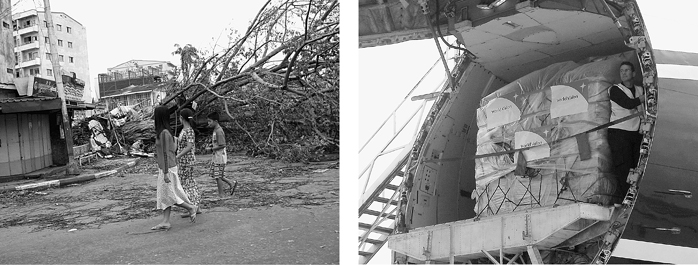
Cyclone Nargis caused widespread destruction and death in Myanmar in May 2008. After a period of refusing international aid and bureaucratic stalling, the ruling military junta finally made a plea for help. Many agencies, such as World Vision (right), responded
Media, Politics, Pride, and Culture
There are many factors that determine the acceptance of disaster relief assistance, such as the amount of media coverage the disaster receives. For example, the Columbian landslides in 1985 and the Pakistani windstorms in 1993 both received limited media coverage, which in turn gave little international exposure to the plight of those suffering from the tragic events. Thus, the lack of media exposure caused less aid to be offered. The media is an effective tool for informing the masses; when data and news footage (e.g., that of property damage, fatalities, or images of loss) regarding disasters are not readily accessible to the masses via media coverage, the amount of disaster aid sent to those countries is limited.
Political favoritism is another reason certain disaster areas receive more attention than others. Political science professor Travis Nelson and others assert that domestic disaster relief within the United States is driven by political concerns that are important to those currently in power. However, international motives for donating disaster aid exist as well. The decision to offer disaster aid represents political reconciliation attempts, political gain, or a subliminal tactic to regain control over a past colony. Disaster aid in the form of political reconciliation is exemplified in the case of the 1999 Marmara earthquake in Turkey. The relationship between Greece and Turkey, which was often strained, grew stronger due in part to the humanitarian assistance offered by Greece. In this example, emergency aid is used as a humanitarian effort that evolved into a reconciliation of past grievances between the two countries.
...
- Africa, North
- Africa, Sub-Saharan
- Asia, East
- Asia, West, Central, and South
- Australia and Pacific Region
- Canada
- Caribbean Island Region
- China
- Desertification
- Earthquake Zones
- Europe, Eastern
- Europe, Western
- Evacuation Routes
- Glacial Melt
- Hurricane Zones
- Japan
- Mediterranean Region
- Mexico
- Middle East
- Ring of Fire
- Russia
- South America
- United Kingdom
- United States, California and West Coast
- United States, Great Lakes
- United States, Hawaii and Pacific Territories
- United States, Mid-Atlantic
- United States, Midwest
- United States, Mountain States
- United States, National
- United States, Northeast
- United States, Northwest and Northern Plains
- United States, Southeast and Gulf Coast
- United States, Southwest
- American Red Cross
- Center for International Disaster Information (CIDI)
- Centers for Disease Control and Prevention (CDC)
- ChildFund International
- Coast Guard, U.S.
- Cooperative for Assistance and Relief Everywhere (CARE)
- Defense, U.S. Department of Direct Relief
- Disaster Preparedness and Emergency Response Associations
- Doctors Without Borders
- Federal Emergency Management Agency (FEMA)
- Food and Agriculture Organization of the United Nations (FAO)
- Habitat for Humanity
- Homeland Security, U.S. Department of Institutional Coordination
- InterAction
- International Law in the Prevention and Mitigation of Disasters
- International Medical Corps
- International Red Cross
- Interpol
- Lutheran World Federation
- Mercy Corps
- National Governments
- Peace Corps
- Red Crescent Society
- Relief International
- Relief Rules
- Salvation Army
- St. Vincent de Paul
- State Governments
- United Nations
- United Nations Children's Fund (UNICEF)
- United Nations Development Programme (UNDP)
- United Nations High Commissioner for Refugees (UNHCR)
- United States Agency for International Development (USAID)
- World Concern
- World Emergency Relief
- World Food Program
- World Health Organization (WHO)
- World Relief
- World Vision
- History of Disaster Relief, Africa
- History of Disaster Relief, Ancient World
- History of Disaster Relief, China and East Asia
- History of Disaster Relief, Europe
- History of Disaster Relief, India
- History of Disaster Relief, Middle East
- History of Disaster Relief, North America
- History of Disaster Relief, Pacific Region
- History of Disaster Relief, Russia
- History of Disaster Relief, South America
- Chemical Disasters
- Cyberattacks
- Economic Disasters
- Food Contamination Disasters
- Gulf Coast Oil Spill (2010)
- Pandemic/Biological Accidents
- Poverty and Disasters
- Radiation Disasters
- Terrorism
- Wars
- Air Transport
- Food Distribution Infrastructure
- Internet
- Mass Transit
- Ports
- Railroads
- Roads
- Schools
- Utilities
- Water Systems
- Community Preparedness
- Community Response
- Evacuation
- Fire Departments
- Home Preparedness
- Local Hazards
- Municipal Offices of Emergency Management
- Personal Preparedness
- Police Departments
- Private Sector Preparedness
- Public Agency Preparedness
- Public-Private Partnerships
- University Preparedness
- Warnings
- Bubonic Plague
- HIV/AIDS
- Malaria (20th Century-Present)
- Measles (1850-Present)
- Severe Acute Respiratory Syndrome (SARS)
- Smallpox (20th Century)
- Tuberculosis (20th Century-Present)
- Earthquakes
- Famine
- Fire
- Floods
- Hurricanes
- Terrorist Attacks
- Tsunami
- Volcanoes
- Wars
- First Aid
- Hysteria
- Pandemic Planning
- Panic
- Panic
- Psychology, Mass
- Psychology, Personal
- Social Work
- Stress Syndromes
- Survivor Guilt
- Working With the Bereaved
- Agricultural Production
- Business Continuity Planning
- Citizen Preparedness Programs
- Cooperation Between Civilian and Military Agencies
- Crisis Management
- Education
- Emergency Response Guidelines and Regulations
- Emergency Rooms
- Evacuation Planning
- Evacuation, Types of
- Exercise Planning
- Food Distribution Systems
- Healthcare
- Hospital Preparedness
- International Standards
- Language Issues and Barriers
- Levels of Nutrition
- Mass Casualty Management
- Media
- National Incident Management System (NIMS)
- National Standards
- Packaging and Tracing of Food
- Paramedics
- Political Economy of Food
- Provision of Food in Disasters
- Refugee Policy
- Refugees, Care of
- Reserve Storage and Transport
- Transportation
- Vulnerable Populations
- Incentives, Intergovernmental and Intersystem
- Mitigation, Benefits and Costs of
- Private Sector, Role in Mitigation
- Public Sector, Role in Mitigation
- Public-Private Interactions in Mitigation
- Regulatory Approaches to Mitigation
- Risk, Government Assumption of
- Risk, Individual Assumption of
- Structural (Engineering) Options for Mitigation
- Avalanches
- Diseases
- Droughts
- Earthquakes
- Fires, Forest
- Fires, Urban
- Floods
- Heat Waves
- Hurricanes/Typhoons
- Landslides
- Pest Invasions
- Sea Surges
- Tornadoes
- Tsunamis
- Volcanoes
- Winter Storms
- Bilateral Versus Multilateral Aid
- Domestic Corruption in International Disasters
- Domestic Politics in International Disasters
- Donations, National
- Donations, Personal
- Funding of International Relief
- Fundraising Cycles
- Politics in International Funding
- Rejection of International Aid
- Intergovernmental Relations and Preparedness
- Planning for Disasters, International
- Planning for Disasters, Local
- Planning for Disasters, National
- Political Support for Preparedness
- Preparedness, Function of
- Preparedness Policy Implementation
- Private Sector, Role in Preparedness
- Research-Based Disaster Planning
- Private Sector, Role in Recovery
- Recovery, International
- Recovery, Local
- Recovery, National
- Recovery, Phases of
- Recovery, Role of Governments in
- Private Sector, Role in Response
- Response, Management Strategies
- Response, Operational Strategies
- Response, Stress Impacts of
- Data Processing
- Early Warning and Prediction Systems
- Funding, U.S.
- Global Warming
- Modeling
- National Oceanic and Atmospheric Administration (NOAA)
- Real-Time Communications
- Research
- Technology
- Technology, Military
- Causes of Complex Emergencies
- Cross-Cultural Interactions
- Cycles of a Disaster
- Disaster Experience
- Education
- Emergency Management Resources
- Ethics of Charity Relief
- Ethnicity and Minority Status Effects on Preparedness
- Gender and Disasters
- Human Rights
- Humanitarian Intervention Versus Humanitarian Action
- Income Inequality and Disaster Relief
- Laws
- Personal Preparedness
- Politics, Domestic
- Politics in International Funding
- Protection of Civilians in Conflict Zones
- Public Policy
- Refugees
- Relief Versus Development
- Risk Communications
- Risk Management
- Risk Perceptions
- Social Impact of Disasters
- Training for Disasters
- Victimology
- United States, California and West Coast
- United States, Great Lakes
- United States, Hawaii and Pacific Territories
- United States, Mid-Atlantic
- United States, Midwest
- United States, Mountain States
- United States, National
- United States, Northeast
- United States, Northwest and Northern Plains
- United States, Southeast and Gulf Coast
- United States, Southwest
- Loading...
Get a 30 day FREE TRIAL
-
 Watch videos from a variety of sources bringing classroom topics to life
 -
Read modern, diverse business cases
-
Explore hundreds of books and reference titles

Read next

More like this
Sage Recommends
We found other relevant content for you on other Sage platforms.
Have you created a personal profile? Login or create a profile so that you can save clips, playlists and searches