
Entry
Reader's guide
Entries A-Z
Subject index
Krakatoa Eruption (1883)
On August 26, 1883, the volcanic Indonesian island of Krakatoa erupted with an explosion so devastating it impacted the entire Earth. One of the most catastrophic natural disasters in recorded history, the Krakatoa explosion sent cubic miles of earth into the ocean, creating tsunamis; affected the weather by spewing fine ash into the upper atmosphere; and sent boulders as large as trucks flying through the air.
The eruption was heard more than 3,000 miles away. Because there was little advanced technology to warn of the eruption or alert people to the ash and tsunamis, over 36,000 people died. In the 19th century, most relief efforts were from nearby populations with unorganized aid from major nations delivered by military transportation.
Krakatoa is located in the Sunda Strait, 25 miles off the west coast of Java on the Indonesian island of Rakata, and was formed by the subduction of the Indian-Australia plate under the Eurasian plate. The highest known elevation was 2,600 feet, and its first known eruption occurred in 416 C.E., which collapsed the existing volcano of Krakatoa into a four-mile-wide caldera, leaving the island remnants of Verlaten and Lang.
Leading up to the Eruption
After 200 years of inactivity, Krakatoa became active in early 1883 with a large earthquake. Seismic activity strengthened until May 20, 1883, when the first explosive eruption occurred.
In the early afternoon of August 26, 1883, explosions increased in frequency to about every 10 minutes. The crater rim was about 0.6 miles in diameter, and 0.3 miles deep. The central vent was plugged by lava, and pressure was rapidly building. Between August 26 and 27, there were four gigantic explosions. The first occurred at 5:07 p.m. on the afternoon of August 26. A black cloud of ash rose 17 miles above Krakatoa. On August 27, three more explosions occurred at 5:30 A.M., 6:44 A.M., and 10:02 A.M. The last, sudden eruption blew away the northern two-thirds of the island, and was the most severe volcanic explosion in modern times. The collapse of the volcanic chambers formed a huge underwater caldera, generating tsunami waves as high as 120 feet. The abruptness of Krakatoa's explosion was caused by ocean water entering the magmatic chambers and creating superheated steam that built up tremendous pressure.
This Parker & Coward lithograph of Krakatoa in Indonesia, 1883, shows the early stages of the devastating eruption
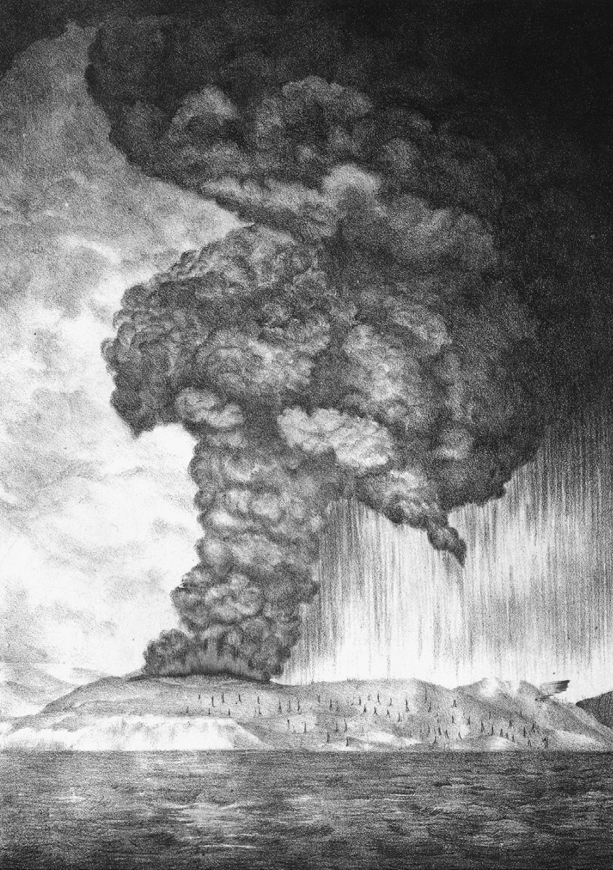
The eruption has been assigned a Volcanic Explosivity Index (VEI) of 6, which rates as “colossal”; the plume height was over 15 miles, and the eruption had a displacement between 6 and 62 cubic miles. The total energy released by the main eruptions was equivalent to 200 megatons of TNT. Most of the energy, released by the third explosion, was estimated to be 150 megatons. About 11 cubic miles of material was ejected into the atmosphere. What remained were a few small islands, including Anak Krakatoa (Krakatoa's Child), which is an extremely active young volcano.
The Effects
Blast waves cracked walls and broke windows up to 100 miles away. Atmospheric shock waves circled the Earth seven times and were recorded throughout the world. Massive amounts of hot gases, rocks, and ash ejected by the eruptions (pyroclastic flows) traveled over the water at hundreds of miles per hour, hitting islands 25 miles away. About 4,500 deaths (10 percent of the total) were attributed to falling tephra (ash, cinders, and rocks) in the pyroclastic flows, and about 2,000 people died from severe burns. The flows were also recorded by several ships. The Louden, 30 miles north-northeast of Krakatoa, was struck by severe winds and tephra; and the W.H. Besse, 50 miles east-northeast of Krakatoa, was hit by hurricane-force winds, heavy tephra, and the strong smell of sulfur.
...
- Africa, North
- Africa, Sub-Saharan
- Asia, East
- Asia, West, Central, and South
- Australia and Pacific Region
- Canada
- Caribbean Island Region
- China
- Desertification
- Earthquake Zones
- Europe, Eastern
- Europe, Western
- Evacuation Routes
- Glacial Melt
- Hurricane Zones
- Japan
- Mediterranean Region
- Mexico
- Middle East
- Ring of Fire
- Russia
- South America
- United Kingdom
- United States, California and West Coast
- United States, Great Lakes
- United States, Hawaii and Pacific Territories
- United States, Mid-Atlantic
- United States, Midwest
- United States, Mountain States
- United States, National
- United States, Northeast
- United States, Northwest and Northern Plains
- United States, Southeast and Gulf Coast
- United States, Southwest
- American Red Cross
- Center for International Disaster Information (CIDI)
- Centers for Disease Control and Prevention (CDC)
- ChildFund International
- Coast Guard, U.S.
- Cooperative for Assistance and Relief Everywhere (CARE)
- Defense, U.S. Department of Direct Relief
- Disaster Preparedness and Emergency Response Associations
- Doctors Without Borders
- Federal Emergency Management Agency (FEMA)
- Food and Agriculture Organization of the United Nations (FAO)
- Habitat for Humanity
- Homeland Security, U.S. Department of Institutional Coordination
- InterAction
- International Law in the Prevention and Mitigation of Disasters
- International Medical Corps
- International Red Cross
- Interpol
- Lutheran World Federation
- Mercy Corps
- National Governments
- Peace Corps
- Red Crescent Society
- Relief International
- Relief Rules
- Salvation Army
- St. Vincent de Paul
- State Governments
- United Nations
- United Nations Children's Fund (UNICEF)
- United Nations Development Programme (UNDP)
- United Nations High Commissioner for Refugees (UNHCR)
- United States Agency for International Development (USAID)
- World Concern
- World Emergency Relief
- World Food Program
- World Health Organization (WHO)
- World Relief
- World Vision
- History of Disaster Relief, Africa
- History of Disaster Relief, Ancient World
- History of Disaster Relief, China and East Asia
- History of Disaster Relief, Europe
- History of Disaster Relief, India
- History of Disaster Relief, Middle East
- History of Disaster Relief, North America
- History of Disaster Relief, Pacific Region
- History of Disaster Relief, Russia
- History of Disaster Relief, South America
- Chemical Disasters
- Cyberattacks
- Economic Disasters
- Food Contamination Disasters
- Gulf Coast Oil Spill (2010)
- Pandemic/Biological Accidents
- Poverty and Disasters
- Radiation Disasters
- Terrorism
- Wars
- Air Transport
- Food Distribution Infrastructure
- Internet
- Mass Transit
- Ports
- Railroads
- Roads
- Schools
- Utilities
- Water Systems
- Community Preparedness
- Community Response
- Evacuation
- Fire Departments
- Home Preparedness
- Local Hazards
- Municipal Offices of Emergency Management
- Personal Preparedness
- Police Departments
- Private Sector Preparedness
- Public Agency Preparedness
- Public-Private Partnerships
- University Preparedness
- Warnings
- Bubonic Plague
- HIV/AIDS
- Malaria (20th Century-Present)
- Measles (1850-Present)
- Severe Acute Respiratory Syndrome (SARS)
- Smallpox (20th Century)
- Tuberculosis (20th Century-Present)
- Earthquakes
- Famine
- Fire
- Floods
- Hurricanes
- Terrorist Attacks
- Tsunami
- Volcanoes
- Wars
- First Aid
- Hysteria
- Pandemic Planning
- Panic
- Panic
- Psychology, Mass
- Psychology, Personal
- Social Work
- Stress Syndromes
- Survivor Guilt
- Working With the Bereaved
- Agricultural Production
- Business Continuity Planning
- Citizen Preparedness Programs
- Cooperation Between Civilian and Military Agencies
- Crisis Management
- Education
- Emergency Response Guidelines and Regulations
- Emergency Rooms
- Evacuation Planning
- Evacuation, Types of
- Exercise Planning
- Food Distribution Systems
- Healthcare
- Hospital Preparedness
- International Standards
- Language Issues and Barriers
- Levels of Nutrition
- Mass Casualty Management
- Media
- National Incident Management System (NIMS)
- National Standards
- Packaging and Tracing of Food
- Paramedics
- Political Economy of Food
- Provision of Food in Disasters
- Refugee Policy
- Refugees, Care of
- Reserve Storage and Transport
- Transportation
- Vulnerable Populations
- Incentives, Intergovernmental and Intersystem
- Mitigation, Benefits and Costs of
- Private Sector, Role in Mitigation
- Public Sector, Role in Mitigation
- Public-Private Interactions in Mitigation
- Regulatory Approaches to Mitigation
- Risk, Government Assumption of
- Risk, Individual Assumption of
- Structural (Engineering) Options for Mitigation
- Avalanches
- Diseases
- Droughts
- Earthquakes
- Fires, Forest
- Fires, Urban
- Floods
- Heat Waves
- Hurricanes/Typhoons
- Landslides
- Pest Invasions
- Sea Surges
- Tornadoes
- Tsunamis
- Volcanoes
- Winter Storms
- Bilateral Versus Multilateral Aid
- Domestic Corruption in International Disasters
- Domestic Politics in International Disasters
- Donations, National
- Donations, Personal
- Funding of International Relief
- Fundraising Cycles
- Politics in International Funding
- Rejection of International Aid
- Intergovernmental Relations and Preparedness
- Planning for Disasters, International
- Planning for Disasters, Local
- Planning for Disasters, National
- Political Support for Preparedness
- Preparedness, Function of
- Preparedness Policy Implementation
- Private Sector, Role in Preparedness
- Research-Based Disaster Planning
- Private Sector, Role in Recovery
- Recovery, International
- Recovery, Local
- Recovery, National
- Recovery, Phases of
- Recovery, Role of Governments in
- Private Sector, Role in Response
- Response, Management Strategies
- Response, Operational Strategies
- Response, Stress Impacts of
- Data Processing
- Early Warning and Prediction Systems
- Funding, U.S.
- Global Warming
- Modeling
- National Oceanic and Atmospheric Administration (NOAA)
- Real-Time Communications
- Research
- Technology
- Technology, Military
- Causes of Complex Emergencies
- Cross-Cultural Interactions
- Cycles of a Disaster
- Disaster Experience
- Education
- Emergency Management Resources
- Ethics of Charity Relief
- Ethnicity and Minority Status Effects on Preparedness
- Gender and Disasters
- Human Rights
- Humanitarian Intervention Versus Humanitarian Action
- Income Inequality and Disaster Relief
- Laws
- Personal Preparedness
- Politics, Domestic
- Politics in International Funding
- Protection of Civilians in Conflict Zones
- Public Policy
- Refugees
- Relief Versus Development
- Risk Communications
- Risk Management
- Risk Perceptions
- Social Impact of Disasters
- Training for Disasters
- Victimology
- United States, California and West Coast
- United States, Great Lakes
- United States, Hawaii and Pacific Territories
- United States, Mid-Atlantic
- United States, Midwest
- United States, Mountain States
- United States, National
- United States, Northeast
- United States, Northwest and Northern Plains
- United States, Southeast and Gulf Coast
- United States, Southwest
- Loading...
Get a 30 day FREE TRIAL
-
 Watch videos from a variety of sources bringing classroom topics to life
 -
Read modern, diverse business cases
-
Explore hundreds of books and reference titles

Read next

More like this
Sage Recommends
We found other relevant content for you on other Sage platforms.
Have you created a personal profile? Login or create a profile so that you can save clips, playlists and searches