
Entry
Reader's guide
Entries A-Z
Subject index
History of Disaster Relief, India
The history of disaster relief in India dates back to the first Indian Famine Commission of 1880, which laid the foundation of India's relief system, called the Famine Codes. In independent India the name changed to the of Scarcity Manuals and Relief Codes. They underwent occasional revisions until 2007, when the Central Disaster Management Act of 2005 superseded these codes.
Because severe famines abound in India's past, disaster relief was introduced to counteract the effect of famines. Famine relief has a very long history in India, which varies in region and scope. Indian development economist Jean Drèze noted that one of the very first treatises on government relief was written more than 2,000 years ago during the rule of Kautiliya. At that time, the method of famine relief distribution by Indian rule included free distribution of raw grain, opening of public grain stores to the people, remission of revenue, public works, and encouragement of migration. The East India Company continued this legacy until the 1860s and later adopted a nonintervention policy.
A woman identified as Miss Neil (right) and an unidentified Indian woman support a famine victim in India, circa 1900–20
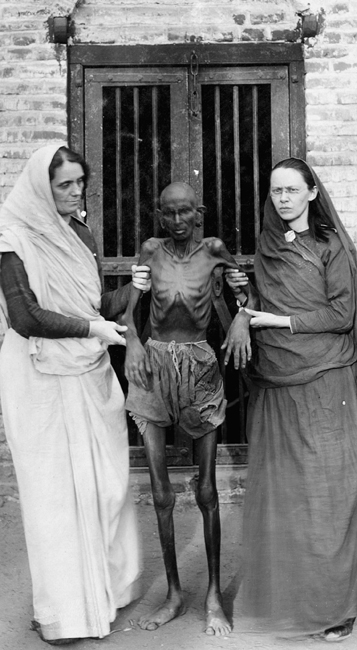
Toward the end of the 19th century and the first decade of the 20th century, India experienced four widespread famines, in 1876–1908; 1896–1907, 1899–1900, and 1907–08. All four affected virtually the entire subcontinent, and each caused several million deaths. The sheer failure on the part of the government to prevent the famine from 1876 to 1908 prompted the establishment of the first Indian Famine Commission of 1880. The commission led to the development of the Famine Codes, which represented an essential (though not quite decisive) step toward the prevention of famines in India. The Famine Codes contained guidelines for the local administration on anticipation, recognition, and relief of famines and other natural calamities, including floods and cyclones. Each state was required to develop its own code by adapting the model drafted by the government to its local circumstances. The widespread famines of 1896–1907 and 1899–1900 further prompted the establishment of the Indian Famine Commission of 1898 and 1901, respectively.
The Indian Famine Commission of 1880
The Famine Commission of 1880 envisioned immediate relief measures for people affected by disasters. The relief measures took both direct and indirect forms. Direct relief included employment for massive public works projects at subsistence wages for those who requested it. Complementary to this was gratuitous relief given to those who were unable to work. These included relief kitchens; poorhouses; and cash handouts for women, the sick, the elderly, and children. Indirect relief measures included remission from land revenue and agricultural loans for both subsistence and production, which was distributed to the cultivators. These measures were also extended for localized floods or cyclones by the respective state governments. According to Drèze, these relief measures hinted that the British administration understood that protection of food entitlement was crucial to the problems of preventing famine (and other natural disasters), since the physical availability of food was not problematic except during the famine of 1896–1902.
...
- Africa, North
- Africa, Sub-Saharan
- Asia, East
- Asia, West, Central, and South
- Australia and Pacific Region
- Canada
- Caribbean Island Region
- China
- Desertification
- Earthquake Zones
- Europe, Eastern
- Europe, Western
- Evacuation Routes
- Glacial Melt
- Hurricane Zones
- Japan
- Mediterranean Region
- Mexico
- Middle East
- Ring of Fire
- Russia
- South America
- United Kingdom
- United States, California and West Coast
- United States, Great Lakes
- United States, Hawaii and Pacific Territories
- United States, Mid-Atlantic
- United States, Midwest
- United States, Mountain States
- United States, National
- United States, Northeast
- United States, Northwest and Northern Plains
- United States, Southeast and Gulf Coast
- United States, Southwest
- American Red Cross
- Center for International Disaster Information (CIDI)
- Centers for Disease Control and Prevention (CDC)
- ChildFund International
- Coast Guard, U.S.
- Cooperative for Assistance and Relief Everywhere (CARE)
- Defense, U.S. Department of Direct Relief
- Disaster Preparedness and Emergency Response Associations
- Doctors Without Borders
- Federal Emergency Management Agency (FEMA)
- Food and Agriculture Organization of the United Nations (FAO)
- Habitat for Humanity
- Homeland Security, U.S. Department of Institutional Coordination
- InterAction
- International Law in the Prevention and Mitigation of Disasters
- International Medical Corps
- International Red Cross
- Interpol
- Lutheran World Federation
- Mercy Corps
- National Governments
- Peace Corps
- Red Crescent Society
- Relief International
- Relief Rules
- Salvation Army
- St. Vincent de Paul
- State Governments
- United Nations
- United Nations Children's Fund (UNICEF)
- United Nations Development Programme (UNDP)
- United Nations High Commissioner for Refugees (UNHCR)
- United States Agency for International Development (USAID)
- World Concern
- World Emergency Relief
- World Food Program
- World Health Organization (WHO)
- World Relief
- World Vision
- History of Disaster Relief, Africa
- History of Disaster Relief, Ancient World
- History of Disaster Relief, China and East Asia
- History of Disaster Relief, Europe
- History of Disaster Relief, India
- History of Disaster Relief, Middle East
- History of Disaster Relief, North America
- History of Disaster Relief, Pacific Region
- History of Disaster Relief, Russia
- History of Disaster Relief, South America
- Chemical Disasters
- Cyberattacks
- Economic Disasters
- Food Contamination Disasters
- Gulf Coast Oil Spill (2010)
- Pandemic/Biological Accidents
- Poverty and Disasters
- Radiation Disasters
- Terrorism
- Wars
- Air Transport
- Food Distribution Infrastructure
- Internet
- Mass Transit
- Ports
- Railroads
- Roads
- Schools
- Utilities
- Water Systems
- Community Preparedness
- Community Response
- Evacuation
- Fire Departments
- Home Preparedness
- Local Hazards
- Municipal Offices of Emergency Management
- Personal Preparedness
- Police Departments
- Private Sector Preparedness
- Public Agency Preparedness
- Public-Private Partnerships
- University Preparedness
- Warnings
- Bubonic Plague
- HIV/AIDS
- Malaria (20th Century-Present)
- Measles (1850-Present)
- Severe Acute Respiratory Syndrome (SARS)
- Smallpox (20th Century)
- Tuberculosis (20th Century-Present)
- Earthquakes
- Famine
- Fire
- Floods
- Hurricanes
- Terrorist Attacks
- Tsunami
- Volcanoes
- Wars
- First Aid
- Hysteria
- Pandemic Planning
- Panic
- Panic
- Psychology, Mass
- Psychology, Personal
- Social Work
- Stress Syndromes
- Survivor Guilt
- Working With the Bereaved
- Agricultural Production
- Business Continuity Planning
- Citizen Preparedness Programs
- Cooperation Between Civilian and Military Agencies
- Crisis Management
- Education
- Emergency Response Guidelines and Regulations
- Emergency Rooms
- Evacuation Planning
- Evacuation, Types of
- Exercise Planning
- Food Distribution Systems
- Healthcare
- Hospital Preparedness
- International Standards
- Language Issues and Barriers
- Levels of Nutrition
- Mass Casualty Management
- Media
- National Incident Management System (NIMS)
- National Standards
- Packaging and Tracing of Food
- Paramedics
- Political Economy of Food
- Provision of Food in Disasters
- Refugee Policy
- Refugees, Care of
- Reserve Storage and Transport
- Transportation
- Vulnerable Populations
- Incentives, Intergovernmental and Intersystem
- Mitigation, Benefits and Costs of
- Private Sector, Role in Mitigation
- Public Sector, Role in Mitigation
- Public-Private Interactions in Mitigation
- Regulatory Approaches to Mitigation
- Risk, Government Assumption of
- Risk, Individual Assumption of
- Structural (Engineering) Options for Mitigation
- Avalanches
- Diseases
- Droughts
- Earthquakes
- Fires, Forest
- Fires, Urban
- Floods
- Heat Waves
- Hurricanes/Typhoons
- Landslides
- Pest Invasions
- Sea Surges
- Tornadoes
- Tsunamis
- Volcanoes
- Winter Storms
- Bilateral Versus Multilateral Aid
- Domestic Corruption in International Disasters
- Domestic Politics in International Disasters
- Donations, National
- Donations, Personal
- Funding of International Relief
- Fundraising Cycles
- Politics in International Funding
- Rejection of International Aid
- Intergovernmental Relations and Preparedness
- Planning for Disasters, International
- Planning for Disasters, Local
- Planning for Disasters, National
- Political Support for Preparedness
- Preparedness, Function of
- Preparedness Policy Implementation
- Private Sector, Role in Preparedness
- Research-Based Disaster Planning
- Private Sector, Role in Recovery
- Recovery, International
- Recovery, Local
- Recovery, National
- Recovery, Phases of
- Recovery, Role of Governments in
- Private Sector, Role in Response
- Response, Management Strategies
- Response, Operational Strategies
- Response, Stress Impacts of
- Data Processing
- Early Warning and Prediction Systems
- Funding, U.S.
- Global Warming
- Modeling
- National Oceanic and Atmospheric Administration (NOAA)
- Real-Time Communications
- Research
- Technology
- Technology, Military
- Causes of Complex Emergencies
- Cross-Cultural Interactions
- Cycles of a Disaster
- Disaster Experience
- Education
- Emergency Management Resources
- Ethics of Charity Relief
- Ethnicity and Minority Status Effects on Preparedness
- Gender and Disasters
- Human Rights
- Humanitarian Intervention Versus Humanitarian Action
- Income Inequality and Disaster Relief
- Laws
- Personal Preparedness
- Politics, Domestic
- Politics in International Funding
- Protection of Civilians in Conflict Zones
- Public Policy
- Refugees
- Relief Versus Development
- Risk Communications
- Risk Management
- Risk Perceptions
- Social Impact of Disasters
- Training for Disasters
- Victimology
- United States, California and West Coast
- United States, Great Lakes
- United States, Hawaii and Pacific Territories
- United States, Mid-Atlantic
- United States, Midwest
- United States, Mountain States
- United States, National
- United States, Northeast
- United States, Northwest and Northern Plains
- United States, Southeast and Gulf Coast
- United States, Southwest
- Loading...
Get a 30 day FREE TRIAL
-
 Watch videos from a variety of sources bringing classroom topics to life
 -
Read modern, diverse business cases
-
Explore hundreds of books and reference titles

Read next

More like this
Sage Recommends
We found other relevant content for you on other Sage platforms.
Have you created a personal profile? Login or create a profile so that you can save clips, playlists and searches