
Entry
Reader's guide
Entries A-Z
Subject index
Evacuation
Evacuation is the most widespread and effective measure to protect the public against sudden-impact disasters. However, it is not always appropriate, feasible, or advisable, especially if there is insufficient lead time in which to warn people and organize their journeys.
Four Categories of Evacuation
Evacuation can be classified into four categories: emergency protection for short-term, pre-impact response; preventative under long-term, pre-impact conditions; rescue during the short term, immediately after impact; and for reconstruction during the long-term, post-impact phase. Principles and processes of evacuation may be applied on a wide variety of scales, ranging from the egress of people from a burning building to the withdrawal of entire populations from coastal areas threatened by hurricanes. Evacuation can be optional (although it rarely is) or mandatory, and backed up by a legal warrant such as a mayoral ordinance. Although it can be mandated by the power of law, it usually cannot be enforced under the threat of police arrest; in any case, in disasters, resources are not likely to be available for such an endeavor.
The use of pre-impact evacuation is critically dependent on the ability to warn evacuees and on the officials who will guide them to safety. In most cases, evacuation should only be the preferred strategy if there is time to carry it out. Hazard and disaster warnings need systems composed of technical, scientific, organizational, and social components. Scientists will monitor the hazard and decide when it reaches critical levels. Public administrators will determine whether evacuation is the correct response, and the general public will have to respond appropriately to the evacuation order. The whole process needs to be organized into a tried and tested system in which all parties know in advance what their roles and responsibilities are.
The critical points in the warning process are often the linkages between the subsystems. For example, there are questions of how to convey information to people in a useful time interval. There are also issues with potential evacuees' perceptions of warning information. Research suggests that people who react best to warnings are relatively young adults, female, parents with children at home, and those who enjoy the support of kinship networks. They are well-educated, relatively wealthy, well-integrated with local institutions, and fully capable of understanding the risks. They tend not to be members of ethnic, cultural, or religious minorities.
An example of the gross failure of a warning process can be found in the eruption of the Volcano Nevado del Ruíz in Colombia on November 13, 1986. The volcano was heavily instrumented, scientific data was constantly monitored, and an accurate hazard map had been produced, but regardless, 23,000 people died in lahars (volcanic mudflows) that overwhelmed the town of Armero and several neighboring villages. There was a failure of communication between volcanologists and local civil protection authorities. If evacuation was ever ordered, it took place too late to save the local inhabitants.
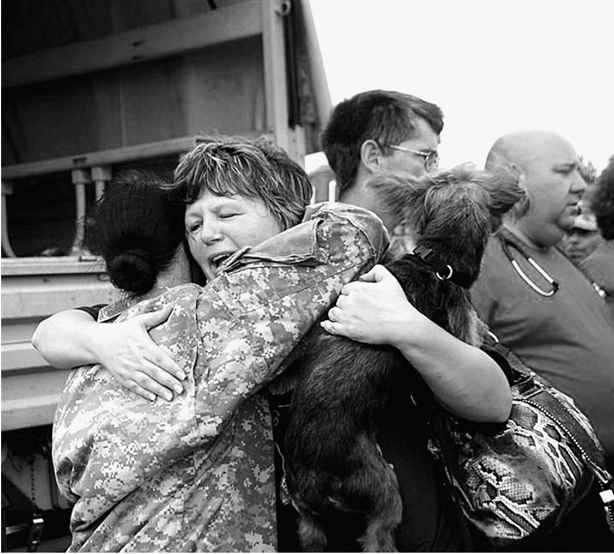
Army 2nd Lt. Angela Fry hugs a relative after she was evacuated from Hurricane like floodwaters in September 2008
Regardless of the profile of the ideal respondent, during warnings there is much confirmation behavior. This can involve contacting friends, colleagues, relatives, and neighbors—i.e., socializing the knowledge of risk—or getting in touch with local officials. Hence, it is important to make warning messages clear and consistent, and to ensure that they are repeated and transmitted by all appropriate means. To give warnings the status of authority, it is also vital that messages be conveyed to the public by officials such as uniformed police. Warnings should explain what is likely to happen; give a simple, nonscientific indication of the likelihood of the impact; indicate the window of time in which the warning is valid; and explain what mitigating actions are advisable or required. False alarms do not necessarily diminish public confidence in the warning process; they can sensitize people to the existence of risks. On the other hand, warnings tend to lack credibility if there is no evidence of abnormal circumstances that require a public reaction (black clouds, unusual activity on the streets, rising river levels, and so on), due to what is called a normalcy bias, or a tendency for people to believe the most reassuring information they face. The process of evacuation ideally channels people progressively farther away from harm, and does not lead them into danger. Hence, in floods, if there is not sufficient time to complete an evacuation from an area (and verify that it has taken place successfully), it may be better to evacuate people vertically, such as to floors of sturdy buildings above flood level.
...
- Africa, North
- Africa, Sub-Saharan
- Asia, East
- Asia, West, Central, and South
- Australia and Pacific Region
- Canada
- Caribbean Island Region
- China
- Desertification
- Earthquake Zones
- Europe, Eastern
- Europe, Western
- Evacuation Routes
- Glacial Melt
- Hurricane Zones
- Japan
- Mediterranean Region
- Mexico
- Middle East
- Ring of Fire
- Russia
- South America
- United Kingdom
- United States, California and West Coast
- United States, Great Lakes
- United States, Hawaii and Pacific Territories
- United States, Mid-Atlantic
- United States, Midwest
- United States, Mountain States
- United States, National
- United States, Northeast
- United States, Northwest and Northern Plains
- United States, Southeast and Gulf Coast
- United States, Southwest
- American Red Cross
- Center for International Disaster Information (CIDI)
- Centers for Disease Control and Prevention (CDC)
- ChildFund International
- Coast Guard, U.S.
- Cooperative for Assistance and Relief Everywhere (CARE)
- Defense, U.S. Department of Direct Relief
- Disaster Preparedness and Emergency Response Associations
- Doctors Without Borders
- Federal Emergency Management Agency (FEMA)
- Food and Agriculture Organization of the United Nations (FAO)
- Habitat for Humanity
- Homeland Security, U.S. Department of Institutional Coordination
- InterAction
- International Law in the Prevention and Mitigation of Disasters
- International Medical Corps
- International Red Cross
- Interpol
- Lutheran World Federation
- Mercy Corps
- National Governments
- Peace Corps
- Red Crescent Society
- Relief International
- Relief Rules
- Salvation Army
- St. Vincent de Paul
- State Governments
- United Nations
- United Nations Children's Fund (UNICEF)
- United Nations Development Programme (UNDP)
- United Nations High Commissioner for Refugees (UNHCR)
- United States Agency for International Development (USAID)
- World Concern
- World Emergency Relief
- World Food Program
- World Health Organization (WHO)
- World Relief
- World Vision
- History of Disaster Relief, Africa
- History of Disaster Relief, Ancient World
- History of Disaster Relief, China and East Asia
- History of Disaster Relief, Europe
- History of Disaster Relief, India
- History of Disaster Relief, Middle East
- History of Disaster Relief, North America
- History of Disaster Relief, Pacific Region
- History of Disaster Relief, Russia
- History of Disaster Relief, South America
- Chemical Disasters
- Cyberattacks
- Economic Disasters
- Food Contamination Disasters
- Gulf Coast Oil Spill (2010)
- Pandemic/Biological Accidents
- Poverty and Disasters
- Radiation Disasters
- Terrorism
- Wars
- Air Transport
- Food Distribution Infrastructure
- Internet
- Mass Transit
- Ports
- Railroads
- Roads
- Schools
- Utilities
- Water Systems
- Community Preparedness
- Community Response
- Evacuation
- Fire Departments
- Home Preparedness
- Local Hazards
- Municipal Offices of Emergency Management
- Personal Preparedness
- Police Departments
- Private Sector Preparedness
- Public Agency Preparedness
- Public-Private Partnerships
- University Preparedness
- Warnings
- Bubonic Plague
- HIV/AIDS
- Malaria (20th Century-Present)
- Measles (1850-Present)
- Severe Acute Respiratory Syndrome (SARS)
- Smallpox (20th Century)
- Tuberculosis (20th Century-Present)
- Earthquakes
- Famine
- Fire
- Floods
- Hurricanes
- Terrorist Attacks
- Tsunami
- Volcanoes
- Wars
- First Aid
- Hysteria
- Pandemic Planning
- Panic
- Panic
- Psychology, Mass
- Psychology, Personal
- Social Work
- Stress Syndromes
- Survivor Guilt
- Working With the Bereaved
- Agricultural Production
- Business Continuity Planning
- Citizen Preparedness Programs
- Cooperation Between Civilian and Military Agencies
- Crisis Management
- Education
- Emergency Response Guidelines and Regulations
- Emergency Rooms
- Evacuation Planning
- Evacuation, Types of
- Exercise Planning
- Food Distribution Systems
- Healthcare
- Hospital Preparedness
- International Standards
- Language Issues and Barriers
- Levels of Nutrition
- Mass Casualty Management
- Media
- National Incident Management System (NIMS)
- National Standards
- Packaging and Tracing of Food
- Paramedics
- Political Economy of Food
- Provision of Food in Disasters
- Refugee Policy
- Refugees, Care of
- Reserve Storage and Transport
- Transportation
- Vulnerable Populations
- Incentives, Intergovernmental and Intersystem
- Mitigation, Benefits and Costs of
- Private Sector, Role in Mitigation
- Public Sector, Role in Mitigation
- Public-Private Interactions in Mitigation
- Regulatory Approaches to Mitigation
- Risk, Government Assumption of
- Risk, Individual Assumption of
- Structural (Engineering) Options for Mitigation
- Avalanches
- Diseases
- Droughts
- Earthquakes
- Fires, Forest
- Fires, Urban
- Floods
- Heat Waves
- Hurricanes/Typhoons
- Landslides
- Pest Invasions
- Sea Surges
- Tornadoes
- Tsunamis
- Volcanoes
- Winter Storms
- Bilateral Versus Multilateral Aid
- Domestic Corruption in International Disasters
- Domestic Politics in International Disasters
- Donations, National
- Donations, Personal
- Funding of International Relief
- Fundraising Cycles
- Politics in International Funding
- Rejection of International Aid
- Intergovernmental Relations and Preparedness
- Planning for Disasters, International
- Planning for Disasters, Local
- Planning for Disasters, National
- Political Support for Preparedness
- Preparedness, Function of
- Preparedness Policy Implementation
- Private Sector, Role in Preparedness
- Research-Based Disaster Planning
- Private Sector, Role in Recovery
- Recovery, International
- Recovery, Local
- Recovery, National
- Recovery, Phases of
- Recovery, Role of Governments in
- Private Sector, Role in Response
- Response, Management Strategies
- Response, Operational Strategies
- Response, Stress Impacts of
- Data Processing
- Early Warning and Prediction Systems
- Funding, U.S.
- Global Warming
- Modeling
- National Oceanic and Atmospheric Administration (NOAA)
- Real-Time Communications
- Research
- Technology
- Technology, Military
- Causes of Complex Emergencies
- Cross-Cultural Interactions
- Cycles of a Disaster
- Disaster Experience
- Education
- Emergency Management Resources
- Ethics of Charity Relief
- Ethnicity and Minority Status Effects on Preparedness
- Gender and Disasters
- Human Rights
- Humanitarian Intervention Versus Humanitarian Action
- Income Inequality and Disaster Relief
- Laws
- Personal Preparedness
- Politics, Domestic
- Politics in International Funding
- Protection of Civilians in Conflict Zones
- Public Policy
- Refugees
- Relief Versus Development
- Risk Communications
- Risk Management
- Risk Perceptions
- Social Impact of Disasters
- Training for Disasters
- Victimology
- United States, California and West Coast
- United States, Great Lakes
- United States, Hawaii and Pacific Territories
- United States, Mid-Atlantic
- United States, Midwest
- United States, Mountain States
- United States, National
- United States, Northeast
- United States, Northwest and Northern Plains
- United States, Southeast and Gulf Coast
- United States, Southwest
- Loading...
Get a 30 day FREE TRIAL
-
 Watch videos from a variety of sources bringing classroom topics to life
 -
Read modern, diverse business cases
-
Explore hundreds of books and reference titles

Read next

More like this
Sage Recommends
We found other relevant content for you on other Sage platforms.
Have you created a personal profile? Login or create a profile so that you can save clips, playlists and searches