
Entry
Entries A-Z
Subject index
Australian Disability Advocacy (1980s)
The Disability Services Act of 1986 shapes funding for disability services in Australia. It marks a shift away from charitable, segregated services and toward community-based services aimed at community integration and participation, increased workforce participation, independence, and promoting positive images of persons with disabilities. The entry of “advocacy services” into the program represented a significant triumph for activist groups in the Australian disability scene, which had increased voice after the International Year for Disabled Persons in 1981.
From Disability Services Act of 1986 Part II, Divisions 1 and 7
Advocacy services means:
self advocacy services, namely, services to assist persons with disabilities to develop or maintain the personal skills and self confidence necessary to enable them to represent their own interests in the community;
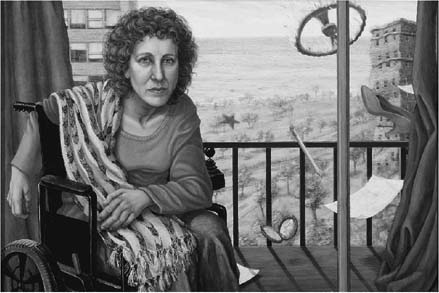
“Circle Story #3: Susan Nussbaum,” by Riva Lehrer. 1998. Acrylic on panel. 16” by 26.” Susan Nussbaum is a playwright, actress, director, and disability rights activist. She has starred in, written and/or directed productions at the Goodman, Victory Gardens, and Blue Rider theaters, and other major venues. Her play Mishuganismo is included in Staring Back, and her latest play, No One As Nasty, opened at Chicago's Victory Gardens Theater in 2000. She also teaches pla writing at the Mark Taper Forum in Los Angeles. Nussbaum was injured in a car accident twenty years ago, and she has examined the disability experience with an unsparing, critical wit.
- citizen-advocacy services, namely, services to facilitate persons in the community to assist:
- persons with disabilities; or
- the families of, and other persons who provide care or assistance, to persons with disabilities; to represent their interests in the community; or group-advocacy services, namely, services to facilitate community organisations to represent the interests of groups of persons with disabilities.
Commentary
Australian disability activist groups were influenced by two main streams of analysis. Physical disability activists, shaped by the disability rights movement emerging from the United Kingdom and the United States, adopted a “social model” of disability. This analysis was taken up by some individuals with intellectual impairment, arguing that with skills and training individuals previously judged incompetent could speak up for themselves. This stream is characterized as the empowerment model of advocacy.
The other stream emerged from the Syracuse University Training Institute for Human Service Planning, Leadership and Change Agentry. The theory of social devaluation was taken into the model for citizen advocacy. It also influenced many parents, especially those with family members with intellectual or multiple impairments. This stream can be characterized as the social role valorization model. It was this stream that gave the advocacy services section of the Disability Services Act of 1986 its name and configuration—thereby providing great opportunities as well as opening up continuing debates.
The two streams have many points of confluence, especially the centrality of the demand for community life and the dissolution of institutional and congregate services and for the defense of certain rights. However, many contested issues continue to reflect their divergence: the clash between a collectivist rights movement and the incipient individualism of social valorization.
But this can never be the full story. Such a division is too crude. Disability advocacy in Australia has taken on a new spirit of cooperation, building on contributions from community development, enriched by understandings of new social movements. Activists and scholars are expanding the social model of disability with wisdom about relationality, the learnings of seeking normalization, and the critical insights of postmodern thought.
...
- Loading...
Get a 30 day FREE TRIAL
-
 Watch videos from a variety of sources bringing classroom topics to life
 -
Read modern, diverse business cases
-
Explore hundreds of books and reference titles

Read next

More like this
Sage Recommends
We found other relevant content for you on other Sage platforms.
Have you created a personal profile? Login or create a profile so that you can save clips, playlists and searches