
Entry
Entries A-Z
Subject index
SOIL TEXTURE
The particle-size distribution in the soil, often described in terms of the relative proportions of various size fractions. Soil texture is probably the single most important soil property influencing soil-profile morphology, water-holding capacity and water-release characteristics (see soil moisture), soil drainage and permeability, workability, soil quality and fertility.
Soil particle-size distribution is determined on that proportion of a soil sample (the fine earth) that passes through a 2-mm sieve: anything larger is described as ‘stones’. Early in the twentieth century, soil scientists agreed that the size limits of the three broad particle-size categories—sand, silt and clay— would be based on a logarithmic scale: sand refers to particles with an equivalent diameter of 2.0–0.2 mm, silt particles are 0.2–0.02 mm and clay particles are <0.002 mm. This has remained in international usage with only minor modifications, although the description of the texture of sedimentary rocks and the grain size of sediments (often referred to as ‘soils’ by engineers) commonly placed the sand-silt boundary at 0.063 mm.
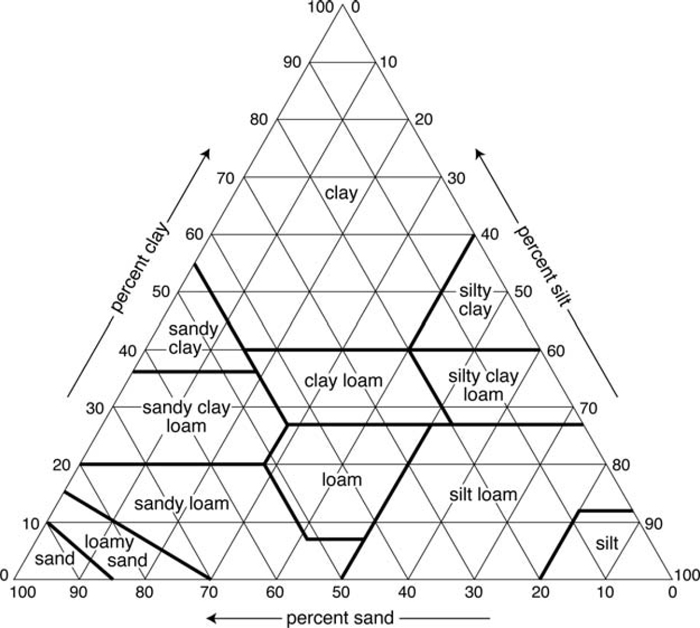
Soil texture may be determined in the field by moistening the sample, working it between finger and thumb and, with experience, recognising the three constituent grain-size categories as gritty (sand), silky (silt) and sticky (clay). In the laboratory, accurate grain-size distributions are determined, after suitable pretreatment of the sample using sieving for sand fractions and pipette analysis or more sophisticated machinery (e.g. a Coulter counter or Sedigraph) for the finer fractions. A larger number of descriptive classes, such as silty clay, sandy clay, loam (an approximately equal mixture of sand, silt and clay), silt loam and loamy sand, are usually employed in the description of soil texture. These may be shown diagrammatically on a triangular graph (see Figure, next page). Soil particle-size distributions may also be shown graphically as a cumulative curve or histogram.
Soil textureSoil texture classes according to the scheme of the United States Department of Agriculture (Soil Survey Staff, 1995).
- Loading...
Get a 30 day FREE TRIAL
-
 Watch videos from a variety of sources bringing classroom topics to life
 -
Read modern, diverse business cases
-
Explore hundreds of books and reference titles

Read next

More like this
Sage Recommends
We found other relevant content for you on other Sage platforms.
Have you created a personal profile? Login or create a profile so that you can save clips, playlists and searches