
Entry
Entries A-Z
Subject index
OXYGEN ISOTOPES
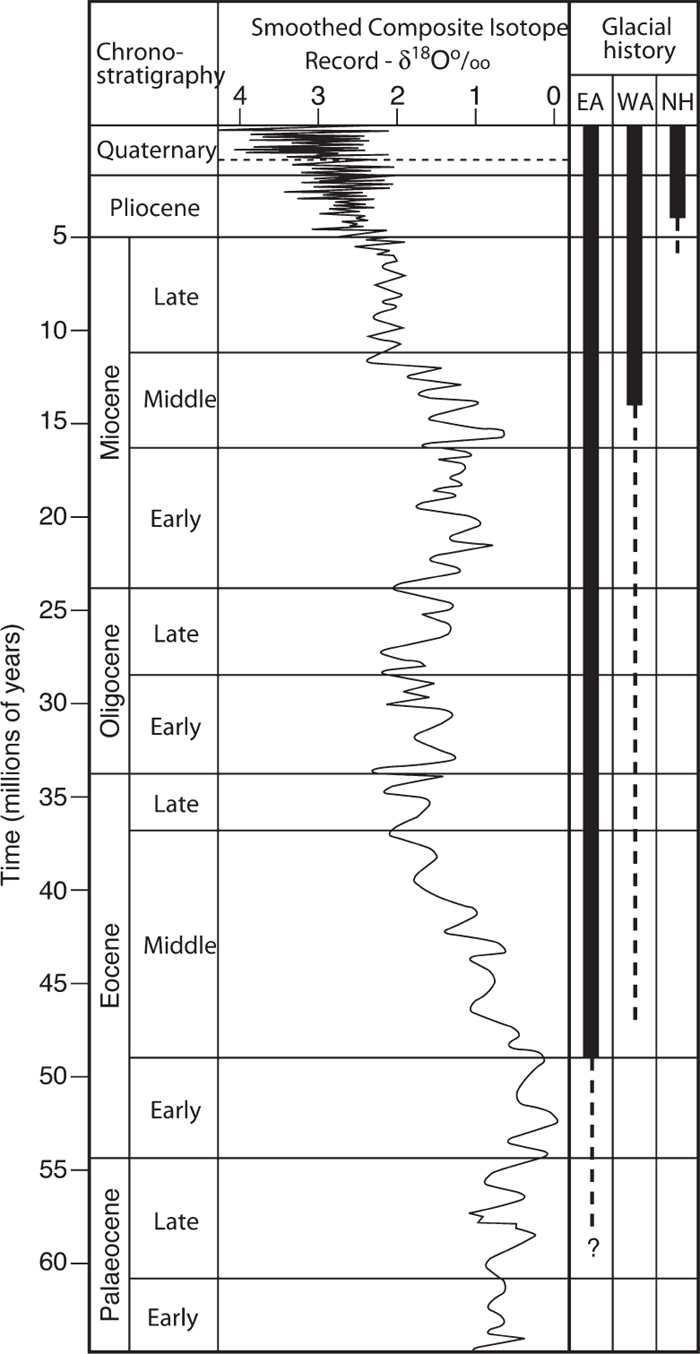
Oxygen has three stable isotopes (natural abundances, 16 O = 99.762 per cent, 17 O = 0.038 per cent and 18 O = 0.200 per cent). The isotope ratio is expressed as 18 O/16O relative to the Vienna Pee Dee Belemnite (VPDB) standard for carbonates and the Vienna Standard Mean Ocean Water (VSMOW) standard for all other samples. The δ18O value of foraminifera in deep-ocean sediments is influenced primarily by global continental ice volume and thus reflects global climate (see Figure). The age of these sediments cannot be dated directly beyond the range of radiocarbon dating: however, ages have been determined indirectly by matching properties of the sediments with changes in orbital forcing indicated by the milankovitch theory. A composite 780 ka record obtained from five marine sediment cores forms the basis of the spectral mapping project timescale (SPECMAP) (the standard against which the generally fragmentary terrestrial records have been compared). Thus, marine isotopic stages (MIS) have been assigned to glacial and interglacial episodes.
The terrestrial record of past climate includes the physico-chemical properties of ice cores taken from Antarctica, the Greenland ice-sheet and high-altitude ice caps. Oxygen isotopes from the EPICA Droning Maud Land (EDML) ice core in Antarctica are directly coupled with the NorthGreenland Ice CoreProject (NGRIP) ice core through the Atlantic meridional overturning circulation (MOC). The decadal-scale variability and century-to millennial-scale variability in the EDML record can be unambiguously linked to corresponding dansgaard-oeschger (d-o) events in NGRIP after methane synchronisation of age scales. In terrestrial plants, the isotope composition of xylem water is identical to the water absorbed by the roots. Mixing occurs as water ascends the plant to the site of photosynthesis through the apoplastic pathway or the slower symplastic pathway. However, there is no isotopic fractionation until the water reaches tissues undergoing water loss, where evaporation causes isotopic enrichment of 18O in the remaining water. The isotope ratio of leaf water is imparted to the intercellular carbon dioxide utilised in carbohydrate synthesis. Biochemical fractionation during photosynthesis causes an enrichment of 18O of the resulting carbohydrate. Post-photosynthetic isotopic exchange occurs between the oxygen atoms of intermediate carbohydrates and metabolic water, with the extent of the exchange determined by carbohydrate recycling. Despite this complexity, the δ18O values of organic matter have been used to reconstruct past climates using a transfer function or mechanistic approach.
Oxygen isotopes Composite oxygen isotope record for the Cenozoic derived from marine sediment cores: the columns on the right indicate the presence of the East Antarctic Ice Sheet (EA) from ca 50 Ma, the West Antarctic Ice Sheet (WA) from ca 15 Ma and ice sheets in the Northern Hemisphere (NH) from ca 5 Ma, based on the occurrence of ice-rafted debris (Wilson et al., 2000).
[See alsocoral, lacustrine sediments, ostracod analysis, peat and peatlands, speleothems]
...
- Loading...
Get a 30 day FREE TRIAL
-
 Watch videos from a variety of sources bringing classroom topics to life
 -
Read modern, diverse business cases
-
Explore hundreds of books and reference titles

Read next

More like this
Sage Recommends
We found other relevant content for you on other Sage platforms.
Have you created a personal profile? Login or create a profile so that you can save clips, playlists and searches