
Entry
Entries A-Z
Subject index
EARTHQUAKE MAGNITUDE
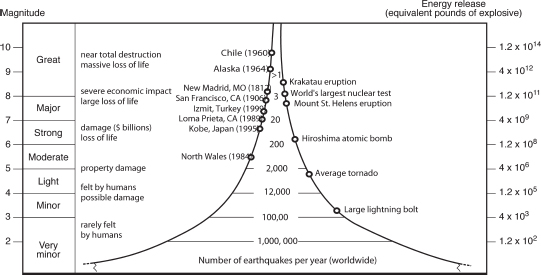
The strength of an earth-quake, expressed in terms of the amount of energy released and calculated from the maximum displacement on a seismogram (see seismometer) with a correction for the distance from the epicentre. Magnitude (also known as seismic magnitude or Richter magnitude) is measured on the logarithmic Richter Scale, developed by Charles Richter in the 1930s (see Figure). Several different scales are now used to calculate magnitude.
The largest recorded earthquake is generally agreed to have been the AD 1960 Chile earthquake, with magnitude 9.6, a megathrust earthquake. It is likely that an upper limit of magnitude for earthquakes generated by slip along faults is determined by the strength of the rocks of the Earth’s crust. On average, there is one earthquake per year of magnitude greater than 8, 18 between magnitudes 7.0 and 7.9, and 120 between magnitudes 6.0 and 6.9. Many of these are not felt, occurring in sparsely populated areas or beneath the oceans. There are an estimated 6,200 earthquakes each year with magnitudes between 4.0 and 4.9; 49,000 between magnitudes 3.0 and 3.9; and about 8,000 per day between magnitudes 1 and 2: none of these is felt (see microseism).
The United Kingdom mainland experiences an Earth-quake of magnitude 5.0 or greater on average once every 8 years and an earthquake of magnitude 4.0–4.9 once every 2 years. The largest earthquake in Britain was in the Dogger Bank area of the North Sea in AD 1931, with a magnitude of 6.1. The AD 1984 North Wales Earth-quake of magnitude 5.4, with its epicentre in the Lleyn Peninsula, was United Kingdom’s largest onshore Earth-quake of the past century. The February 2008 Market Rasen (Lincolnshire) earthquake was of magnitude 5.2.
The effects of an earthquake are expressed by earthquake intensity, which depends not only on the magnitude but also on the local ground conditions, building quality, the depth of the focus (earthquake) and the distance from the epicentre. Earthquake intensity is measured on scales such as the Mercalli scale and the European Macroseismic Scale. A large, but deep earthquake (focal depth 637 km) of magnitude 8.3 in Brazil in 1994 was felt from Argentina to Canada, but it caused just 5 deaths and little damage, whereas an earthquake in Newcastle, New South Wales, in AD 1989 of magnitude 5.4 and focal depth 4 km caused 12 deaths and an earthquake in Cairo in AD 1992 of magnitude 5.9 and focal depth 22 km caused 552 deaths.
Earthquake magnitudeThe approximate number of earthquakes per year of a given magnitude, together with descriptive terms for earthquake magnitude, the effects of earthquakes of different magnitudes, sizes of some well-known earthquakes and other events and the equivalent explosive energy released (Bolt, 1999).
[See alsoearthquake engineering, earthquake prediction]
- Loading...
Get a 30 day FREE TRIAL
-
 Watch videos from a variety of sources bringing classroom topics to life
 -
Read modern, diverse business cases
-
Explore hundreds of books and reference titles

Read next

More like this
Sage Recommends
We found other relevant content for you on other Sage platforms.
Have you created a personal profile? Login or create a profile so that you can save clips, playlists and searches